
Key Highlights
- How to choose B2B advertising platforms based on buyer intent, lead quality, and sales cycle.
- Why Google Ads and LinkedIn Ads are often the strongest starting points for B2B campaigns.
- How Meta Ads, Microsoft Ads, YouTube, display, and programmatic ads support awareness and retargeting.
- Which KPIs matter most for B2B advertising, including qualified leads, sales conversations, pipeline, and ROI?
- How to avoid wasting ad spend by matching each platform to the right campaign goal.
Editor's Note: This post was originally published in September 2023 and has been updated with additional content about different types of landing pages in July 2026.
Which B2B advertising platforms are you using for marketing? Are you frustrated because digital advertising is expensive, and you are not seeing results as quickly as you hoped? We know the business-to-business (B2B) buying journey is long, as more people are involved in purchase decisions. Clients also want the products or services they buy to offer long-term solutions, a return on investment (ROI), efficiency, and expertise.
What is a B2B Advertising Platform?
A B2B digital advertising platform is a tool or network that helps businesses advertise their products or services to other businesses.
Instead of targeting individual consumers, it focuses on business buyers, decision-makers, and professional audiences.
Why Does My B2B Business Need a Digital Strategy?
Because B2B is all about building a long-term relationship, companies want to know who they are doing business with and that the service provider is trustworthy. Are you sharing your brand personality on digital platforms while offering thought leadership and information highlighting your expertise? It might make all the difference while you continue to target your prospects at every stage of the purchasing journey. Sharing valuable information that highlights your expertise not only positions you as a trusted authority but also helps educate and engage your target audience.
When it comes to targeting prospects at every stage of the purchasing journey, personalization is key. Tailoring your messaging and content to address the specific pain points and needs of your prospects can greatly impact their decision-making process. By providing relevant and valuable information, you can establish yourself as a reliable source of solutions and build lasting relationships with potential customers.
Furthermore, leveraging digital platforms that are filled with your B2B prospects allows you to reach a wider audience and engage with them on a more personal level. Through social media, blog posts, and other content channels, you can showcase your brand personality, share industry insights, and provide valuable resources that address the challenges faced by your target audience. This not only helps build trust but also positions your business as a thought leader in your industry.
Is it time to see how you can improve your current advertisements or try another digital advertising platform? We discuss the best platforms for B2B marketing.
| B2B buyers rarely convert after one ad click. Most need education, trust, and repeated contact before they speak to sales. Your strategy should support the full buying journey, from awareness to decision. |
Best Online Advertising Platforms for Your Brand
B2B Option #1: Google Ads
Best for: Capturing buyers who are already searching for your product or service.
Google is often the first place to start. It holds 90.46% of global search traffic share and 58% of the search advertising market share. Search advertising is also projected to reach US$965.6bn in 2028.
Google may be the biggest digital advertising platform in size, but if your Google Ads results are not what you want, you should try the following:
- Negative keywords: Ensure you use all the negative keywords relevant to your business, products, or services to prevent unqualified clicks from wasting your budget.
- Customize landing pages: Never underestimate the importance of making sure your landing page matches your Google advertisement, even when advertising several products or services.
- Remarketing: The B2B sales cycle is long, so use remarketing to subtly remind your potential customers that you are still interested in doing business with them and that your business has the offering they need.
By implementing these tactics, B2B brands can optimize their presence on Google and effectively reach their target audience.
| Negative keywords are essential for B2B campaigns. They help stop your ads from showing for searches that are not a fit, which protects your budget and improves lead quality. |
B2B Option #2: LinkedIn Ads
Best for: Reaching specific B2B decision-makers.
LinkedIn is the world’s largest professional network, which makes it a strong platform for B2B lead generation and awareness. It is also widely used by content marketers, with 96% using LinkedIn for organic social media marketing.
LinkedIn Ads work well when you need to target by job title, industry, company size, seniority, or specific accounts.
To improve your results:
- Optimize your company page
Your header image and first two sentences should speak directly to your buyer’s needs. - Use Showcase Pages where relevant
Create Showcase Pages for different brands, business units, or initiatives when each one serves a distinct audience. - Support ads with content
Publish helpful content from both company and individual profiles. This builds trust and supports your paid campaigns.
Measure success by lead quality, engagement from target accounts, website visits, and sales conversations.
|
LinkedIn Ads can cost more than other platforms, but the targeting is strong. Judge results by job fit, company fit, sales conversations, and pipeline potential. |
B2B Option #3: Meta Ads

Best for: Awareness, retargeting, and content promotion.
Meta Ads can support B2B campaigns, especially when used for educational content, video, events, webinars, and retargeting. 69.6% of small businesses use Facebook as a marketing tool. Since 81.8% of all users access it on a mobile device, a mobile-first creative is essential.
Meta may not always deliver the same lead quality as search or LinkedIn for cold B2B campaigns. But it can keep your brand visible and help move prospects back to your website.
To improve your results:
- Keep the copy short
Put the most important message in the first two lines. - Use vertical creative
Use vertical videos and images that work well on mobile screens. - Add a clear call to action
Tell users exactly what to do next, such as download a guide, register for a webinar, or book a consultation. - Use video to explain your offer
Short videos can show how your product, service, or business solves a specific problem.
Measure success by engaged visits, retargeting conversions, content downloads, webinar sign-ups, and assisted leads.
|
Meta Ads can work well for retargeting website visitors, promoting webinars, and sharing useful content. It is often less effective as a cold lead generation channel for complex B2B offers. |
B2B Option #4: Microsoft Ads 
Best for: Expanding search reach beyond Google.
Microsoft Ads can be a useful option for B2B companies that want to reach buyers outside Google Search. It can also support account-based marketing strategies and help teams target business audiences with more control.
Microsoft Advertising may offer cost advantages. Businesses can experience cost-per-click rates up to 33% lower than Google Ads, depending on the industry, competition, and campaign setup.
To improve your results:
- Use Microsoft Ads alongside Google Ads
Start with your best-performing Google campaigns, then adapt them for Microsoft. - Focus on high-intent keywords
Target searches that show buying intent, such as service comparisons, pricing, and provider searches. - Connect campaigns to your CRM (customer relationship management)
Track which leads become real sales opportunities.
Measure success by cost per qualified lead, conversion rate, sales conversations, and cost per opportunity.
B2B Option #5: Programmatic Advertising 
Best for: Building awareness across specific audiences and accounts.
Programmatic advertising uses technology to automate ad buying across websites, apps, and digital media placements. For B2B companies, it can help reach specific audiences based on demographics, interests, behaviors, and account-based criteria.
This makes programmatic useful when you want to build awareness, support long sales cycles, or reach people across multiple touchpoints.
To improve your results:
- Define your audience clearly
Focus on the industries, roles, accounts, or buyer groups that matter most. - Use clear creative
Your ads should explain who you help, what problem you solve, and what action the viewer should take. - Retarget engaged visitors
Use programmatic campaigns to bring interested prospects back to your site.
Measure success across platforms by reach, engagement, website visits, account engagement, assisted conversions, and qualified leads.
Best B2B Advertising Platforms for Lead Generation
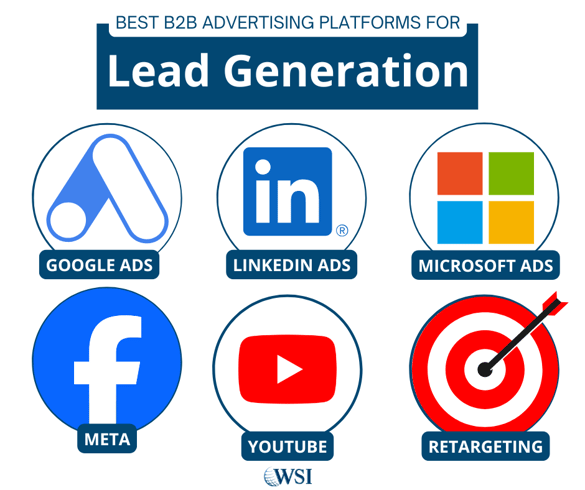
The best B2B digital marketing platform depends on your audience, sales cycle, and lead quality goals. For most B2B companies, start with:
Google Ads
Best for capturing buyers who are already searching for your solution.
LinkedIn Ads
Best for reaching specific job titles, industries, company sizes, and decision-makers.
Microsoft Ads
Best for expanding search reach beyond Google, often with less competition.
Meta, YouTube, and Display Retargeting
Best for staying visible while prospects compare options.
A strong B2B ad strategy usually combines search, targeted social ads, and retargeting. Start with Google to capture demand. Use LinkedIn to reach the right buyers. Retarget website visitors who are not ready to convert.
Measure success by qualified leads, sales conversations, and pipeline, not form fills alone.
| Use search ads when buyers are actively looking. Use LinkedIn when you need to reach a specific role or company. Use retargeting when prospects need more time before they act. |
Top B2B Platforms for Awareness
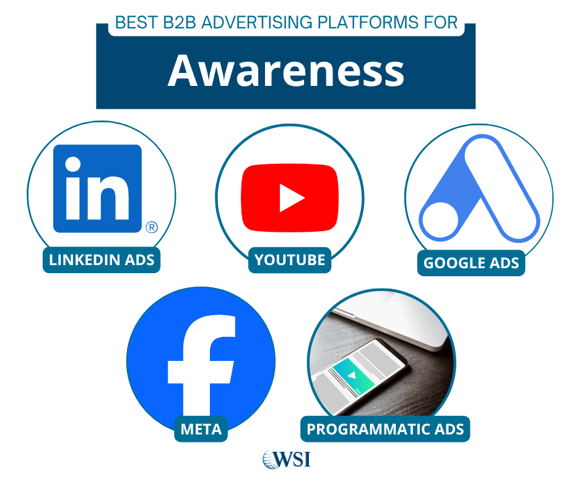
The best B2B marketing platform for awareness helps you reach the right people before they are ready to buy. For most B2B companies, consider:
LinkedIn Ads
Best for reaching specific job titles, industries, company sizes, and decision-makers.
YouTube Ads
Best for explaining complex products or services through short video content.
Google Display Ads
Best for building visibility across relevant websites and remarketing to past visitors.
Meta Ads
Best for promoting educational content, events, webinars, and thought pieces to broader business audiences.
Programmatic and ABM Ads
Best for reaching target accounts across multiple sites and channels.
A strong B2B awareness strategy focuses on useful content, clear messaging, and repeated exposure. Use LinkedIn to reach defined buyer groups. Use YouTube and display to explain your offer at scale. Use ABM ads when you need to influence specific companies.
Measure success by reach, engagement, website visits, branded search growth, and assisted conversions, not leads alone.
Main B2B Marketing KPIs Your Campaign Needs to Track
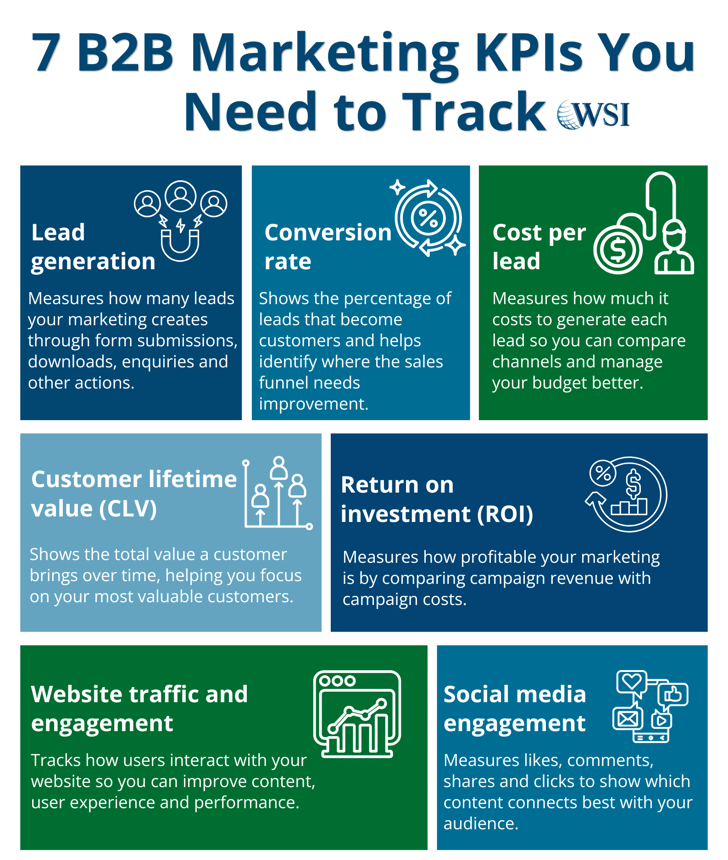
When running a B2B marketing campaign, it is crucial to track key performance indicators (KPIs) to measure the success and effectiveness of your efforts. By monitoring these metrics, you can gain valuable insights into the performance of your campaign and make data-driven decisions to optimize your strategy. Here are the main KPIs that your B2B marketing campaign needs to track:
Lead Generation
This KPI measures the number of leads generated through your marketing efforts. It includes metrics such as the number of form submissions, downloads, and inquiries. Tracking lead generation allows you to assess the success of your lead generation tactics and make adjustments if necessary.
Conversion Rate
The conversion rate measures the percentage of leads that convert into customers. It is a critical KPI for evaluating the effectiveness of your sales funnel and identifying areas for improvement. By tracking the conversion rate, you can identify any bottlenecks in the customer journey and optimize your marketing and sales processes accordingly.
Cost per Lead
This metric calculates the average cost of acquiring a lead. It helps you determine the efficiency of your marketing campaigns and compare the effectiveness of different channels or tactics. By tracking the cost per lead, you can allocate your budget more effectively and optimize your ROI.
Customer Lifetime Value (CLV)
CLV measures the total value a customer brings to your business over their lifetime as a customer. It takes into account factors such as the average purchase value, purchase frequency, and customer retention rate. Tracking CLV allows you to identify your most valuable customers and tailor your marketing efforts to maximize their lifetime value.
Return on Investment (ROI)
ROI measures the profitability of your marketing campaigns by comparing the revenue generated to the cost of the campaign. It is a crucial KPI for assessing the overall effectiveness and profitability of your marketing efforts. By tracking ROI, you can identify which campaigns or channels are delivering the best results and allocate your resources accordingly.
Website Traffic and Engagement
Monitoring website traffic and engagement metrics, such as the number of visitors, time spent on site, and bounce rate, can provide insights into the effectiveness of your content and user experience. By analyzing these metrics, you can identify opportunities to optimize your website and improve user engagement.
Social Media Engagement
If you are using social media platforms for B2B marketing, tracking metrics such as likes, comments, shares, and click-through rates can help you assess the engagement and effectiveness of your social media campaigns. It allows you to identify which content resonates with your target audience and refine your social media strategy.
By tracking these KPIs, you can gain valuable insights into the effectiveness of your B2B marketing campaign and make data-driven decisions to optimize your strategy. Remember, it is essential to align your KPIs with your overall business goals and regularly review and analyze the data to drive continuous improvement.
| A form submission is only the start. Track whether leads become qualified opportunities, sales conversations, and revenue. This gives you a clearer view of real campaign performance. |
Tips for Choosing the Right Online Advertising Platforms for B2B Marketers
Choosing the right online advertising platforms for B2B marketers requires careful consideration of several factors that can impact your marketing team's success. Start by evaluating the available platforms on the market that support account-based marketing (ABM) buyers. Consider how well these platforms integrate with your existing CRM and other marketing software to ensure seamless automation of processes, including email campaigns and B2B campaigns.
Segmentation is crucial; look for advertising channels that allow you to reach distinct B2B customers while also considering the intent signals that indicate their readiness to purchase. Make sure that the platform you choose can automate your marketing solutions across multiple marketing channels, which increases the efficiency of your marketing and sales teams. By leveraging B2B marketing automation platforms and integrating with the rest of your tech stack, you can optimize your ad spending and discover the best strategies to attract new business effectively.
| Test platforms with clear goals, focused offers, and proper tracking. Once you see which channels create qualified sales opportunities, move more budget toward those campaigns. |
Our Digital Marketing Agency is Here to Help
Do you want to improve your digital advertising results? Are you interested in adding another platform to your advertising strategy? Wherever you are on your journey, a WSI Certified Digital Marketing Consultant is ready to help!
Sign up for expert advice today, and we will work together to improve your ROI from the best B2B advertising platforms.