
Key Highlights
- How AI-powered lead generation reshapes traditional methods of prospecting and engagement
- Key AI tools and techniques that streamline lead generation processes
- The importance of balancing AI automation with human interaction for optimal results
- How AI can improve lead scoring, segmentation, and predictive analytics to drive conversions
AI-powered lead generation reshapes how businesses attract, engage, and convert prospects. Traditional methods like manual outreach and intuition-driven sales strategies are being replaced by data-driven automation and intelligent algorithms.
Companies leveraging and implementing AI can streamline prospecting, personalize outreach at scale, and optimize lead nurturing strategies with unprecedented precision. However, while using AI to generate leads boosts efficiency, the human touch remains crucial in fostering trust and closing deals. This article explores how AI-driven tools, strategies, and metrics transform lead generation, helping businesses capture attention and drive conversions.
What is AI Lead Generation?
AI-powered lead generation refers to the use of smart technology to help businesses find and connect with potential customers more efficiently. It analyzes data, predicts who’s most likely to be interested, and personalizes outreach, all while automating repetitive tasks. This makes the process faster, smarter, and more effective at turning leads into customers. 
How Does AI for Lead Generation Work?
AI for lead generation works by using data and smart algorithms to automate and improve the process of identifying, engaging, and nurturing potential customers. Here's how it typically works:
- Data Collection: AI gathers data from various sources like websites, social media, and customer interactions.
- Lead Identification: It analyzes this data to identify patterns and find people who are most likely to be interested in your product or service.
- Lead Scoring: AI scores leads based on factors like behavior, demographics, and engagement. High scores mean a lead is more likely to convert into a customer.
- Personalized Outreach: AI tailors emails, ads, or messages based on individual preferences and behaviors to make communication feel more personal and relevant.
- Chatbots and Automation: AI-powered chatbots engage leads in real-time on websites, answering questions and qualifying them, while automation handles follow-up emails and scheduling.
- Predictive Analytics: AI predicts which leads are most likely to take the next step, allowing sales teams to focus their efforts where they’re most likely to see results.
In short, AI streamlines the lead generation process, making it smarter, faster, and more targeted.
| AI can predict which leads are most likely to convert, helping sales teams focus their efforts where they’re most likely to see results. By leveraging AI's predictive capabilities, you can make more informed decisions. |
Traditional vs AI-Driven Lead Generation -3.png?width=520&height=345&name=unnamed%20(6)-3.png)
Traditional Lead Generation
- Manual Processes: Relies on human effort to find, contact, and nurture leads.
- Cold Calling/Emails: Often involves cold calls or generic emails to reach potential customers.
- Limited Data: Based on limited customer data or insights, making it harder to target the right audience.
- Time-Consuming: Requires a lot of time for research, outreach, and follow-up.
- Less Personalization: Outreach tends to be more general, not tailored to individual preferences.
AI-Driven Lead Generation
- Automated Processes: Uses AI tools to automatically find, score, and engage leads.
- Personalized Outreach: Tailors messages, emails, and ads based on individual behaviors and preferences.
- Data-Driven: Leverages big data and analytics to identify high-quality leads and predict customer behavior.
- Efficient: Speeds up the process by automating repetitive tasks like follow-ups and lead qualification.
- Smarter Targeting: AI uses predictive analytics to focus on leads that are more likely to convert.
The Evolving Landscape of Lead Generation in the AI Era
Sales is no longer just about the art of persuasion—it is about survival in an AI-driven world. Traditional sales methods like gut instinct, cold calls, and manual lead tracking are becoming obsolete. In their place, predictive analytics, automation, and conversational AI transform how businesses engage with customers, analyze data, and drive revenue.
According to research from Columbia Business School, AI and automation are revolutionizing sales from lead generation to deal closing. Companies that fail to adapt to these advancements risk falling behind competitors who use cutting-edge AI tools to sell smarter and faster. However, human relationships remain critical in high-value sales despite AI's growing role. Striking the right balance between automation and personalization is essential for long-term success.
One of the most significant changes in sales organizations is the rise of go-to-market (GTM) engineers. These specialists replace traditional sales operations roles, focusing on internal automation and optimizing sales workflows. Rather than relying solely on sales reps to manage CRM systems and analytics, GTM engineers develop AI-powered solutions that enhance efficiency and effectiveness. This shift allows businesses to accelerate sales cycles, eliminate repetitive tasks, and focus on strategic interactions.
Benefits of AI for Lead Generation
AI offers numerous benefits for lead generation, making the process more efficient, accurate, and scalable. Here are some key advantages
Enhanced Targeting and Segmentation
AI can analyze large sets of data to identify high-quality leads. By using machine learning algorithms, AI helps segment prospects based on various factors such as behavior, demographics, and engagement history. This ensures that marketing efforts are focused on the most promising leads, improving conversion rates.
Automated Lead Scoring
AI-powered systems can automatically score leads based on predefined criteria, such as how likely they are to convert. By analyzing past behaviors and interactions, AI assigns a score to each lead, allowing sales teams to prioritize high-value prospects.
Personalized Outreach
AI can automate and personalize emails, messages, and follow-ups based on the lead's behavior and interests. This leads to a more tailored approach, increasing the likelihood of engagement and conversion.
Predictive Analytics
AI can predict future behaviors of leads, helping businesses forecast which leads are most likely to convert. This predictive capability allows sales and marketing teams to optimize their strategies and focus their efforts on leads with the highest probability of success.
Chatbots and Virtual Assistants
AI-powered chatbots can engage with leads 24/7, providing instant responses to inquiries and qualifying leads. They can ask targeted questions to gather relevant information and seamlessly hand over qualified leads to the sales team.
Improved Lead Nurturing
AI tools can automate and manage lead nurturing processes by sending timely, relevant content and messages that align with the lead's interests and stage in the buyer journey. This helps maintain engagement over time and ensures leads don’t slip through the cracks.
Data-Driven Insights
AI analyzes vast amounts of data to uncover trends, patterns, and behaviors that may not be immediately apparent to humans. These insights help marketers refine their lead-generation strategies and understand customer preferences more deeply.
Time and Resource Efficiency
AI automates many of the manual tasks associated with lead generation, such as data entry, follow-up emails, and outreach. This frees up valuable time for sales teams to focus on closing deals and engaging with high-priority leads.
Continuous Optimization
AI systems learn from past data and continuously improve. They can adjust strategies in real-time based on performance metrics, ensuring that lead generation efforts are always aligned with current market trends and customer behavior.
Scalability
AI enables businesses to scale their lead-generation efforts without sacrificing quality. Since AI can handle and analyze large volumes of data, companies can generate leads at a much larger scale than would be possible manually.
Cost Efficiency
By automating various aspects of lead generation, AI reduces the need for manual labor and costly human interventions. This lowers the overall cost of acquiring leads and increases ROI.
In short, AI significantly enhances the lead generation process by automating tasks, improving targeting, personalizing interactions, and providing valuable insights. This leads to higher-quality leads, better customer engagement, and more efficient use of resources.
AI-Powered Tools and Techniques for Identifying and Nurturing Leads
AI has evolved beyond simple sales assistance into full-fledged automation for lead generation. AI-powered tools can now handle tasks in sequence, from prospecting and targeting to outreach and engagement, creating an efficient and data-driven sales process. Some of the most effective AI-driven lead generation techniques include:
1. AI-Driven Prospect Identification
AI can analyze vast amounts of data from multiple sources to identify high-potential leads. By using predictive analytics, AI tools assess customer behavior, purchase history, and online interactions to determine which prospects are most likely to convert. Platforms like Apollo.io and Clay.com use AI to refine ideal customer profiles and uncover new opportunities.
2. Automated Multi-Channel Outreach
AI agents now handle multi-channel campaigns across email, LinkedIn, and other platforms. These tools personalize outreach messages, optimize timing, and adjust messaging based on prospect responses. Tools like LeadGenius are in charge of AI-driven outbound strategies, allowing businesses to scale their prospecting efforts while maintaining a human-like touch.
3. Conversational AI and Chatbots
AI chatbots and virtual assistants engage leads in real time, answering questions, qualifying prospects, and booking appointments. These tools, powered by natural language processing (NLP), can handle a high volume of inquiries and ensure that only qualified leads are passed to human sales representatives. Companies like Drift and Intercom leverage AI-driven chatbots to streamline customer interactions and improve lead conversion rates.
4. AI-Powered Lead Scoring
AI enhances traditional lead scoring by continuously analyzing engagement patterns, intent signals, and behavioral data. This allows sales teams to prioritize leads that are most likely to convert. AI-driven scoring models adapt over time, refining criteria based on past successes and failures.
The Key Features in AI Lead Generation Tools
Key features in AI lead gen tools include: 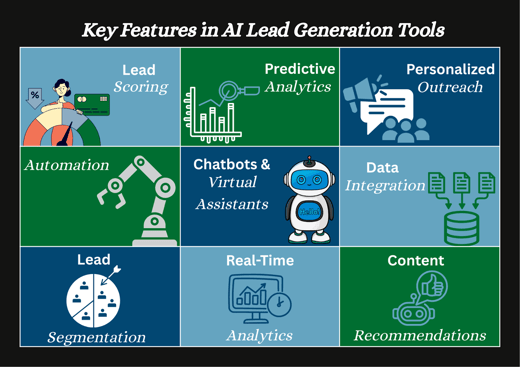
- Lead Scoring: AI assigns scores to leads based on their likelihood to convert, helping sales teams focus on the most promising prospects.
- Predictive Analytics: AI analyzes data to predict which leads are most likely to take the next step, improving decision-making and strategy.
- Personalized Outreach: AI customizes messages, emails, and content to individual leads based on their behaviors, preferences, and interactions.
- Automation: Automates repetitive tasks like sending follow-up emails, scheduling meetings, and managing CRM data, increasing efficiency.
- Chatbots and Virtual Assistants: AI-powered chatbots engage with visitors in real-time, answering questions and qualifying leads instantly.
- Data Integration: AI tools integrate with existing data sources (e.g., CRM, website analytics) to provide a complete view of lead behavior and engagement.
- Lead Segmentation: AI can categorize leads into different groups based on factors like demographics, behavior, or engagement level, allowing for more targeted outreach.
- Real-Time Analytics: Provides insights and analytics in real-time, enabling businesses to quickly adjust strategies based on lead activity.
- Content Recommendations: AI suggests personalized content to leads based on their behavior and interactions, keeping them engaged and moving through the sales funnel.
Strategies for Personalizing Lead Magnets and Offers
While AI excels at automating lead generation, personalization remains the key to capturing attention and building trust. Lead magnets, such as eBooks, webinars, and free trials, must evolve to remain effective in an increasingly saturated digital landscape. Here’s how businesses can leverage AI while ensuring a personalized touch:
1. Segmenting Audiences for Hyper-Personalization
AI can help segment audiences based on demographics, behaviors, and preferences, allowing businesses to create tailored lead magnets for different customer groups. By analyzing engagement data, AI tools suggest content formats and topics most likely to resonate with each segment.
2. Dynamic Content Generation
AI-powered content generation tools can personalize headlines, subheadings, and body text based on user data. For example, inserting a prospect’s name, industry, or job role into an email subject line can significantly increase open rates. Dynamic text replacement and conditional logic ensure that lead magnet content speaks directly to the prospect’s specific needs and pain points.
3. AI-Generated Interactive Experiences
Traditional lead magnets like static PDFs are becoming less effective. Instead, AI can power interactive experiences like quizzes, assessments, and customized reports. These tools engage prospects in real time and provide personalized insights, increasing the offer's perceived value. Platforms like Outgrow and Typeform allow businesses to create AI-powered interactive lead magnets.
4. Predictive Recommendations
AI can recommend relevant content or offers based on past interactions. By tracking user engagement across websites, emails, and social media, AI identifies patterns and suggests the best action. This approach ensures that prospects receive highly relevant information, increasing the likelihood of conversion.
Measuring Lead Quality and Conversion Rates
AI-driven lead generation is only as valuable as the results it produces. Businesses must measure lead quality and conversion rates to ensure that AI-powered strategies drive tangible outcomes. Here’s how AI can help analyze and optimize lead generation performance:
1. AI-Enhanced Lead Scoring and Qualification
Machine learning-powered lead scoring models adapt based on real-time data, continuously refining the criteria for high-quality leads. To prioritize the most promising prospects, AI considers multiple factors, including engagement levels, buying signals, and firmographic data.
2. Predictive Analytics for Conversion Optimization
AI-driven analytics platforms analyze sales interactions and provide actionable insights. By identifying patterns in successful deals, AI helps businesses refine their outreach and messaging strategies to increase conversion rates.
3. Real-Time Performance Tracking
AI dashboards track key performance indicators (KPIs) such as response rates, engagement levels, and pipeline velocity. These insights enable sales and marketing teams to adjust their strategies on the fly, ensuring continuous improvement.
4. Sentiment Analysis and Customer Feedback
AI-powered sentiment analysis tools gauge prospect responses to determine overall interest and engagement. By analyzing tone, language, and sentiment in email replies or chatbot interactions, businesses can refine their approach to maximize positive engagement.
The Future of AI-Driven Sales: Balancing Efficiency with Personalization
The rise of AI-powered lead generation is reshaping the sales landscape. According to Columbia Business School, AI transforms go-to-market strategies, automates repetitive tasks, and enhances efficiency. However, human interaction remains essential despite these advancements, especially in high-value enterprise sales.
Businesses must find the right balance between AI-driven efficiency and human-led personalization. While AI handles prospecting, outreach, and lead qualification, sales teams should focus on relationship building, strategic negotiations, and consultative selling.
Companies that embrace AI while maintaining a human-centric approach will define the future of sales. By leveraging AI-powered lead generation tools and balancing automation with authenticity, businesses can drive sustainable growth and outperform competitors in the evolving digital landscape.
By automating routine tasks, AI reduces manual labor and costs, ultimately increasing your return on investment. Get started with AI-powered lead generation today!
We Can Implement AI for Your Business - Contact Us!
Are you ready to integrate AI into your lead generation strategy? Contact WSI to explore how AI-powered solutions can help you capture more leads, nurture relationships, and drive conversions.