

Key Highlights
- Shadow AI is already pervasive. Employees are using tools such as ChatGPT and Gemini without authorization, often inadvertently exposing sensitive business data.
- It poses serious security risks. Unapproved AI usage can lead to compliance violations, IP leaks, and reputational damage — often outside IT’s visibility.
- Employees turn to Shadow AI for productivity. Speed, ease of use, and lack of guidance drive AI adoption — not malicious intent.
- Most businesses have no governance plan. A 2024 survey found that over 60% of companies lack formal policies for AI use in the workplace.
- Shadow AI is a wake-up call for leadership. This trend reveals gaps in digital literacy, training, and trust — not just technology oversight.
- Mitigating Shadow AI requires a proactive strategy. Clear policies, employee education, and sanctioned AI tools are key to safe, productive adoption.
Artificial intelligence (AI) tools have become part of daily work for many businesses. Employees use them to draft emails, create reports, analyze data, and speed up tasks. Most of the time, they’re simply trying to work more efficiently. The challenge is that many of these tools are being used without approval or oversight. This is what’s known as Shadow AI, and it’s already present in most organizations.
Shadow AI isn’t intentionally harmful, but it introduces risks that leaders often don’t see until they become real problems. It affects data security, customer trust, compliance, and even business reputation. In this first part of the series, we explore what Shadow AI is, why it’s spreading quickly, and why every organization needs to pay attention to it.
What Shadow AI Means
Shadow AI refers to the use of AI tools within a business without any internal review, permission, or governance. It’s similar to Shadow IT, but the stakes are higher because AI tools can store or learn from the information they receive.
For example, an employee may paste customer information into an AI tool to help draft a proposal. Once that information is submitted, it may leave the organization’s control.
Why Shadow AI Has Grown So Quickly
Several factors contribute to its rapid growth:
- Teams are often stretched thin and looking for ways to work faster
- AI tools are easy for anyone to access
- Many tools are free or low-cost
- Employees want quick answers and support
Combine these factors, and you get widespread, unmonitored AI use across departments.
How Widespread This Has Become
Recent industry research shows that AI use is growing far faster than most organizations realize. Employees are adopting tools independently, often without oversight, and the gap between usage and governance continues to widen. The data below highlights how significant this issue has become.
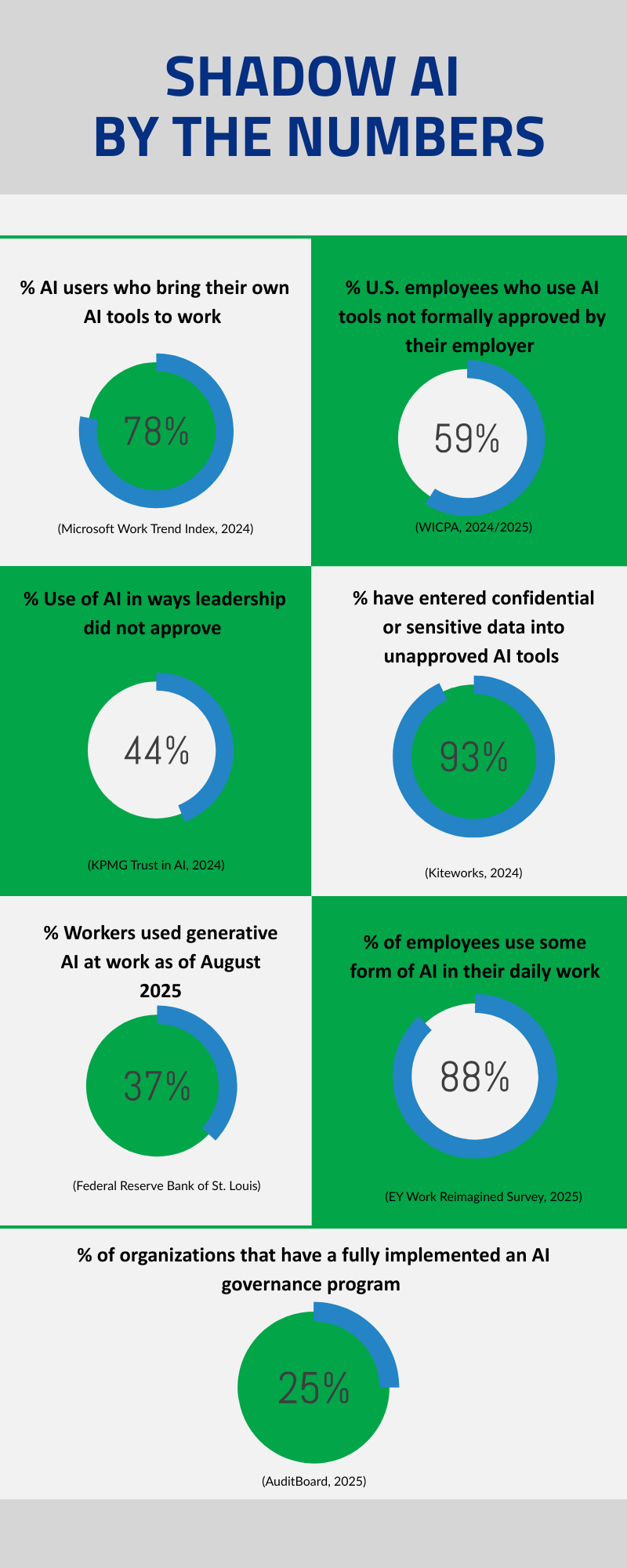
This creates a widening disconnect between how AI is used and how it should be managed to reduce risk.
If you're unsure how AI is being used across your organization, WSI can help assess your current AI landscape.
Stay tuned for the full series and upcoming AI Governance resources.