Key Highlights:
- AI favors verified expertise. AI systems prioritize brands they can verify as credible—meaning those without strong, consistent signals are far less likely to appear in AI-generated answers. This changes the SEO game entirely.
- Original insights win over recycled content. To stand out, you need proprietary research, unique data, or process-driven case studies—not just rehashed advice. AI rewards what’s truly your own.
- Third-party validation carries serious weight. Media coverage, podcast mentions, and backlinks from reputable sites tell AI that others trust you too—and that’s the proof it prioritizes.
- Recognizable experts elevate your content. Content authored by real, named professionals with credentials signals trust and transparency. “By Admin” doesn’t cut it anymore.
- Schema and consistency build a structured presence. AI connects the dots between your website, Google profile, social media, and directories—only when they all match. Schema helps AI read you clearly.
The rules of search have changed. Traditional SEO—built on keywords, backlinks, and page rankings—is no longer enough to secure visibility. With the rise of AI search engines like ChatGPT, Perplexity, and Google's AI Overviews, authority has become the new currency.
If AI can’t verify your expertise, you won’t get surfaced—no matter how good your content is. AI doesn’t just crawl your website; it cross-references your identity across the web. It’s no longer about optimizing for an algorithm—it’s about earning the trust of intelligent systems acting as gatekeepers.
In this blog, we’ll explore the five essential signals your brand must send to build AI-level authority:
- Original research
- Credible third-party validation
- Recognizable expert voices
- Structured identity (via Schema and platforms like Google Business)
- Cross-channel consistency
These aren’t optional. They are the new baseline for being seen in search. If you're still optimizing for rankings without building trust, you're targeting the wrong audience—because now, AI decides what your audience sees.
The Trust Deficit
Old SEO tactics aren’t enough. Today, AI search engines prioritize trust—not clicks or keyword density. Brands still chasing Google rankings with outdated playbooks are missing the shift.
AI platforms like ChatGPT and Google’s AI Overviews act as gatekeepers, only showing content from sources they trust. As the book explains, AI also compresses the search funnel. Instead of browsing multiple articles, people get answers instantly inside AI interfaces. That means fewer visitors arrive at your site—but the ones who do are of dramatically higher intent. They’ve already consumed AI-generated comparisons, context, and summaries before they click. Visibility now depends on earning citations inside those AI responses.
That means your website, messaging, and authority signals need to be verifiable across platforms—or you’ll be invisible.
Here’s the new reality: your competitors are already optimizing for AI trust. That means if your brand isn't recognizable, consistent, and externally validated, you’re invisible to the engines that now drive discovery.
It’s no longer enough to say “we’re experts” or publish high-quality content. AI needs evidence—signals it can triangulate from across the web that prove you are who you say you are.
The traditional SEO evolution looked like this: Keywords → Content quality → Authority.
Now, the bar has risen again: AI-verifiable authority is the only game that matters.
 To close this trust deficit, marketers must embrace a new SEO mindset: one built around authority, structured identity, and continuous credibility building. The AI Search Revolution: Adaptive SEO in the Age of AI, written by WSI's Founder, Dan Monaghan, lays out this new playbook, a modern roadmap to help marketers and business owners shift from outdated tactics to AI-trusted strategies.
This blog distills the trust-building principles emphasized throughout The AI Search Revolution into five practical signals your brand must send.
From E-E-A-T to AI-Verifiable Proof
You’ve likely heard of E-E-A-T—Google’s framework for evaluating Experience, Expertise, Authoritativeness, and Trustworthiness. For years, it’s served as a guide to SEO. But in the era of AI-driven search, it’s more than a best practice—it’s the foundation of visibility.
AI uses E-E-A-T as a verification protocol. It doesn't just evaluate your page—it evaluates your presence. It asks:
- Are you a real expert?
- Can your claims be validated elsewhere?
- Is your identity consistent across the web?
- Do other trusted sources talk about you?
Put simply, AI won’t just take your word for it.
To earn trust (and search placement), your expertise must be backed by visible credentials, real-world recognition, and a unified brand footprint—across your website, social platforms, directories, news mentions, and more.
Think of AI like a digital bouncer guarding access to the search results—the new VIP list. If your name’s not on the list (verified across multiple sources), you don’t get in.
The only way to gain entry is through proof, not promises. And that proof comes from consistently sending five powerful trust signals—let’s break those down next.
AI Doesn’t Just Evaluate You — It Embeds You
The book makes it clear that authority isn’t only about proving expertise — it’s about becoming embedded in the knowledge systems AI uses to answer questions.
When your brand appears consistently across trusted platforms, directories, media, and structured data sources, AI can build a stable entity profile to reference. This embeddability allows your brand to appear in AI Overviews, ChatGPT answers, and Perplexity citations, even when no specific page ranks on Google.
The 5 Signals of Trust: Your Blueprint for AI-Proof Authority
To win visibility in AI search, you need more than good content—you need proof you’re the real deal. AI models assess that proof using five trust signals. If you consistently send these signals across your digital footprint, you dramatically increase your chances of being seen, quoted, and recommended.
Signal 1: Prove You've Done the Work (Original Research & Unique Insights)
Original research and unique insights are the foundation of trust. AI wants evidence that your content is not just reworded summaries—it’s based on your own experience, data, or process.
Ask yourself: How much of your content is genuinely original?
If your answer is “not much,” you’re at risk of being filtered out. AI favors sources that contribute something new—such as internal data, customer studies, firsthand case studies, or original how-to frameworks. AI is not interested in summaries, listicles, or opinions from other people's blogs. There are hundreds of thousands of articles like that, and none of them make it into the AI Overviews. If you want to impress AI and get it to prioritize your content, you need to show your originality. You need real-world proof to show that you have done the work.
➡️ Key Action: Publish thought leadership grounded in firsthand insights.
Signal 2: Get Others to Say It for You (Credible Mentions & Third-Party Validation)
Third-party validation proves you’re recognized beyond your own platform. AI doesn’t just want to see your claims—it wants to see others quoting, referencing, or endorsing you.
Mentions on reputable sites, podcast interviews, webinars, and conference recaps all act like digital votes of confidence. One study found that prominent media mentions accounted for 27% of the citations used by large language models.
So, if nobody else is talking about you, you need to get them to talk about you. Take those original ideas and thought leadership pieces and pitch them to journalists. Use your social media platforms to comment on industry trends so you become recognized as an authority. Put yourself forward to participate in podcasts and interviews. The more of that you do, the more third-party mentions you will get, and the more trust you will develop.
➡️ Key Action: Proactively seek press mentions, reviews, and industry visibility.
Signal 3: Put a Face on the Expertise (Recognizable Experts)
AI, like people, trusts people. If your best content is published by “Admin” or “Marketing Team,” it loses credibility. AI prefers named authors with visible credentials and consistent authorship across channels.
Whether it’s a founder, marketing lead, or subject-matter expert, make sure your expert has a face, a name, and a reputation.
➡️ Key Action: Assign named authorship to content and build up their bio footprint. Show your face, let your voice be heard, and let it be distinct and recognizable.
Signal 4: Make Your Identity Unmistakable (Structured Presence)
This is about structured presence—the consistent, verifiable digital identity AI uses to confirm you’re real.
That means your business details (name, address, logo, description, etc.) must be consistent across your website, directories, social channels, and Schema markup. Even minor mismatches can confuse AI and lower your trust rating. Your company name, logos, bios, descriptions, and even minutiae like your current contact details must be the same everywhere.
This means ensuring every verified listing tells the same story — especially on Wikidata, Crunchbase, your Google Business Profile, and other authoritative directories AI relies on to confirm entity information. They aren’t vanity listings; they’re the backbone of how AI verifies you’re real and quoteable. Many companies focus on updating their website details but forget to update their Google Business Profile. Most human users wouldn’t spot this omission; AI will, and your search engine results will feel the impact.
To build your structured presence, implement robust Schema markup (Organization, Person, Service, etc.) on your website. 'Schema' is a term to describe the behind-the-scenes code that helps AI understand your business structure. Maintain a complete and accurate Google Business Profile and ensure your Knowledge Panel is correct. The goal is to give AI a clean, structured file of your business.
The book stresses that AI relies heavily on structured signals, such as Schema and entity data from sources like Wikidata, to understand who you are and whether your content is trustworthy enough to cite.
➡️ Key Action: Use Schema markup and align all your online listings to one unified identity.
Signal 5: Show Up the Same Everywhere (Cross-Channel Consistency)
Cross-channel consistency is more than branding—it’s a trust signal. AI scans everything: your reviews, social profiles, press mentions, and website messaging.
Think about all your messaging and try to look at it from AI’s point of view. In a millisecond, it scans your presence across the internet. If it finds the same story everywhere, it knows you are an authority it can trust.
If you claim “fast response times” but don’t answer reviews—or if your tagline, phone number, or value prop changes between platforms—AI sees the disconnect.
One recent analysis found that branded web mentions show the strongest correlation with inclusion in AI Overviews — underscoring the importance of consistent, external validation. Authority isn’t a campaign. It’s a discipline. Consistency builds credibility that compounds over time. You can’t earn one extraordinary mention and call it done. You need to show up the same way—credible, helpful, human—every place your name appears.
➡️ Key Action: Audit all touchpoints for consistency in language, claims, and contact info.
Your Authority-Building Action Plan
Knowing the five trust signals is just the start. Now it’s time to operationalize them with practical steps that build long-term authority and search visibility.
Here’s how to turn insight into action:
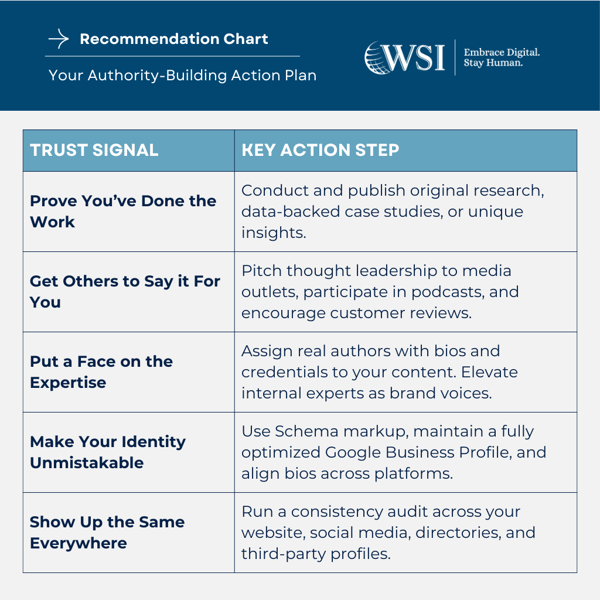
Remember: This isn’t a one-time checklist. It’s a discipline—one that compounds over time. AI needs to see these signals repeated and reinforced across platforms and timeframes.
That’s the heart of Adaptive SEO: building durable, verifiable trust in a search landscape where credibility trumps content alone.
For a deeper dive into how this mindset shift plays out in real-world strategies, check out The AI Search Revolution—your guide to staying visible, credible, and competitive.
From Invisible to Inescapable
In the age of AI search, visibility isn’t earned through keywords—it’s earned through trust.
Every mention, profile, and piece of content shapes how AI sees your business. If you’re not sending clear, consistent signals of credibility, you risk being filtered out—no matter how good your message is.
The question isn’t just “Are you ranking?”—it’s “Does AI recognize you as an authority?”
At WSI, our Adaptive SEO experts help brands like yours close that trust gap. We analyze your authority signals, identify blind spots, and build a blueprint that earns AI’s confidence—and your audience’s clicks.
Whether you're just starting or ready to scale your digital footprint, now is the time to act.
Schedule your complimentary strategy session and take the first step from invisible… to inescapable.
Frequently Asked Questions About Earning AI’s TrustQ: What does it mean that “authority is the new currency” in digital marketing? Q: How is AI changing traditional SEO? Q: What are the five trust signals AI looks for?
Q: How can my business start building AI-level trust? Q: How does WSI help businesses earn AI’s trust? |