Key Highlights
- Social media is now a trust filter. Platforms reward credible, human-centered content, not self-promotion or frequency.
- Human voices outperform brand accounts. Employee and executive posts drive higher engagement and visibility than corporate channels.
- Communities shape perception and search. Forums and niche groups influence AI discovery and buyer behavior long before a site visit.
- Creators build lasting relevance. Long-term partnerships with trusted creators beat short-term influencer campaigns.
- Authentic formats earn trust. UGC, case studies, educational content, and live Q&As consistently perform across social and AI platforms.
- Trust-first strategy scales visibility. Showing up consistently, clearly, and credibly builds recognition across algorithms and audiences.
Social media has changed—again. In 2026, visibility isn’t driven by volume or viral hacks. It’s driven by trust.
Platforms now prioritize credibility over cadence. Audiences engage with real people, not polished promos. Brands that lead with human voice, community participation, and transparent storytelling build lasting influence—both on social platforms and in AI-powered discovery.
Social is no longer a promotion tool: it’s a public trust engine. And that trust shapes search rankings, buyer behavior, and AI visibility across platforms. If your strategy still prioritizes posting over proof, it’s time to shift.
A Brief History of Social Media: How Has It Evolved
1970s to 1990s
Before modern social media, people used online communities such as bulletin board systems, forums, chat rooms, and early internet groups. These tools let users post messages, join discussions, and build digital communities.
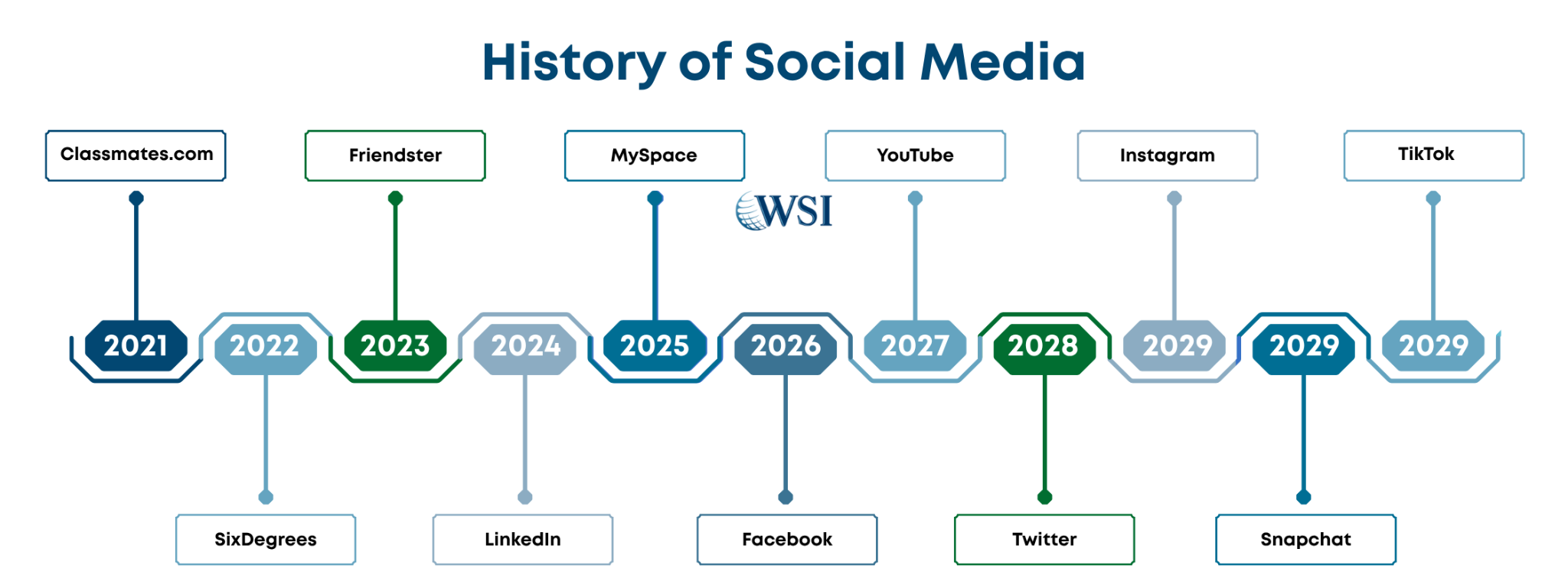
In the 1990s, early social networking sites began to appear. Classmates.com launched in 1995, and SixDegrees.com launched in 1997. SixDegrees is often considered one of the first true social networking sites because users could create profiles and connect with others online.
Early 2000s
The early 2000s brought platforms that looked more like the social media we know today.
Friendster launched in 2002 and helped popularize online friend networks. MySpace launched in 2003 and became a major platform for personal pages, music, and youth culture. LinkedIn also launched in 2003, focusing on professional networking. Facebook launched in 2004, first for college students, then expanded more widely.
This period shifted social media from niche online communities to mainstream personal identity platforms.
Mid-2000s to early 2010s
YouTube launched in 2005 and made online video sharing mainstream. Twitter, now X, launched in 2006 and made short, real-time updates a core part of online communication. Facebook opened more broadly and became one of the world’s largest platforms.
Smartphones changed everything. As mobile internet grew, people started posting photos, videos, updates, and messages throughout the day. Instagram launched in 2010, Snapchat in 2011, and social media became more visual, immediate, and mobile-first.
2010s
By the 2010s, social media had become essential for businesses. Brands used platforms for advertising, content marketing, customer support, community building, and lead generation.
Paid social advertising also grew quickly. Platforms offered detailed targeting based on interests, behavior, location, and demographics. This made social media a key part of digital marketing.
Facebook dominated much of this period, while YouTube, Instagram, LinkedIn, Pinterest, Snapchat, WhatsApp, and Twitter served different audiences and use cases. Our World in Data notes that by 2019, Facebook had about 2.3 billion users, with YouTube, Instagram, and WeChat each exceeding 1 billion users.
Late 2010s to Today
TikTok accelerated the shift toward short-form video. Instead of showing users mainly content from friends, TikTok popularized algorithm-led discovery, where people see content based on behavior and interests.
This influenced nearly every major platform. Instagram added Reels, YouTube added Shorts, and Facebook increased video recommendations. Social media became less about following friends and more about content discovery, entertainment, creators, and communities.
Pew Research Center has reported that YouTube and Facebook remain among the most widely used platforms among U.S. adults, while Instagram, TikTok, WhatsApp, and Reddit have grown in recent years.
How Social Media Has Changed
Social media has changed from a place for personal updates into a major channel for media, search, shopping, customer service, and brand trust.
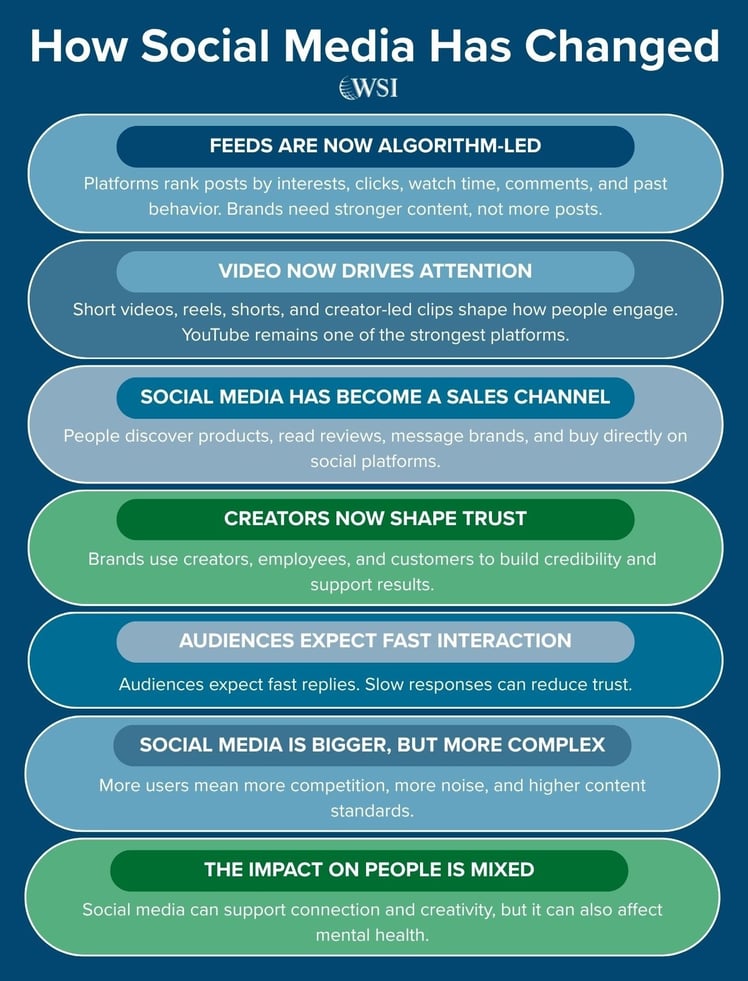
The biggest changes are:
- Feeds are now algorithm-led
People no longer see posts in simple time order. Platforms decide what appears based on interests, watch time, clicks, comments, and past behavior. This means brands need stronger content, not more content. - Video now drives attention
Short videos, reels, shorts, and creator-led clips changed how people consume content. YouTube also remains very strong, and DataReportal reported that YouTube was the most-used social platform at the start of 2025. - Social media has become a sales channel
People discover products, read reviews, message brands, and buy directly from social platforms. - Creators now shape trust
Brands rely more on creators, employees, and customers to build credibility. Hootsuite notes that creator partnerships are becoming more focused on performance and ROI, not follower count alone. - Audiences expect fast interaction
Customers use social media to ask questions, complain, compare options, and check whether a business is active. A slow or poor response can affect trust. - Social media is bigger, but more complex
DataReportal estimated 5.24 billion active social media user identities worldwide in early 2025, up 4.1% year over year. More reach also means more competition, more noise, and higher content standards. - The impact on people is mixed
Pew Research found that many teens say social media helps them feel connected and creative, while about 1 in 5 say it hurts their mental health.
Social Media Trends in 2026
Social Media Now Proves Credibility—Not Just Promotes Products
In 2026, social media is less about broadcasting and more about behavior. Platforms reward brands that demonstrate trust through:
- Customer stories and testimonials
- Peer recommendations and expert commentary
- Ongoing community participation and dialogue
This isn’t new—social proof has long influenced decisions. Robert Cialdini’s research on influence identified social proof as a primary driver of trust decades ago. But now, platforms amplify those signals and suppress self-promotion. Edelman’s Trust Barometer confirms it: people trust “others like them,” not brands.
Visibility comes from public validation—not polished claims. Brands that treat social as a mirror of trust (not a megaphone) get surfaced more often across both social feeds and AI-driven discovery.
Real People Outperform Corporate Posts, Even on Your Own Channels
In today’s feeds, who speaks matters more than how often you post.
Platforms like LinkedIn consistently prioritize:
- Unique employee perspectives over generic company promotions
- Executive insights on brand talking points
- Human explanations over templated tone
Why? Because real, authentic voices signal accountability and authenticity—traits AI systems and users both reward.
Excessive brand posting leads to lower engagement, audience fatigue, and reduced credibility. Instead of more posts, focus on fewer, higher-quality updates that carry a clear point of view.
In 2026, clarity beats cadence—and substance drives visibility.
How Communities Shape Visibility
Your audience isn’t just scrolling feeds—they’re joining communities where trust is built through conversation. Pew Research documents the growing influence of online communities, particularly in professional and interest-based contexts.
Whether it’s Reddit threads, LinkedIn groups, Slack channels, or Discord forums, these environments:
- Surface lived experience over brand claims
- Reinforce trust through peer validation
- Influence search and AI results with authentic input
Google’s AI systems increasingly cite community-driven content because it reflects what real people think and do. That means early impressions now form before someone ever visits your website.
Winning in communities requires patience and presence:
- Listen before you pitch
- Contribute without selling
- Support moderators and peer experts
Platforms promote participation, not domination. Trust is earned through consistency—not control.
Creators Now Anchor Brand Trust—Not Just Awareness
In 2026, creators aren’t influencers—they’re trust builders.
Audiences follow creators because they feel known, not marketed to. This applies across both B2C and B2B, where long-term relevance now beats short-term reach.
Key trends defining creator-led strategy:
- Authenticity > polish: Vulnerability, learning, and process feel more real than scripted posts.
- Partnership > promotion: One-off posts come across as transactional. Long-term collaborations signal alignment.
- Niche > mass: Smaller, focused audiences drive deeper engagement and trust.
- Leadership = creators: Founders and execs now publish insights directly, building personal authority.
AI and platform algorithms back this model. Discovery engines like TikTok, LinkedIn, and ChatGPT prioritize originality, clarity, and real perspectives.
The takeaway: Collaborate, don’t control. Creator trust can’t be manufactured—but it can be earned.
The Formats That Build Credibility Across Platforms and AI
Trust isn't just what you say—it's how you say it.
The most effective formats in 2026 deliver real value, proof, and transparency. These consistently earn attention from both platforms and AI systems:
- User-generated content (UGC): Real stories from real customers drive belief and outperform brand-crafted narratives.
- Case studies & examples: Specific outcomes (with numbers) build confidence and support search visibility.
- Educational content: Teaching positions your brand as a trusted expert—and helps AI extract answers.
- Behind-the-scenes content: Showing the process builds transparency, which builds trust.
- Live Q&A or discussions: Interaction shows confidence, accessibility, and relevance.
- Thought leadership: Original insight, especially from named experts, performs well across AI Overviews and search.
Google’s Search Central and AI tools increasingly reward content rooted in experience, clarity, and authorship. Content that answers real questions—without fluff—ranks, gets cited, and spreads.
The Future of Social Media
The future of social media will be shaped by AI, social search, creators, commerce, privacy rules, and trust.
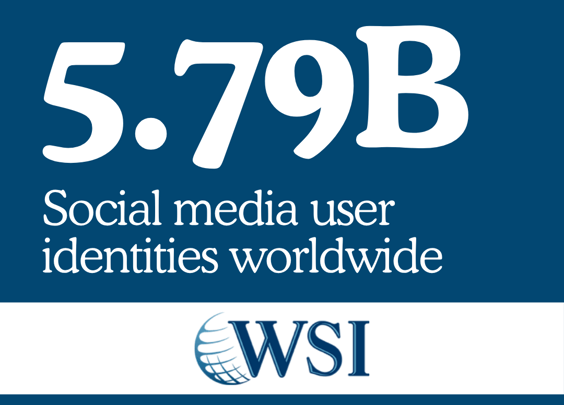
As of April 2026, DataReportal reports 5.79 billion social media user identities worldwide, equal to about 69.9% of the global population. Social media is still growing, but it is also becoming more fragmented across platforms, formats, and private communities.
AI Will Change How People Create and Discover Content
AI will help users write posts, edit videos, create images, summarize comments, and plan content. It will also shape what people see in their feeds. Sprout Social notes that AI-driven social search is already starting to provide direct answers inside platforms, similar to search summaries.
For businesses, this means content must be clearer, more useful, and easier for AI systems to understand.
Social Media Will Become a Search Engine
More people will search TikTok, Instagram, YouTube, Reddit, LinkedIn, and other platforms before using traditional search engines. They want real examples, reviews, opinions, and short explanations.
This means brands should treat social posts like searchable content. Use clear captions, customer questions, location terms, product names, and problem-based topics.
Human Content Will Matter More
AI content will become common. Because of that, real people, real stories, and real proof will stand out more. Hootsuite’s 2026 trends report says AI tools are becoming standard, while human-made authenticity is still a key factor for trust.
Businesses should show staff, customers, processes, reviews, results, and behind-the-scenes content.
Creators Will Become a Bigger Part of Marketing
Creator marketing will keep moving from a side activity to a core media channel. IAB projected U.S. creator ad spend to reach $37 billion in 2025, growing faster than the broader media market.
Brands will work more with niche creators, local creators, employees, and industry experts. The best creator partnerships will be judged by leads, sales, trust, and content quality, not only views.
Social Commerce Will Keep Growing
Social platforms will keep adding shopping features, product discovery, reviews, creator demos, and checkout options.
For e-commerce brands, social media will act more like a storefront. For service businesses, it will act more like a trust-building and lead-generation channel.
Private and Smaller Communities Will Gain Value
Public posting will still matter, but more conversations will move into DMs, groups, paid communities, newsletters, and closed spaces. People want more control over who sees their content and who they interact with.
Businesses should build owned audiences, such as email lists, CRM contacts, loyalty groups, and customer communities. This reduces dependence on platform algorithms.
Regulation Will Get Stricter
Governments are placing more pressure on platforms around youth safety, privacy, age limits, ads, and harmful design features. Australia’s under-16 social media restrictions came into effect on 10 December 2025, and the EU Digital Services Act bans targeted ads to children and requires stronger minor protections.
Brands will need cleaner consent practices, careful targeting, safer youth content, and better privacy controls.
Measurement Will Shift from Likes to Business Results
Followers, likes, and views will still help show reach. But they will not be enough. Businesses will focus more on website visits, leads, booked calls, sales, cost per lead, customer retention, and repeat purchases.
The future of social media is not about posting more. It is about creating useful content, earning trust, using AI carefully, working with the right creators, building owned audiences, and connecting social activity to real business outcomes.
Social Media Is Now a Strategic Trust Engine
This isn’t a social trend—it’s a strategic shift. In 2026, social media acts as a public credibility layer, shaping how platforms, people, and AI systems judge your brand.
Algorithms no longer just sort by engagement—they filter for authenticity, consistency, and trust.
That means:
- A real voice beats polished promotion
- Community presence matters more than post frequency
- Trust-first visibility scales across social, search, and AI discovery
For leadership teams, the call is clear: Stop chasing trends. Start building trust—in public.
Brands that lead with credibility get surfaced. Brands that don’t get overlooked, no matter how much they post.
Social Media Strategy Built for 2026
If you want support aligning your social strategy with trust-driven visibility, WSI helps organizations navigate this shift. Our AI consulting services focus on building credibility across social, search, and AI-powered discovery—so trust compounds wherever buyers engage.