
Key Highlights
- Marketing dashboards often create more noise than clarity. Leaders need reporting that connects activity to pipeline, revenue, and growth decisions.
- Channel metrics have a role, but they should not lead executive conversations. Traffic, clicks, rankings, and engagement need business context to become useful.
- Revenue-focused measurement shows where growth is working, slowing, or leaking value. It helps leaders move faster on what to scale, fix, pause, or fund next.
- The Revenue Signal Framework connects marketing activity to business outcomes. It focuses on three layers: demand quality, pipeline movement, and revenue conversion.
- Demand quality shows whether marketing is attracting the right audience. The goal is not more activity, but better-fit prospects with stronger revenue potential.
- Pipeline movement reveals whether interest is turning into qualified opportunities. It helps teams spot friction in qualification, sales follow-up, messaging, or handoff.
- Revenue conversion connects marketing performance to financial results. Metrics like CAC, lifetime value, and marketing-attributed revenue show which efforts are worth scaling.
- A simple leadership scorecard helps turn reporting into action. It gives teams a clearer view of budget priorities, pipeline health, and revenue impact.
Marketing reporting has become easier to produce and harder to use.
Every platform has a dashboard. Every campaign has a scorecard. Every team has its own version of performance. On paper, growth should be easier to manage. In practice, leaders often end up with more numbers to review and less confidence in what to do next.
The disconnect shows up fast. Traffic is up, but lead quality is unclear. Engagement looks strong, but the pipeline is slow. Paid media is generating conversions, but revenue impact is hard to prove.
Reports can show what happened in a campaign, channel, or platform. They do not always show what the business should do next. Increase spend? Adjust the offer? Improve lead quality? Fix the sales handoff? Pause the campaign entirely?
Marketing metrics earn their place when they help leaders make decisions. The job is not to track less for the sake of simplicity. It is to focus on the numbers that reveal where growth is gaining traction, where it is leaking value, and where action is needed next.
The Problem Isn’t More Data. It’s Revenue Clarity
Over time, measurement systems tend to expand on their own. A new channel gets added, a new platform is introduced, or a new reporting tool is adopted. Each one brings its own dashboard, metrics, and definition of success.
Individually, these systems can be useful. Together, they often create a data-rich reporting environment that slows decisions down. The numbers are visible, and they may even be accurate, but they don’t always show how marketing activity connects to pipeline, sales, or revenue.
Friction builds across the business. Marketing may be focused on engagement, sales may be focused on pipeline, and leadership may be focused on revenue. When those views don’t connect, teams spend more time interpreting reports than acting on them.
Useful reporting brings those views together. It helps leaders see which marketing activities are creating demand, which ones are moving opportunities forward, and which ones are creating revenue worth scaling.
Why Traditional Dashboards Break Down
Traditional dashboards are usually built around channels, not outcomes. Search engines, paid media platforms, email tools, CRMs, and social platforms all report performance in their own way. Each system may be useful on its own, but none of them is designed to give leaders a single commercial view of growth.
Gartner's 2026 marketing outlook points to a familiar pressure for marketing leaders: move faster, spend smarter, and stay ahead of changing customer expectations. Dashboards can support that work, but only when they connect activity to the decisions leaders need to make.
Too often, reporting reflects channel activity instead of business performance. Search tools show traffic and rankings. Social platforms show reach and engagement. Email tools show opens and clicks. CRMs show leads and opportunities. The pieces are useful, but they do not automatically explain which efforts are helping revenue grow.
For leadership teams, this creates three common problems:
The meaning of the data becomes unclear.
Each channel defines success differently, which makes comparisons difficult. A metric may look strong in one system while having little impact on pipeline or revenue.
Activity is mistaken for progress.
High traffic, impressions, clicks, or engagement can look encouraging. Without conversion and revenue context, they may only show movement, not momentum.
Decision-making slows down.
Teams spend too much time debating what the numbers mean and not enough time deciding what to change, scale, or stop.
Dashboards lose value when they only describe performance. A useful dashboard should help shape performance. It should make the next decision clearer, whether that decision is about budget, targeting, messaging, lead quality, or sales follow-up.
The Revenue Signal Framework
The best measurement systems do not start with channels. They start with the growth decisions leadership needs to make.
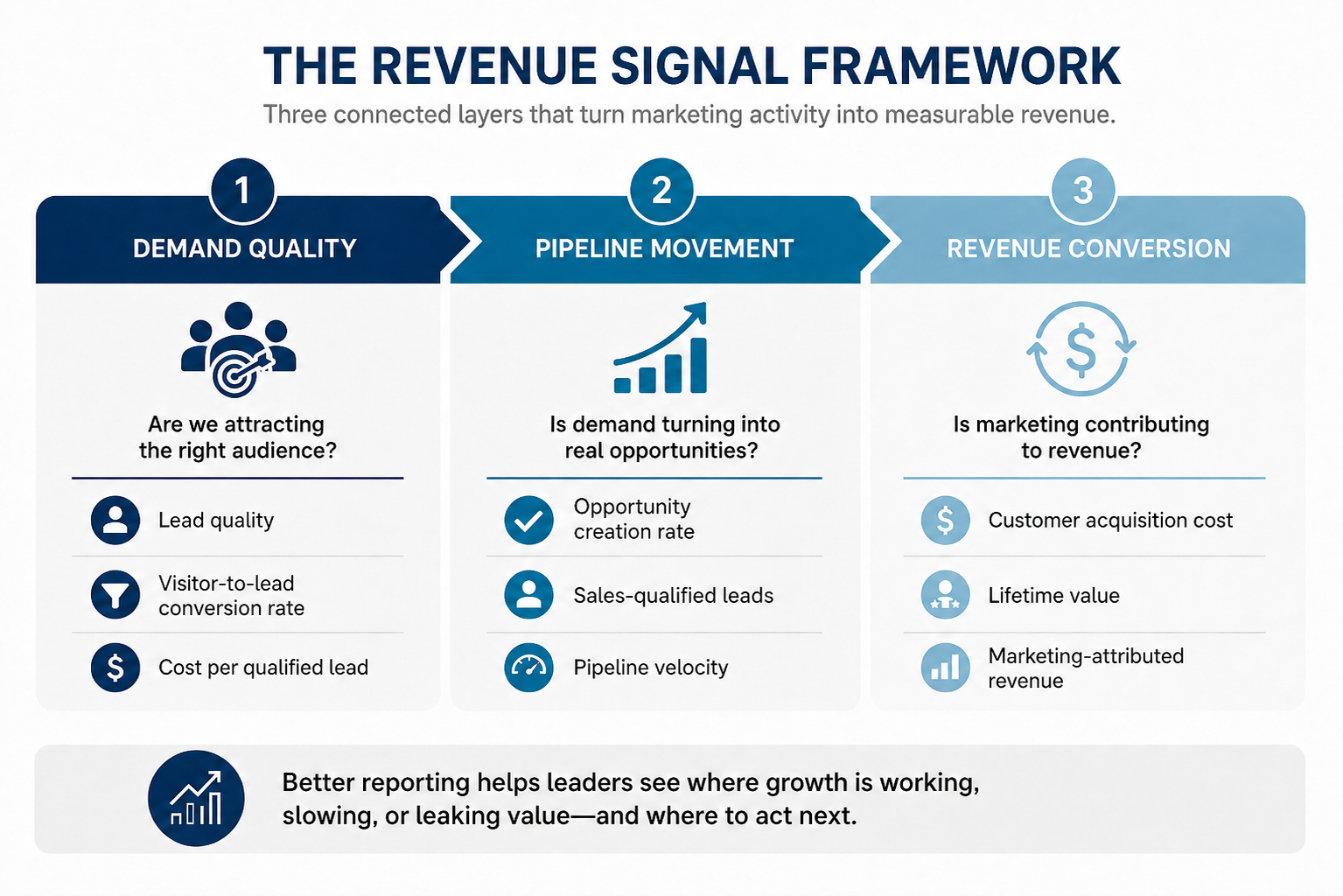
The Revenue Signal Framework organizes performance into three connected layers: demand quality, pipeline movement, and revenue conversion. Each layer shows how marketing activity moves through the business, from first contact to closed revenue.
The framework helps leaders spot where growth is working, where momentum is slowing, and where action is needed.
Signal 1: Demand Quality
Demand quality shows whether the right audience is finding and engaging with your business.
Traffic alone can tell you whether people are showing up. It cannot tell you whether they fit your ideal customer profile, have real intent, or are likely to become profitable customers. The same applies to engagement. A click, view, or download may show interest, but it does not automatically signal buying potential.
The key metrics here include lead quality, visitor-to-lead conversion rate, cost per qualified lead, and the percentage of marketing-qualified leads that match your ideal customer profile.
If traffic is high but conversion rates are low, the issue may be targeting, messaging, offer strength, or audience fit. If traffic is lower but conversion quality is strong, the next opportunity may be expanding reach without weakening lead quality.
Demand quality acts as the first filter in the system. When this signal is weak, every downstream metric becomes harder to improve.
Signal 2: Pipeline Movement
Once demand is created, the next question is whether it is moving through the pipeline.
Pipeline movement measures the progression from interest to qualified opportunity. Useful metrics include sales-qualified leads, opportunity creation rate, win rate, sales cycle length, and pipeline velocity.
Pipeline velocity is especially valuable because it combines several pipeline growth metrics into one view. It shows how quickly qualified opportunities move toward revenue based on deal size, conversion rate, and sales cycle length.
A large pipeline can still hide a growth problem if opportunities are moving too slowly or failing to convert. The issue may be qualification, sales follow-up, offer clarity, pricing, or the handoff between marketing and sales.
A smaller, faster-moving pipeline can outperform a larger one when the fit is stronger and the buying path is clearer.
This signal helps leaders find the friction between demand and revenue.
Signal 3: Revenue Conversion
Revenue conversion connects marketing activity to financial performance.
This layer looks at whether demand and pipeline activity are turning into profitable growth. Key metrics include customer acquisition cost, lifetime value, marketing-attributed revenue, conversion rate to customer, and return on marketing investment.
Customer acquisition cost shows how efficiently new customers are being acquired. Lifetime value shows whether those customers are worth the investment over time. Marketing-attributed revenue connects activity across channels to business outcomes.
This is where marketing measurement becomes a growth investment conversation. Leaders can see which campaigns, channels, and customer segments are creating revenue, not just activity.
When this signal is clear, decisions become sharper. Budget can move toward what is working, underperforming efforts can be corrected faster, and growth becomes easier to forecast.
Why This Framework Changes Decision-Making
Revenue signals change the conversation from “How did the campaign perform?” to “What should we do next?”
A dashboard may show that traffic increased, lead volume dropped, and paid conversions improved. Without a revenue signal structure, those numbers can pull teams into separate debates. Marketing looks at channel activity. Sales looks at lead quality. Leadership looks at revenue impact.
The framework connects those views. Demand quality shows whether marketing is attracting the right audience. Pipeline movement shows whether that demand is turning into real opportunities. Revenue conversion shows whether those opportunities are becoming profitable customers.
Teams get a common operating view. Instead of reconciling disconnected dashboards, they can focus on the decisions that improve growth: where to invest, what to fix, what to scale, and what to stop.
Decisions move faster because teams are working from the same growth signals. Leaders can see where performance is strong, where friction is slowing revenue down, and which actions deserve priority.
Metrics That Don’t Belong at the Top
A revenue-focused system does not eliminate channel metrics. It puts them in the right place.
Traffic, impressions, rankings, clicks, and engagement can all be useful. They help teams optimize campaigns and understand how individual channels are performing. The problem starts when these metrics become the main focus of leadership reporting.
At the executive level, metrics should help answer bigger questions: Are we attracting the right audience? Are opportunities moving through the pipeline? Is marketing contributing to profitable growth?
Some metrics still belong in the dashboard. They just don’t belong at the top.
Vanity Metrics
Total traffic, impressions, reach, and social likes can show visibility, but they do not prove business impact. These numbers often rise during campaigns that create little or no revenue movement.
They can be useful for awareness and channel diagnosis. They should not be used as the main evidence of growth.
Legacy Performance Indicators
Keyword rankings and email open rates still provide context, but they no longer tell enough of the story on their own.
Buying journeys are less linear than they used to be. Prospects move across search, social platforms, AI tools, review sites, peer recommendations, and direct conversations before making a decision. A keyword ranking or open rate may show one point of influence, but not the full path to revenue.
Use these metrics to improve specific tactics, not to judge overall marketing performance.
Isolated Engagement Metrics
Click-through rates, engagement rates, and content interactions can show interest. Without conversion, pipeline, or revenue context, they do not explain value.
A high click-through rate may mean the message is attracting attention. It does not automatically mean the audience is qualified or ready to buy.
These metrics still have a place in campaign optimization. Revenue signals should guide strategic decisions.
From Dashboards to Decision Systems
A revenue-focused scorecard changes reporting from a review exercise into a decision tool.
The goal is not more reporting. It is sharper reporting. A practical scorecard should help leaders see where demand is coming from, how opportunities are moving, and whether marketing is contributing to profitable growth.
The strongest scorecards usually work across three layers.
Demand Generation Layer
This layer shows whether the business is attracting and qualifying the right audience.
Key metrics may include lead quality, conversion rates by source, cost per qualified lead, and marketing-qualified leads by customer fit. The focus is not volume alone. It is whether demand matches the customers the business wants to win.
Leadership question: Are we attracting the right opportunities, or just creating more activity?
Pipeline Health Layer
This layer shows whether demand is turning into real sales opportunities.
Key metrics may include opportunity creation rate, win rate, sales cycle length, and pipeline velocity. These numbers help reveal whether leads are progressing, stalling, or dropping out before revenue can be created.
Leadership question: Where is momentum building, and where is the pipeline slowing down?
Revenue Impact Layer
This layer connects marketing activity to financial outcomes.
Key metrics may include customer acquisition cost, lifetime value, marketing-attributed revenue, and return on marketing investment. These indicators show whether growth is efficient, profitable, and sustainable.
Leadership question: Which marketing investments are creating revenue worth scaling?
Each layer has a job. Together, they help leaders move from “What happened?” to “What should we do next?”
What a Simple Dashboard Looks Like
An effective leadership dashboard does not try to show everything. It focuses on the metrics that help leaders make better decisions.
For many leadership teams, five to seven core metrics are enough. More than that, and the conversation can drift from decision-making into data review.
Operational dashboards can still include more detail for campaign optimization. Leadership reporting should stay focused on revenue signals: demand quality, pipeline movement, and revenue conversion.
A simple scorecard might look like this:
The goal is not to build a perfect dashboard. It is to build one that supports better decisions.
A strong leadership dashboard should:
-
Show trends over time, not isolated data points
-
Track movement across revenue signals
-
Connect marketing performance to budget, pipeline, and revenue decisions
When reporting is structured this way, dashboards become tools for action instead of archives of activity.
Why These Changes Affect Growth Outcomes
Revenue-focused measurement gives leaders a clearer view of where growth is being created, slowed, or lost.
The impact shows up in practical ways. Budget conversations become sharper because teams can see which activities are influencing pipeline and revenue. Priorities become easier to set because effort is tied to business impact, not surface-level visibility. Forecasting becomes more reliable because demand, pipeline, and revenue are connected in one view.
That connection gives leadership teams more confidence. They can move faster on what is working, fix weak points earlier, and stop over-investing in activity that looks good in a report but does not move the business forward.
Better measurement will not solve every growth challenge, but it will show you where to look first.
For growth-oriented businesses, that is the real value of a revenue-focused scorecard. It turns marketing data into a working system for better decisions, stronger alignment, and more consistent growth.
WSI helps businesses turn scattered reporting into a clearer growth measurement system. Our consultants work with leadership teams to simplify reporting, connect marketing activity to revenue outcomes, and identify the metrics that deserve attention at the top.
Ready to see which metrics are helping growth and which ones are just filling slides? Talk to a WSI Consultant about building a revenue-focused marketing scorecard.