Key Highlights
- LinkedIn can shape the first impression buyers never tell you about. A prospect may use AI search to compare vendors, check expertise, or validate a referral before your team knows they are looking.
- Old positioning creates commercial risk. If your LinkedIn presence still reflects past services or markets, buyers may rule you out for work you are fully equipped to handle.
- Leadership content gives credibility a human source. A company page can state what you do, but expert posts show how your team thinks, solves problems, and understands the market.
- Alignment matters across every visible asset. Your website, company page, executive profiles, and posts should reinforce the same business focus so buyers are not left piecing together conflicting versions.
- The best next step is a visibility check. Search your business, leaders, and service categories in AI tools, then fix the LinkedIn gaps that create confusion, weaken trust, or hide your strongest expertise.
Ask an AI tool who’s credible in your industry, and there’s a good chance LinkedIn helps shape the answer.
Research shows that LinkedIn ranks as the second most cited domain overall, behind Reddit and ahead of Wikipedia, YouTube, and every major news publisher. In ChatGPT Search, LinkedIn appeared in 14.3% of responses.
For professional and B2B queries, the kind buyers use when researching vendors, LinkedIn moves even higher. LinkedIn’s own marketing team has pointed to third-party research showing the platform as the single most cited source for those queries across major AI systems.
LinkedIn has also acknowledged that AI-powered search has cut its own traffic by up to 60% in some categories. That gap matters: being the source AI uses and being the destination someone clicks are no longer the same thing.
If your LinkedIn presence is outdated, AI search may be working from the wrong version of your business.
Many LinkedIn profiles and company pages still read like static resumes: written once, updated occasionally, and loosely connected to current positioning. That worked when LinkedIn acted mainly as a professional directory. It works far less well now that AI systems treat LinkedIn as a source of credibility, context, and expertise.
Why AI Tools Pay Attention to LinkedIn
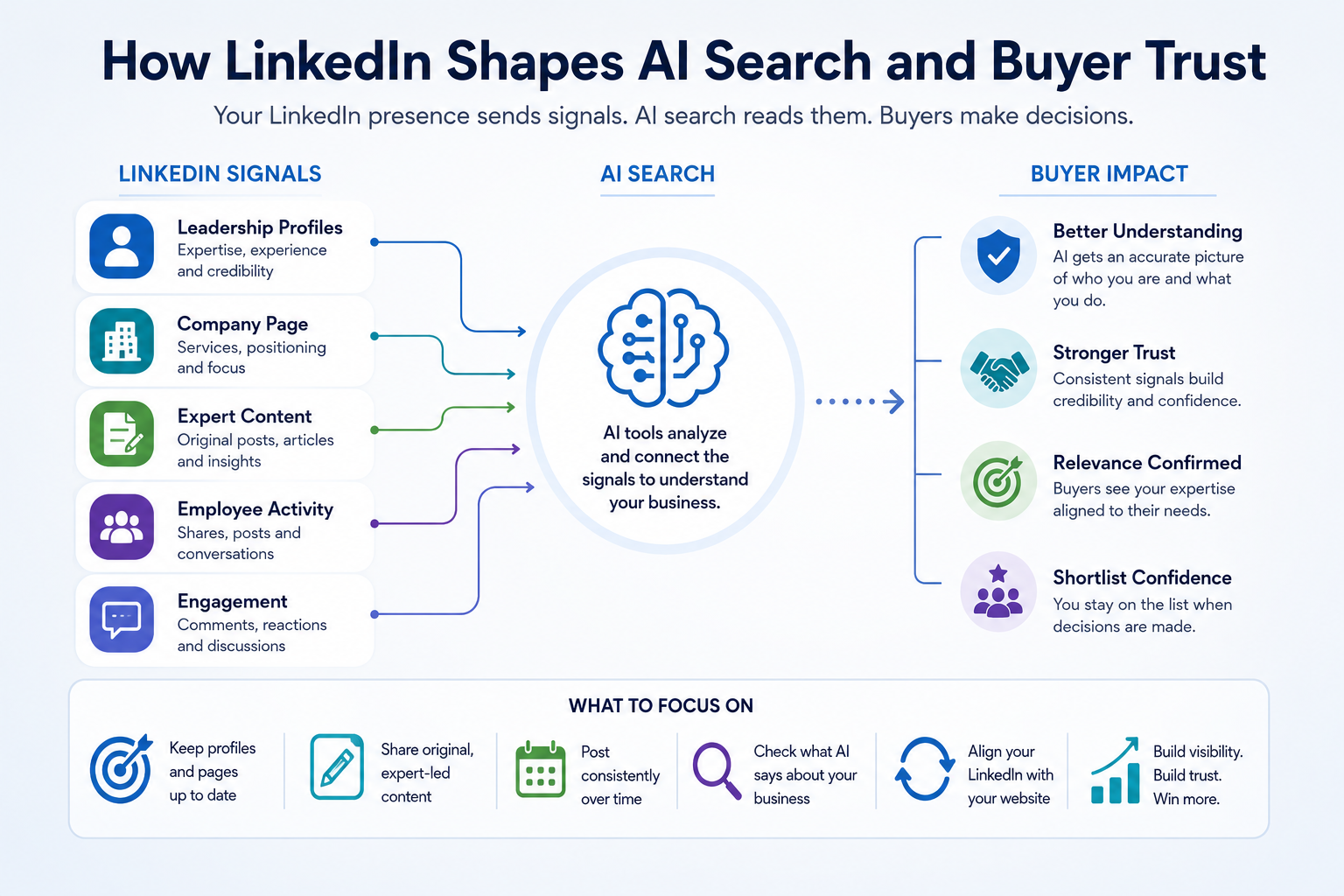
AI search builds answers by pulling signals from multiple sources, then looking for patterns that appear credible, current, and consistent. In B2B, LinkedIn fits that model well because it connects expertise, identity, company context, and public activity in one place.
Executive profiles connect expertise to a real person. Company pages tie that person to an organization. Posts, comments, and articles show subject matter depth in public. Employee activity adds another layer of validation.
When a buyer asks an AI tool who understands industrial automation, healthcare marketing, or cybersecurity compliance, the system looks for corroboration. It checks for named experts, recent commentary, and alignment between what a company claims and what its people are saying.
LinkedIn plays a larger role in buyer research because it connects the proof buyers look for: people, expertise, company context, and recent activity.
For businesses, this changes the role LinkedIn plays in the buyer journey. It now supports discovery, validation, and shortlist confidence. A buyer may never click your LinkedIn page. AI may still use it to summarize who you are, what you know, and whether your expertise appears credible.
What AI Search Looks for on LinkedIn
AI systems look for repeatable credibility signals. On LinkedIn, those signals usually come from five places.
-
Named expertise: A profile attached to real experience gives AI context. A person’s role, background, and subject matter focus help connect their advice to a credible source.
-
Company alignment: Leadership profiles, employee activity, and company-page messaging should point in the same direction. When they do, AI has a more accurate read on what the business does, who it serves, and where its expertise sits.
-
Specific content: Broad advice is easy to ignore. A founder explaining how their team reduced customer churn, shortened a sales cycle, or improved hiring quality gives AI something specific to understand and reference.
-
Recent activity: A quiet profile sends a weaker signal than one with current posts, updated experience, and active conversations. In fast-moving industries, recency helps show that your expertise still applies.
-
Public interaction: Comments and discussions show how people respond to your ideas, challenge them, or build on them. That interaction adds context around authority, relevance, and influence.
Together, those details shape how AI understands your expertise, market position, and credibility.
For example, a regional accounting firm may have spent years promoting tax preparation and bookkeeping on LinkedIn. Over time, the firm shifts toward CFO advisory, cash-flow planning, and acquisition support for owner-led businesses. If partner profiles still lead with tax services, the company page lists bookkeeping first, and recent posts focus on filing deadlines, AI tools may keep describing the firm as a tax provider.
The fix is practical: update partner headlines and About sections around CFO advisory, revise the company page services in the same language, and publish a short series of posts explaining the business problems the firm now solves. One post could cover cash-flow forecasting before expansion. Another could explain how owners prepare financials before acquisition talks. A third could share common reporting gaps that limit growth decisions.
That gives buyers and AI systems a more accurate picture to work from.
What LinkedIn Content AI Is More Likely to Use
AI search isn’t chasing viral LinkedIn content. The cited posts in the study usually had moderate engagement, often around 15 to 25 reactions. Useful content appears to travel farther than high-engagement content.
The content most often cited shared a few traits:
-
It was original. In the study, 95% of cited LinkedIn content was original. Simple reshares with a short comment rarely appeared in AI answers.
-
It taught something useful. Educational and advice-driven posts accounted for 54% to 64% of citations across the AI tools studied.
-
It fit the format. Long-form LinkedIn articles between 500 and 2,000 words drew the most citations. Feed posts performed best between 50 and 299 words, enough room to make one clear point without turning the post into a mini white paper.
-
It appeared consistently. About 75% of cited authors posted five or more times in a four-week period. Every business leader doesn’t need to post daily, but long stretches of silence weaken the signal.
The practical takeaway: publish clear, original, educational content at a steady pace. Buyers get something useful to evaluate. AI systems get cleaner source material to reference.
Why Expert Voices Carry More Trust Than Company Updates
AI tools tend to favor people over brand pages on LinkedIn, and buyers often do the same.
A company page can explain services, share updates, and reinforce positioning. A named expert brings experience, perspective, and accountability into the open.
A founder writing about a supply chain challenge or a marketing lead breaking down attribution issues creates a clearer signal than a generic company update. AI can connect the idea to a person, a role, and a business context.
Treat LinkedIn as a shared visibility system. The company page sets the foundation. Leaders and subject matter experts create the proof buyers can evaluate.
When AI Search Gets the Details Wrong
Being cited is useful only when the context is right.
AI can pull your business into an answer and still get key details wrong: the service you offer, the audience you serve, the markets you operate in, or the positioning you have already moved away from.
That risk grows when LinkedIn content is outdated. A buyer could ask an AI tool what your company does and receive an answer shaped by an old profile, an inactive company page, or posts that no longer reflect your current strategy.
Run a quick visibility check:
- Ask ChatGPT, Copilot, or Google AI Mode what your business does.
- Check who it says you serve.
- Look at how it describes your expertise.
- Compare the answer to your current positioning.
- Read it like a prospect would.
In visibility audits, this is often where the first gap appears. A company’s website may describe one positioning strategy, while LinkedIn profiles, old posts, and executive bios point AI systems toward another.
Cleaning up those inconsistencies is one of the fastest ways to improve how your business is understood across AI-assisted search.
LinkedIn Is Moving Closer to the Buying Decision
LinkedIn is building features around how professionals use AI, compare answers, and evaluate credibility.
Crosscheck by LinkedIn Labs is one example. Announced in May 2026, it lets members compare responses from different AI models side by side and choose which answer is more useful. LinkedIn says Crosscheck is currently available to Premium subscribers in the United States, with a broader rollout planned.
Its purpose is simple: help people test AI answers instead of accepting the first response they see. That behavior matters. Buyers are learning to compare sources, question summaries, and look for proof before they trust an answer.
LinkedIn content becomes part of that proof. Profiles, posts, comments, and company pages need to show current, consistent expertise so buyers and AI tools can understand the business accurately.
A useful next step is to run the same check on your own business. Ask AI tools how they describe your company, leaders, and service category. If the answers miss the same expertise, describe an old service, or confuse who you serve, start with the LinkedIn assets you control.
Your Next 90 Days on LinkedIn
A stronger LinkedIn presence starts with sharper priorities. Start with the areas buyers and AI tools are most likely to evaluate.
- Review executive profiles: Update leadership headlines, About sections, featured links, and experience summaries so they reflect the expertise you want buyers to associate with the business now.
- Tighten the company page: Align your description, services, industries served, and recent posts with the same positioning used on your website.
- Publish expert-led content: Ask leaders or subject matter experts to share practical posts tied to real business problems, such as reducing sales cycle friction, improving customer retention, preparing for expansion, or managing risk.
- Create a realistic rhythm: Choose a cadence your team can maintain. Two strong expert posts per week are better than a burst of activity followed by silence.
- Check what AI says about you: Search your company name, leadership names, and service categories in ChatGPT, Copilot, Perplexity, and Google AI Mode. Look for outdated descriptions, missing expertise, or confusion around who you serve.
- Look for repeated gaps: If several AI tools describe your business in the same outdated, vague, or incomplete way, your source material likely needs work. Start with the LinkedIn assets you control: leadership profiles, the company page, and recent expert content.
A Practical Example: Fixing a Mismatched LinkedIn Presence
A manufacturing consultancy wants to be known for helping mid-market manufacturers reduce downtime through automation planning. The CEO’s profile talks mainly about “operations consulting,” the company page lists broad services, and recent posts share general productivity tips.
After running AI searches, the team finds that AI tools describe the firm as a general operations advisor. Crosscheck shows similar patterns across multiple models.
The next move is focused cleanup. The CEO updates their headline to reference manufacturing automation strategy. The company page adds downtime reduction, plant-floor workflow, and automation readiness to its service language. The team publishes four posts over the next month: one on hidden downtime costs, one on readiness gaps before automation investment, one on a client-style scenario, and one on metrics manufacturers should track before buying new technology.
Now the public proof points align around the same story: industry, problem, expertise, and business outcome. That gives buyers a stronger reason to trust the company, and it gives AI systems better material to understand what the business actually does.
LinkedIn plays a role in how business credibility is found, checked, and compared. Companies that treat it as an active trust asset will have a clearer advantage as AI-assisted buyer research grows.
Make LinkedIn Part of Your AI Visibility Strategy
Your website still matters. It remains the place where buyers go deeper, compare services, and decide whether to start a conversation.
LinkedIn is increasingly where trust gets shaped earlier, both by people and by the AI tools helping them research.
It deserves the same attention as your website, search presence, and sales materials.
At WSI, we see this as a visibility alignment problem. Your website, LinkedIn presence, executive profiles, and expert content need to tell the same story about who you serve, what problems you solve, and where your business creates value.
Start by checking how AI-assisted search describes your business. If the answer feels outdated, unclear, or incomplete, LinkedIn is one of the first places to fix. A WSI Consultant can help you identify the gaps, align your visibility strategy, and improve what buyers see before they contact you.