
Key Highlights
- Benchmarks are a starting point. A typical marketing investment falls between 5% and 20% of revenue, but the right number depends on growth goals, margins, and competitive pressure.
- Future goals should guide spending. Budgeting based on where you want to go—not where you’ve been—helps marketing actively support revenue growth instead of reacting to it.
- Structure drives performance. Strong results come from aligning awareness, consideration, and conversion into one system that moves buyers toward action.
- Efficiency matters early on. When budgets are tight, focusing on high-intent opportunities improves attribution, conversion clarity, and short-term impact.
- Expansion comes after foundation. Once conversion paths are working, investing in awareness and demand generation strengthens long-term pipeline and brand visibility.
- Clarity beats complexity. Many budgets underperform due to scattered spend or weak tracking. Clear structure and measurement improve consistency and ROI.
If you’re running a growing business, this question comes up often:
How much should you spend on marketing?
Budgets are under more pressure than ever. Channels keep expanding, costs are rising, and leadership expects clearer returns. At the same time, growth targets aren’t getting any smaller.
So the real question isn’t just how much to spend. It’s how to invest in a way that drives consistent, measurable growth.
Start With a Marketing Spend Benchmark
Across industries, many small and mid-sized businesses invest somewhere between 5% and 20% of revenue into marketing.
In practice, that range tends to shift based on growth ambition, competitive pressure, and how mature the business’s marketing system is.
- Businesses maintaining steady growth often stay toward the lower end
- Companies looking to expand typically invest more to increase visibility and lead flow
- Businesses entering new markets or scaling quickly tend to push investment higher
This range works best as a planning reference. The right investment depends on how your growth goals, margins, and marketing performance come together.
Where your business should land depends on:
- Your growth targets
- Your margins
- Your sales cycle
- The level of competition in your market
A percentage gives you a reference point. How you structure that investment determines how it performs.
Align Your Budget With Where You’re Going
Many businesses set their marketing budget based on last year’s numbers.
A more useful approach is to align investment with future goals.
If growth is the priority, your marketing budget should reflect:
- How much new revenue do you want to generate
- How competitive your space is
- How much effort does it take to reach and convert your audience
Marketing supports future growth by building pipeline, visibility, and demand over time.
Where Your Marketing Budget Actually Makes an Impact
Two companies can spend the same percentage of revenue and see very different results.
The difference usually comes down to how that budget is structured and how clearly each part of the funnel is doing its job.
Marketing works best when it’s treated as a connected system that guides buyers from first touch to final decision—and beyond.
At a high level, that journey looks like this:
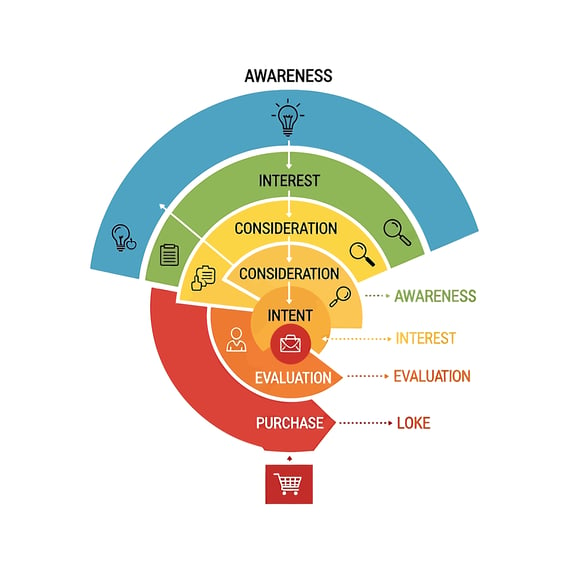
Awareness → Interest → Consideration → Intent → Conversion → Loyalty
Each stage contributes differently depending on where your business is today.
This is where a structured, strategy-first approach makes a difference—connecting channels, messaging, and measurement into a system that supports growth.
Why Budgets Often Underperform
In practice, most businesses lean too heavily in one direction.
Some invest early in visibility—ads, social, and content—without having a strong conversion path in place. That tends to drive traffic without results.
Others focus almost entirely on bottom-funnel activity. That can generate short-term leads, but it limits long-term growth because the pipeline isn’t being replenished.
Both scenarios create friction—either wasted spend or limited growth potential.
A More Effective Way to Think About Allocation
A more useful question than “how much should we spend?” is:
“Where will additional investment create the most impact right now?”
The answer changes as your business evolves.
- With tighter budgets, the priority is usually capturing existing demand
- As performance improves, the focus expands to generating new demand
- At scale, investment shifts toward strengthening the full funnel and building brand position
This progression is what allows marketing to consistently support growth.
What Each Stage Contributes
Each stage plays a different role in moving a buyer forward:
- Awareness builds familiarity and keeps your brand visible early
- Consideration helps buyers compare options and understand where you fit
- Intent and Conversion turn interest into action and revenue
- Loyalty strengthens retention and long-term value
Strong performance comes from how these stages work together as a system.
How to Spend Your Marketing Budget
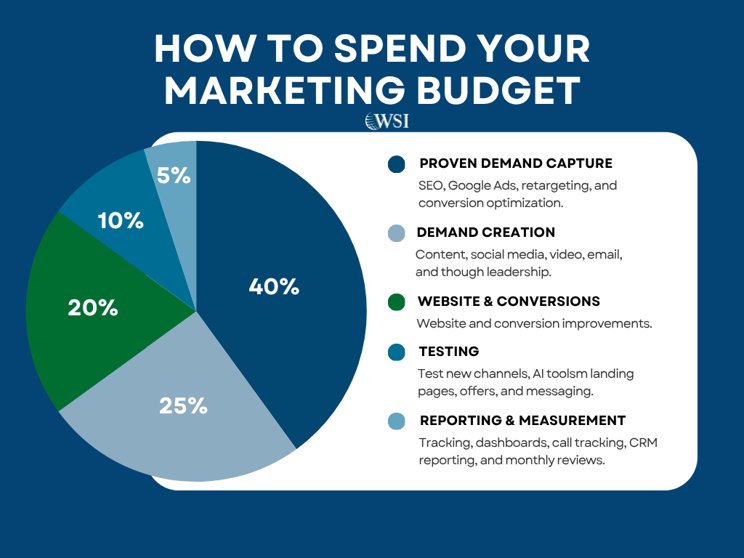
1. 40% to proven demand capture
Use this for SEO, Google Ads, retargeting, and conversion optimization. These channels target people already looking for your product or service.
2. 25% to demand creation
Use this for content, social media, video, email, and thought leadership. This builds awareness before buyers are ready to purchase.
3. 20% to website and conversion improvements
Your traffic budget is wasted if your website is slow, unclear, hard to use, or not accessible.
4. 10% to testing
Test new channels, AI tools, landing pages, offers, and messaging. Keep what works. Stop what does not.
5. 5% to reporting and measurement
Set up tracking, dashboards, call tracking, CRM reporting, and monthly reviews. You need to know what creates leads and sales.
If Your Budget Is Tight: Focus on High-Intent Opportunities
When the budget is limited, efficiency becomes the priority.
In most cases, the strongest starting point is the lower half of the funnel—where buyers are already searching, comparing, and preparing to act.
That typically includes:
- Website performance and conversion clarity
- Reviews and reputation signals
- SEO for high-intent searches
- Paid search campaigns targeting ready-to-buy queries
These areas tend to produce measurable outcomes and clearer attribution, which helps guide future investment decisions.
As Budget Increases: Expand Into Demand Generation
Once your conversion foundation is performing well, expanding into awareness becomes more effective.
At this stage, marketing starts to influence how buyers think before they’re ready to purchase.
This can include:
- Display and video campaigns
- Native and educational content
- Email nurturing
- Select offline channels, depending on your market
These channels often work over a longer timeframe, but they play an important role in shaping preference and recognition.
Consistency across messaging becomes increasingly important here. Buyers will encounter your brand in multiple places before making a decision.
How the Funnel Works Together
A helpful way to think about this is as a pipeline:
- Top of Funnel: Builds awareness and familiarity
- Middle of Funnel: Educates and differentiates
- Bottom of Funnel: Converts demand into revenue
When these stages are aligned, performance improves across the board:
- Conversion rates increase
- Cost per acquisition stabilizes
- Growth becomes more predictable
How to Measure Marketing ROI

Formula:
Marketing ROI = (Revenue from marketing minus marketing cost) ÷ marketing cost × 100
Besides tracking revenue, you should also be tracking:
- Cost per lead
- Cost per sale
- Lead-to-sale conversion rate
- Average order value
- Customer lifetime value
- Sales cycle length
- Channel performance
- Repeat purchases
- Marketing-sourced revenue
For better accuracy, connect your website, CRM, call tracking, ad platforms, and analytics tools.
This helps you see which campaigns create real customers, not only clicks or form fills.
Deciding What’s Right for Your Business
There’s no universal percentage that guarantees results. But a few questions can help guide your decision:
How Quickly Do We Want to Grow?
Faster growth typically requires earlier and more sustained investment.
How Competitive Is Our Space?
Higher competition often increases the cost of visibility and acquisition.
How Well Is Our Current Funnel Performing?
If conversion rates or lead quality are inconsistent, improving efficiency may have a bigger impact than increasing spend.
Before increasing the budget, it’s worth reviewing:
- Conversion performance
- Lead quality
- Sales process efficiency
Improvements in these areas often unlock better returns from the same level of investment.
A Practical Way to Phase Your Investment
Most businesses evolve their marketing investment in stages:
- Early stage: Focus on conversion and capturing high-intent demand
- Growth stage: Expand into content, retargeting, and nurturing
- Scaling stage: Invest across the full funnel, including brand visibility
Each stage builds on the previous one, which is why skipping ahead often creates inefficiencies.
A More Useful Way to View Marketing Investment
Marketing becomes more effective when it’s approached as an integrated part of the business rather than a standalone function.
When the strategy, channels, and measurement are aligned, it supports:
- More consistent pipeline generation
- Better visibility into performance
- Improved customer value over time
The structure behind the investment is what drives results.
Common Budget Pitfalls
A few patterns tend to show up across industries:
- Investing in visibility before improving conversion
- Spreading budget across too many channels at once
- Limited tracking or unclear attribution
- Reactive decisions, like cutting spending during slow periods
- Following competitors without a clear strategy
In most cases, the issue isn’t effort—it’s a lack of structure behind it.
Examples of a Marketing Budget
1: Small Local Business, Monthly Budget: $2,500
- SEO and Google Business Profile: $700
- Google Ads: $800
- Social media content: $400
- Website updates and maintenance: $300
- Email marketing: $100
- Reporting and analytics: $200
2: Mid-Sized B2B Company, Monthly Budget: $10,000
- SEO and content marketing: $3,000
- Google Ads and LinkedIn Ads: $3,500
- Website conversion improvements: $1,500
- Marketing automation and email nurturing: $1,000
- Video and case study production: $500
- Reporting and CRM integration: $500
3: eCommerce Business, Monthly Budget: $25,000
- Google Shopping and paid search: $8,000
- Meta and TikTok ads: $7,000
- SEO and product content: $3,000
- Influencer partnerships: $2,000
- Email and SMS campaigns: $2,000
- Conversion rate optimization: $2,000
- Analytics and attribution tools: $1,000
What a Smart Marketing Investment Actually Looks Like
For most small and mid-sized businesses:
- 5%–8% supports steady, efficiency-focused growth
- 8%–15% supports expansion and increased competitiveness
- 15%–20%+ supports faster growth and broader market presence
This range gives you a starting point. From there, performance is shaped by how effectively your investment is aligned to:
- Clear growth objectives
- A structured marketing funnel
- Ongoing measurement and optimization
How to Manage Your Marketing Spend
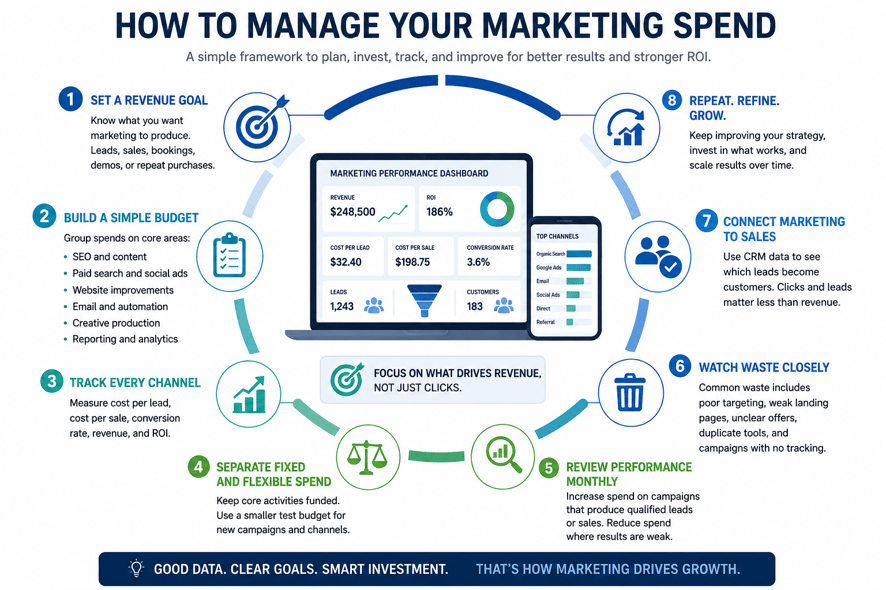
1. Set a revenue goal
Know what you want marketing to produce. Leads, sales, bookings, demos, or repeat purchases.
2. Build a simple budget
Group spends on core areas:
- SEO and content
- Paid search and social ads
- Website improvements
- Email and automation
- Creative production
- Reporting and analytics
3. Track every channel
Measure cost per lead, cost per sale, conversion rate, revenue, and ROI.
4. Separate fixed and flexible spend
Keep core activities funded. Use a smaller test budget for new campaigns and channels.
5. Review performance monthly
Increase spend on campaigns that produce qualified leads or sales. Reduce spend where results are weak.
6. Watch waste closely
Common waste includes poor targeting, weak landing pages, unclear offers, duplicate tools, and campaigns with no tracking.
7. Connect marketing to sales
Use CRM data to see which leads become customers. Clicks and leads matter less than revenue.
Making Your Marketing Investment Work Smarter
If your current spend feels unclear or inconsistent, start by stepping back and looking at how your marketing is working today.
Where is demand coming from?
Where are leads dropping off?
Which parts of your funnel are pulling their weight—and which need attention?
Those answers will give you a clearer direction than any benchmark.
From there, you can decide where to invest next and how to structure your marketing to support the kind of growth you’re aiming for.
Having that structure in place is often the difference between consistent growth and unpredictable results.
If you’d like a second perspective, the WSI team can help you map your current marketing, identify gaps, and prioritize where your investment will have the most impact.