
Key Highlights
- The first inquiry is no longer the starting line: Treat every new lead as someone who may already have a shortlist, objections, and internal decision criteria in place.
- Lead nurturing protects the intent you already earned: Build follow-up around momentum, so prospects do not go quiet after raising their hand.
- Uncertainty is the real conversion barrier: Use proof, implementation clarity, and risk-reduction messaging to answer the questions buyers may not say out loud.
- Sales conversations start before the sales call: Give prospects useful context early so your team can spend less time explaining basics and more time discussing fit, priorities, and outcomes.
- Proof needs timing, not just placement: Share case studies, customer examples, checklists, and implementation guidance when they match the buyer’s current concern.
- Lead volume is only part of the growth picture: Review where qualified prospects slow down, what follow-up they receive, and whether nurturing is improving sales-ready conversations.
- Connected follow-up supports sustainable growth: Align demand generation, inquiry handling, nurture content, and sales activity so more qualified leads move from interest to revenue.
A lead inquiry used to mark the beginning of the buying journey. Now it often arrives much closer to the decision.
Today’s buyers do their homework early. They compare providers, read reviews, explore solutions, and build shortlists before they ever speak to sales. By the time they fill out a form or request a proposal, they often know what they want and what questions still need answers.
That changes how lead nurturing works.
Getting a prospect’s attention is expensive. Losing it after they raise their hand is even more costly.
For growth-focused businesses, lead nurturing now plays a different role. It is less about introducing the problem or explaining the basics. It is about helping informed buyers reduce uncertainty, validate their choices, and move forward with confidence.
This is where trust carries more weight than information volume.
A strong nurturing strategy keeps that momentum moving. It addresses the questions, objections, and decision criteria that shape the next step. It also helps businesses generate more value from the demand they already create through marketing, referrals, networking, and sales activity.
Research from Gartner shows that B2B buyers spend only a small part of their buying journey meeting with potential suppliers directly. Most evaluations happen independently, long before a sales conversation begins. That makes the post-inquiry experience more important than many businesses realize.
When Buyers Know the Basics, Nurturing Has a New Job
Prospects rarely arrive with a blank slate anymore. They may already understand the problem, the available solution options, the providers worth comparing, and the questions they need answered before making a decision.
That means lead nurturing cannot rely on introductory education alone.
Well-informed prospects usually need help with a different set of questions:
- Can this business deliver the outcomes we need?
- What will implementation involve?
- What level of investment and internal commitment will be required?
- How will risk be managed?
- What proof shows this approach has worked before?
AI is making it easier to capture attention, but attention fades quickly without a clear follow-up path. Our piece on AI-powered lead generation covers the demand side of that equation. Lead nurturing is the next step: keeping informed prospects engaged, supported, and confident enough to move forward.
When a prospect has already researched their challenge and then reaches out, they are showing meaningful intent. The opportunity is not to overwhelm them with more content. It is to help them make sense of what they already know and see why your business is the right fit.
Why Informed Buyers Still Hesitate
Information does not remove risk. Informed buyers are not always easier to convert. Sometimes they are harder, because they arrive with stronger opinions, more comparisons, and a clearer sense of what could go wrong.
A prospect can understand the problem, know the available options, and still pause before moving forward. That pause is usually where the real buying decision happens.
They are weighing cost, timing, internal effort, stakeholder approval, and the risk of choosing the wrong partner. Another guide, checklist, or overview will not solve that alone.
Lead nurturing has to do a more strategic job here. It needs to help buyers organize what they know, pressure-test their assumptions, and see a clear path from interest to action.
Confidence Is the Real Conversion Barrier
When an informed buyer slows down, they are often asking questions they may not say out loud:
- Will this work for our business?
- What will this require from our team?
- How soon will we know if it is working?
- Can I defend this investment internally?
- What happens if we choose the wrong partner?
Effective nurturing answers those questions before doubt turns into delay.
That means proof should appear before the proposal. Implementation expectations should be clear before the sales call. Case studies should match the buyer’s situation, not sit buried on a separate page.
The goal is to reduce uncertainty at every stage, so buyers can move forward with more confidence.
How Lead Nurturing Improves Sales Performance
Lead nurturing is often treated as a marketing follow-up task. That misses its bigger business role.
Done well, nurturing improves the quality of the opportunities entering your sales process. It helps prospects self-qualify, reduces repeated sales explanations, and gives your team better signals about who is ready for a serious conversation.
This is also where nurturing connects directly to a stronger lead generation and sales strategy. The goal is not only to create more inquiries. It is to turn more of the right inquiries into revenue.
Better Sales Conversations Start Before the Sales Call
Every touchpoint before a sales conversation shapes the quality of that conversation.
When prospects have already seen relevant proof, understood your approach, and worked through common concerns, sales teams can spend less time covering basics and more time discussing fit, priorities, and outcomes.
Effective nurturing supports sales growth in four practical ways:
- Higher-quality opportunities: Prospects can assess whether your services match their needs before taking the next step.
- Improved sales efficiency: Sales conversations become more focused because common questions have already been addressed.
- Stronger buyer confidence: Credibility builds across multiple touchpoints instead of relying on one sales call to do all the work.
- Better pipeline performance: Sales teams spend more time with qualified, engaged buyers and less time chasing poor-fit leads.
For business owners, that means stronger return from the demand they are already paying to create.
What Effective Lead Nurturing Looks Like in Practice
Good nurturing does not mean sending more emails.
It means giving the buyer the right proof, context, and next step at the moment they need it. Every touchpoint should reduce uncertainty or make the next decision easier.
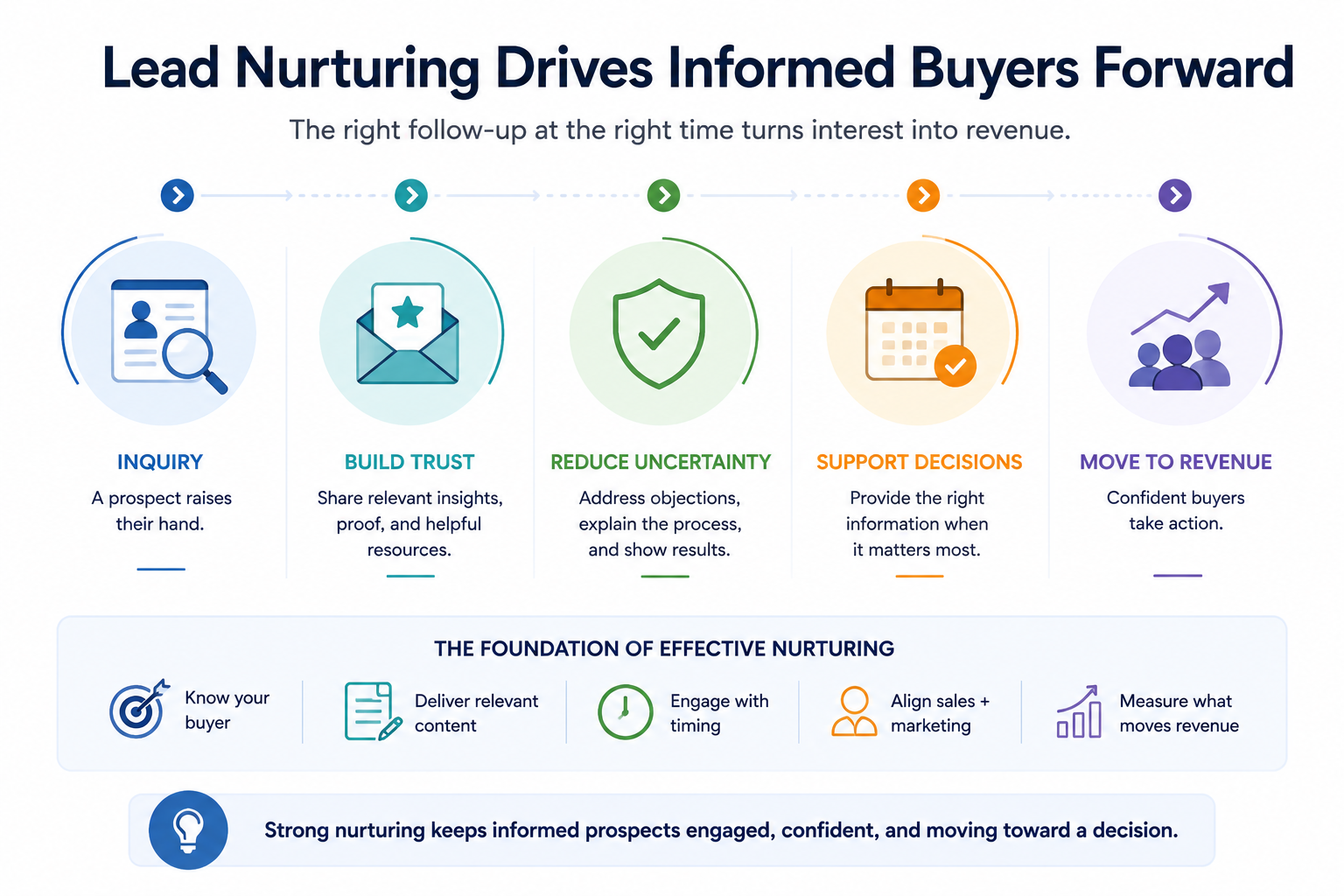
Match the Proof to the Buyer’s Doubt
Different moments require different types of support:
- Case studies: Use when buyers need evidence that similar businesses achieved measurable results.
- Customer success stories: Use when buyers need reassurance that others with similar challenges made the right choice.
- Expert insights: Use when buyers are still shaping their point of view and need practical guidance.
- Decision-support resources: Use when buyers need to compare options, estimate ROI, plan implementation, or build internal approval.
The timing matters.
A case study sent after a pricing question can build confidence. A planning checklist before a sales call can make the conversation more useful. An implementation guide can reduce anxiety before a proposal review.
Strong nurturing feels helpful because it responds to what the buyer is likely thinking next.
Take a managed IT provider speaking with a manufacturing company about cybersecurity support. The operations director has already researched vendors, understands the risks, and has shortlisted a few options before making contact. After the first conversation, the process slows.
The delay may have less to do with interest and more to do with internal questions: How disruptive will implementation be? Will this create downtime? How quickly can vulnerabilities be addressed?
A simple nurture sequence could look like this: first, respond with a clear recap of the buyer’s challenge and next step. Then share proof that matches their situation, such as a relevant case study or customer example. Before the next sales conversation, send a short implementation overview or planning checklist so the buyer knows what moving forward would involve. After the call, follow up with answers to the objections or stakeholder questions that surfaced.
The point is not to automate every interaction. It is to make each touchpoint useful enough to protect momentum.
How to Find Gaps in Your Lead Nurturing Strategy
Lead generation metrics often get the executive spotlight. Lead nurturing deserves the same attention because it directly affects conversion rates, sales efficiency, and pipeline quality.
HubSpot’s 2026 marketing data shows the same shift in measurement: lead quality and marketing-qualified leads are the top success metric for marketers, ahead of conversion rate, ROI, customer acquisition cost, and lead volume. That reinforces the point: growth teams need to look at the quality and progression of leads, not just how many enter the pipeline.
In many growth-focused businesses, lead volume is often the first thing under review when revenue slows. The bigger issue is often what happens after inquiry.
The best place to start is by reviewing what prospects receive after they first engage.
Does your follow-up help them make a better decision, or does it repeat what they already know?
Questions That Reveal Where Momentum Breaks
Ask:
- Are prospects receiving content that supports evaluation, or only introductory information?
- Do follow-ups address common objections before the sales call?
- Are marketing and sales aligned on what buyers need at each stage?
- Where do qualified prospects stop responding or slow down?
- Are nurture activities producing more sales-ready conversations?
- Which content actually helps move opportunities forward?
Open rates and clicks can be useful signals, but they are not the final measure. The stronger question is whether nurturing is helping the right prospects move closer to revenue.
Building a Lead Nurturing Strategy That Supports Sustainable Growth
Lead nurturing works best when it is connected to the full growth system: how demand is created, how inquiries are handled, how sales teams follow up, and how buyers are supported through decision-making.
When those pieces work together, businesses get more value from the demand they already create. They also give informed prospects a clearer, more confident path from first inquiry to revenue.
The opportunity is not always to chase more leads. Often, it is to stop losing the qualified ones already showing intent.
If your business is generating interest but too many qualified leads are slowing down before the sale, it may be time to look beyond lead volume. A stronger follow-up strategy can improve conversion, strengthen pipeline quality, and create more value from the demand you already generate. Connect with a WSI Consultant to build a lead generation and nurturing strategy designed for sustainable growth.