
Key Highlights
- How AI is used in financial services and why it matters for growth
- The core benefits of AI include efficiency, accuracy, and better decision-making
- Key challenges financial institutions face when adopting AI
- Real-world AI applications in banking, lending, and compliance
- How AI is reshaping customer experience and personalization
- The role of AI in fraud detection and risk management
- How AI supports digital marketing in the finance industry
- What AI means for jobs and human expertise in finance
- Practical steps to start using AI in your financial business
- How to measure the impact of AI on performance and ROI
AI in the finance industry is a very transformative process. It makes processes more efficient, helps people make better decisions, and changes how customers interact with businesses.
In this blog post, we discuss how AI for financial services is changing the finance industry and explore AI-driven digital marketing strategies for the finance industry.
What is AI in Finance?

AI and finance refer to the use of artificial intelligence technologies to improve how financial services operate, make decisions, and serve customers.
In simple terms, it means using machines to analyze data, learn patterns, and automate tasks that were traditionally done by humans.
|
AI is no longer optional in finance. It directly impacts speed, accuracy, and customer expectations. Businesses that delay adoption risk falling behind competitors who are already using AI to improve performance. |
Benefits of AI in the Financial Industry: Increases Efficiency and Accuracy
Artificial intelligence in the finance industry has opened the door to many benefits, from assessing risk and finding scams to customer service and conversational AI in banking. Using machine learning algorithms and natural language processing in finance, financial institutions can automate processes, analyze vast amounts of data, and gain valuable insights in real time. AI helps make accurate predictions, improve investment choices, and improve risk management. This makes it easier for finance professionals to make decisions quickly based on data.
|
AI helps reduce operational costs, improve decision speed, and increase customer engagement. The biggest gains come from combining automation with better data insights. |
Possible Challenges of AI in the Finance Industry
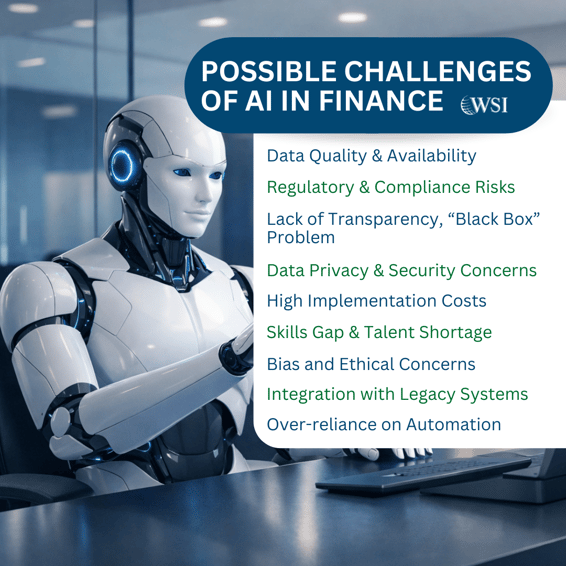
AI brings clear benefits to finance, but it also creates real challenges that businesses need to manage carefully. If you ignore these, you risk compliance issues, poor decisions, or loss of customer trust.
Here are the key challenges and what they mean in practice:
1. Data Quality and Availability
AI depends on data. If the data is incomplete, outdated, or biased, the output will be unreliable.
Common issues:
- Inconsistent data across systems
- Missing historical data
- Poor data governance
Business impact:
Bad data leads to wrong predictions, poor credit decisions, and inaccurate reporting.
What to do:
Clean and structure your data first. Build a clear data management process before introducing AI.
2. Regulatory and Compliance Risks
Finance is heavily regulated. AI adds complexity because decisions are often automated and harder to explain.
Challenges:
- Meeting financial regulations
- Ensuring transparency in AI decisions
- Handling customer data responsibly
Business impact:
Non-compliance can result in fines, legal action, and reputational damage.
What to do:
Work with compliance teams early. Ensure AI systems can explain decisions clearly, especially in lending or risk scoring.
3. Lack of Transparency, “Black Box” Problem
Some AI models make decisions that are difficult to interpret.
Example:
A loan application gets rejected, but the system cannot clearly explain why.
Business impact:
- Loss of customer trust
- Difficulty in audits and regulatory reviews
What to do:
Prioritize explainable AI. Choose models that provide clear reasoning behind decisions.
4. Data Privacy and Security Concerns
Financial data is highly sensitive. AI systems increase the amount of data being processed and stored.
Risks:
- Data breaches
- Misuse of personal financial data
- Cyberattacks targeting AI systems
Business impact:
Loss of customer trust and potential legal penalties.
What to do:
Strengthen cybersecurity. Follow strict data protection standards like POPIA or GDPR equivalents.
5. High Implementation Costs
AI is not cheap to implement correctly.
Costs include:
- Technology and tools
- Skilled talent
- Integration with existing systems
Business impact:
Poor planning can lead to high costs without clear returns.
What to do:
Start small. Focus on one use case with measurable ROI, such as fraud detection or customer support automation.
6. Skills Gap and Talent Shortage
AI requires specialized skills that many financial institutions lack.
Challenges:
- Shortage of AI experts
- Difficulty training existing teams
- Dependence on external vendors
Business impact:
Slow adoption and poor implementation.
What to do:
Invest in training or partner with experienced consultants. At WSI, this is where guided AI adoption adds value.
7. Bias and Ethical Concerns
AI systems can inherit bias from training data.
Examples:
- Biased credit scoring
- Discriminatory lending decisions
Business impact:
Legal risk and brand damage.
What to do:
Audit AI models regularly. Ensure fairness and ethical use of data.
8. Integration with Legacy Systems
Many financial institutions rely on outdated systems.
Challenges:
- Compatibility issues
- Data silos
- Slow implementation
Business impact:
Delays and increased costs.
What to do:
Plan integration carefully. In some cases, gradual system upgrades are necessary.
9. Over-reliance on Automation
AI can improve efficiency, but too much reliance can be risky.
Risks:
- Reduced human oversight
- Blind trust in AI outputs
Business impact:
Errors can scale quickly without human checks.
What to do:
Keep human review in critical decisions like lending or large transactions.
What This Means for Your AI Finance Industry Strategy
AI in finance works best when it is:
- Introduced step by step
- Aligned with business goals
- Monitored continuously
From a WSI perspective, the focus should be on measurable outcomes:
- Cost reduction
- Improved conversion rates
- Better customer experience
If you want, I can map these challenges to a specific business type like a bank, fintech startup, or insurance company and show how to handle them in your market.
|
Many institutions invest in AI before fixing their data. Poor data quality leads to poor results. Always start with clean, structured data before scaling AI. |
How AI Is Shaping the Future of Banking
AI is revolutionizing the financial services industry, reshaping how banking services are delivered and enhancing customers' banking experiences. By leveraging machine learning and AI, financial institutions can analyze vast amounts of financial data to identify patterns and trends, improving decision-making and efficiency.
Examples of artificial intelligence in banking include generative AI models that streamline document processing for tasks like loan approvals and customer onboarding. These AI tools improve the speed and accuracy of operations while reducing errors, offering a seamless experience for both customers and banks.
Furthermore, AI systems enable financial institutions to provide tailored products and services by analyzing personal finance data and social media activity. This personalization fosters deeper customer engagement and loyalty. For financial firms, AI capabilities like investment research and market data analysis help uncover new investment opportunities and adapt to changing market conditions.
AI also enhances traditional banking by enabling intuitive and secure online banking experiences. As banks continue embracing AI, they can offer smarter, faster, and more secure banking services, transforming how customers achieve their financial goals.
AI Applications in Financial Services
Here are the most important AI applications in financial services and how they work in practice:
Fraud Detection and Prevention

AI monitors transactions in real time and flags unusual patterns.
How it’s used:
- Detect suspicious card transactions
- Identify account takeovers
- Monitor login behavior
Business value:
- Reduces fraud losses
- Builds customer trust
- Speeds up response times
WSI insight:
You can connect fraud insights with customer communication. For example, trigger instant alerts or automated responses that improve user experience while protecting accounts.
Credit Scoring and Risk Assessment

AI evaluates a customer’s ability to repay loans using more than just credit history.
How it’s used:
- Analyze spending behavior
- Assess income patterns
- Use alternative data sources
Business value:
- More accurate lending decisions
- Faster approvals
- Expanded access to credit
WSI insight:
This is a strong area for personalization. You can align lending offers with user behavior and lifecycle stage to improve conversion rates.
Algorithmic Trading
AI systems analyze market data and execute trades automatically.
How it’s used:
- High-frequency trading
- Portfolio optimization
- Market trend analysis
Business value:
- Faster execution
- Reduced human error
- Ability to act on real-time signals
Note:
This requires strict risk controls and ongoing monitoring.
Chatbots and Virtual Assistants

AI-powered chatbots handle customer interactions 24/7.
How it’s used:
- Answer account questions
- Assist with transactions
- Provide financial guidance
Business value:
- Lower support costs
- Faster response times
- Improved customer satisfaction
WSI insight:
AI chatbots should be trained on your actual customer queries. This improves accuracy and increases conversion from support interactions.
Personalized Financial Advice

AI analyzes user data to provide tailored recommendations.
How it’s used:
- Budgeting tips
- Investment suggestions
- Savings plans
Business value:
- Higher engagement
- Increased product uptake
- Better customer retention
WSI insight:
Tie this to your content strategy. Personalized insights can be delivered through email, apps, or dashboards to drive ongoing engagement.
Regulatory Compliance and Reporting (RegTech)

AI helps automate compliance processes and detect risks.
How it’s used:
- Monitor transactions for compliance
- Automate reporting
- Detect suspicious activity
Business value:
- Reduced compliance costs
- Lower risk of fines
- Faster audits
Process Automation (RPA + AI)
AI enhances robotic process automation by adding decision-making ability.
How it’s used:
- Process loan applications
- Handle document verification
- Automate onboarding
Business value:
- Faster operations
- Reduced manual errors
- Lower operational costs
Customer Segmentation and Marketing Optimization

AI helps financial institutions understand and target customers more effectively.
How it’s used:
- Segment users based on behavior
- Predict churn
- Optimize ad targeting
Business value:
- Higher campaign performance
- Better lead quality
- Increased conversions
WSI insight:
This is where AI directly connects to digital marketing. You can:
- Improve paid ad targeting
- Personalize landing pages
- Optimize email campaigns
Anti-money Laundering (AML)
AI identifies complex patterns linked to money laundering activities.
How it’s used:
- Monitor large transaction networks
- Detect unusual financial flows
- Flag high-risk accounts
Business value:
- Stronger compliance
- Reduced investigation time
- Improved accuracy
| If you need quick wins, focus on fraud detection, chatbots, and marketing optimization. These areas typically deliver faster returns and measurable impact. |
The Future of AI in the Financial Industry
AI is a big part of the future of finance, and many things could happen. As AI technology improves, the finance industry will use more predictive analytics, machine learning algorithms, and algorithmic trading systems. AI-powered virtual assistants will be everywhere, giving people personalized financial advice and making it easier for them to make difficult financial choices. Using AI in banking will change the industry and give businesses and customers more power.
AI and the Digital Transformation of Corporate Finance
The use of AI is radically changing corporate finance. AI-powered solutions streamline financial processes, automate repetitive tasks, and enable accurate budgets and forecasts. From accounts payable and receivable to financial reports and compliance, AI makes complicated financial tasks more accessible, reducing mistakes and making the whole process more efficient. Using AI in business finance helps organizations be more flexible, save money, and make better decisions.

What AI Will Mean for Jobs in Finance
AI brings a wave of automation and efficiency, but people need to figure out how it will affect jobs in the finance field. AI may automate some routine tasks, but it will also create new jobs requiring advanced data analysis skills, algorithm creation, and making decisions that are good for the long run. AI is a powerful tool that can help finance professionals improve their skills and focus on high-value jobs, innovation, and driving business growth.
The Future of Working Together: AI and Human Expertise
AI in financial services doesn't replace human expertise; instead, it adds to it, making it easier for professionals to make better choices. When AI and human experts work together, they form a synergy that uses the best parts of both, which leads to better results. Human judgment, critical thinking, and ethical considerations are still critical in finance. This ensures that AI technology is used responsibly.
Strategies for Digital Marketing in the AI-Driven Finance Industry
With the rise of AI in corporate finance, the finance business is going through a significant change. As AI keeps changing different parts of finance, digital marketers must change their strategies to take advantage of AI's power and stay ahead of the competition. In the AI-driven finance business, here are some key digital marketing strategies:
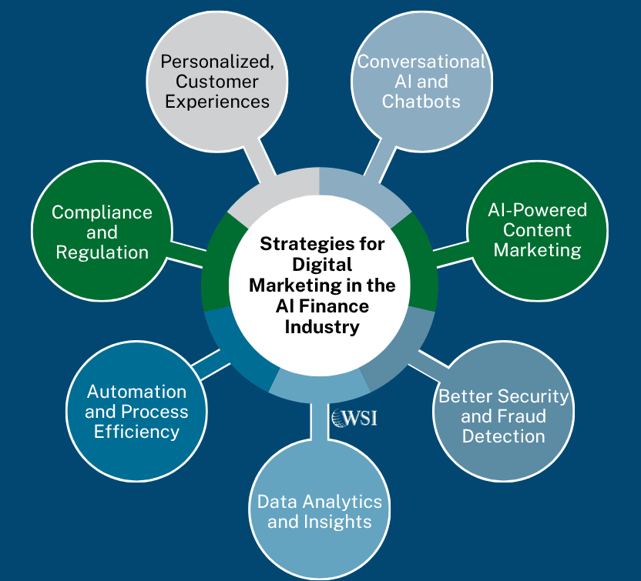
Personalized Customer Experiences:
Artificial intelligence (AI) lets financial institutions collect and analyze vast amounts of customer data, which makes it possible to run personalized marketing campaigns. Using AI algorithms, digital marketers can offer customized content, product suggestions, and targeted ads based on what customers like and how they act. Personalization makes customers more interested, boosts sales rates, and encourages them to stay loyal over time.
Conversational AI and Chatbots:
Using conversational AI on financial websites or mobile apps can improve customer service and participation. Chatbots can help customers with questions about their accounts, give financial tips, and offer support around the clock. The conversational interfaces that AI powers improve the customer experience, save time, and let financial institutions handle more customer questions more effectively.
AI-Powered Content Marketing:
AI can be used to find insights based on data and popular themes in the finance industry. Using AI algorithms, digital marketers can make content that their target audience finds interesting and valuable. AI can also help optimize material for search engines, bringing more people to a website and making it more visible.
Better Security and Fraud Detection:
Cybercriminals constantly threaten the financial business. AI-powered fraud detection can help improve security by identifying trends, outliers, and possible fraud or security breaches. Digital marketers can use these advanced security measures to build customer trust and credibility in their marketing efforts.
Data Analytics and Insights:
AI allows for advanced data analytics, which gives digital marketers a deep understanding of how customers act, how the market is changing, and how their competitors are doing. By using AI algorithms, marketers can gain valuable insights, make data-driven decisions, and improve their marketing strategies for the best results.
Automation and Process Efficiency:
Marketing tasks like developing leads, running email campaigns, and managing social media can be made easier with automation that AI drives. Digital marketers can save time and money by using automated systems to divide customers into groups, schedule personalized emails, and analyze campaign success. Automation also gives marketers more time to work on strategic and artistic projects.
Compliance and Regulation:
There are a lot of laws and regulations in the finance business, so digital marketers need to ensure their campaigns follow legal and compliance laws. AI can help monitor marketing activities, flag possible legal problems, and ensure that all marketing efforts follow the industry's rules.
| AI improves targeting, personalization, and campaign performance. The biggest opportunity is using customer data to deliver relevant messaging at the right time. |
Contact Us for Help With AI in the Finance Industry!
AI is changing the finance industry, making operations more efficient, and giving businesses the tools they need to thrive in a digital world. As AI improves, people in finance must realize its potential and change their digital marketing strategies to take advantage of AI-driven insights. The future of banking lies in the smooth integration of AI technologies, which will make things faster, more accurate, and more personal for customers.
WSI is here to help you unlock your business potential with our tailored AI Consulting Services. Contact WSI to learn how our AI-driven digital marketing experience can help your finance business stay ahead of the curve in a changing market. Stay ahead with AI in the finance industry today.