
Key Highlights
- AI is accelerating content production across channels. Businesses can now publish blogs, emails, and posts in hours instead of days.
- More content is not improving pipeline performance. Many teams are seeing flat lead quality and slower conversion despite higher output.
- Buyers are comparing options before reaching out. They rely on content to assess credibility, expertise, and fit early in the process.
- AI-generated content often lacks signals that drive decisions. It explains services but misses customer context, objections, and proof.
- The 80/20 model improves content effectiveness. AI supports speed while human input adds insight, examples, and positioning.
- Content that includes real scenarios performs better. Examples, opinions, and outcomes help reduce uncertainty and build trust.
- Structured workflows improve consistency and results. Aligning content with customer questions and sales insights increases business impact.
AI can now produce content at a speed most businesses could not match a year ago. Blogs, emails, and social posts can be created in hours.
The impact is not showing up in your pipeline.
Many businesses are publishing more content and seeing little change in inquiries, lead quality, or sales conversations. In some cases, performance declines. Content looks consistent, but it sounds interchangeable. Buyers scan it, move on, and choose a competitor who feels clearer and more credible.
This gap is becoming more visible as AI search and Google updates prioritize businesses that demonstrate real expertise. Content that reads like a summary rarely builds trust or moves someone to act. The better move is to publish content that reflects how your business thinks, solves problems, and delivers outcomes.
A structured AI content strategy allows you to scale production while protecting what drives conversion. AI handles the heavy lifting. Your team adds the insight that makes the content worth acting on.
AI Content Is Everywhere. Most of It Sounds the Same.
AI has lowered the barrier to producing content. The result is volume across every industry.
When multiple businesses use similar prompts, structures, and datasets, the output starts to converge. Topics are covered. Points are accurate. The content is easy to produce.
It is also easy to ignore.
In recent Google updates focused on helpful content and experience signals, content without a clear point of view or supporting proof has seen declining visibility and engagement. Businesses that rely on templated or AI-heavy output often see stable traffic but weaker lead quality and fewer meaningful opportunities. (See our breakdown of Google’s March 2026 Core Update for more.)
In many cases, this does not show up as a traffic problem. It shows up in weaker leads, longer sales cycles, and more time spent on prospects who never convert.
This creates a practical problem. If your content looks like every other option a buyer is reviewing, it does not help them decide. It adds to the noise.
Buyers are comparing faster, often before they contact you. They are looking for signals that your business understands their situation and can deliver results. If those signals are missing, they move on.
Why Buyers Still Choose People, Not Content
AI can provide accurate information, but your customers don't choose you based on information alone. They choose based on trust.
Trust comes from feeling understood. Customers want to know they're dealing with people who recognize their situation and can deliver the right outcome. Research supports this—nearly 9 in 10 consumers value authenticity when choosing a brand, and most can quickly spot content that feels impersonal. According to Nosto, 88% of consumers say authenticity is a key factor in persuasive content.
AI can clearly and logically describe your services. But even when the information is accurate, it often sounds generic because it's built on patterns, not lived experience. It doesn't reflect the concerns your customers raise, the objections you handle, or the details that reassure someone they're making the right decision.
That context comes from you. When your content draws from customer conversations, proven outcomes, and first-hand expertise, it becomes more credible. It reads as if it comes from someone who has done the work, not just summarized it. That tone builds trust faster, especially when customers are already filtering out anything that feels automated.
This directly affects pipeline quality and conversion.
When content reflects real customer situations, objections, and outcomes, it reduces uncertainty earlier. Prospects arrive with clearer expectations. Sales conversations move faster. Close rates improve because trust is established before the first interaction.
When that layer is missing, sales teams spend more time qualifying weak-fit leads or rebuilding confidence that content should have created.
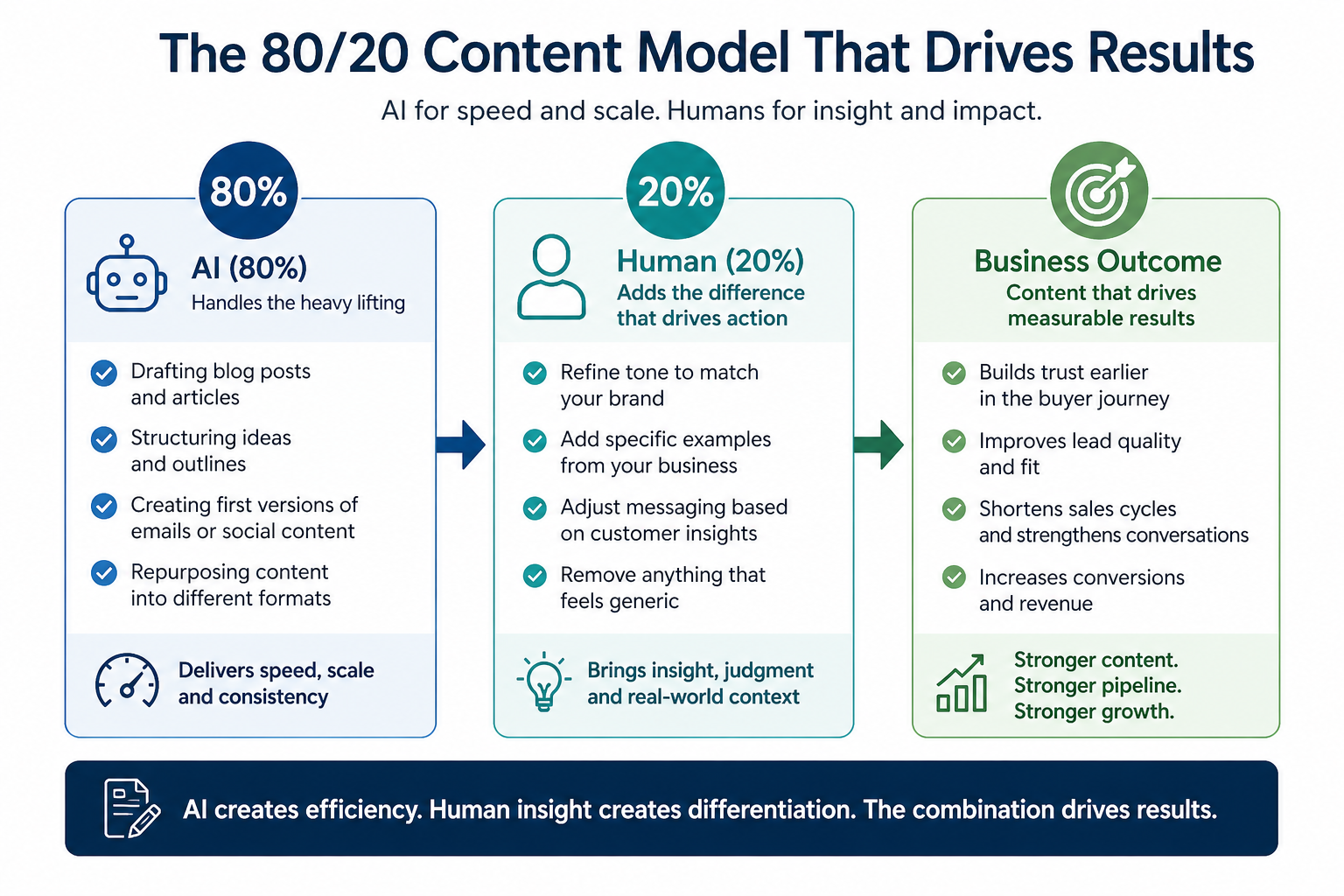
The 80/20 Model: Where AI Stops and Your Advantage Starts
The most effective approach is not all-human or all-AI. It's a hybrid model where each does what it does best.
AI handles the first 80%. This includes:
-
Drafting blog posts and articles
-
Structuring ideas and outlines
-
Creating first versions of emails or social content
- Repurposing content into different formats
This gives you speed and consistency. You can produce more content, stay visible, and cover more topics without stretching your resources. Businesses using AI are producing content significantly faster, and in many cases, reducing production costs.
The remaining 20% is where the real value comes in. This is where content is shaped to:
-
Refine tone to match your brand
-
Add specific examples from your business
-
Align messaging with customer insights
- Remove anything that feels generic
That final layer transforms content from "good enough" into something that drives action. It turns accurate but generic material into a clear expression of your expertise. Without that 20%, content may inform—but it rarely converts.
In practice, the 80/20 model works when it is tied to commercial outcomes, not just content production.
At WSI, we see the difference clearly. Businesses that apply this approach to core topics often reduce content production time while improving engagement and lead quality. The shift comes from aligning content with how buyers evaluate options, not just how topics are explained.
AI helps you stay visible. The human layer helps you get chosen.
For example, an AI-generated blog might explain a service clearly. But when you add a short story about solving a specific customer problem or highlight a common mistake you see, it becomes far more persuasive.
This model works because it balances efficiency with authenticity.
We've applied this approach with clients. A B2B services company used AI to produce weekly drafts, then layered in insights from sales conversations and client work. Within a few months, engagement improved, and qualified inquiries increased because the content addressed real concerns, not just general topics.
What This Looks Like in Practice
Here is the difference in practical terms:
The Rules That Keep AI Content Consistent and On-Brand
If you're going to use AI at scale, you need consistency. Without it, your content can quickly lose direction—different tones, mixed messages, and no clear identity.
You can solve this with a set of editorial guardrails, simple rules that guide how your content should sound and what it should focus on. They don't need to be complex, but they do need to be clear.
Start with tone:
-
Are you direct and practical, or more conversational?
-
Do you use simple language or industry terms?
- How do you explain complex ideas?
Then define your priorities:
-
Focus on outcomes, not just features
-
Align messaging with real customer needs
- Avoid unnecessary jargon
You can also set structure guidelines:
-
Lead with clear, relevant points
-
Keep paragraphs concise
- Make it easy for readers to take action
Without this structure, AI content becomes a volume exercise. With it, content becomes a system that supports positioning, credibility, and conversion.
For growth-focused businesses, this is where content moves from a marketing activity to a revenue asset.
What Makes Content Convert, Not Just Inform
This is where most AI-led content struggles to drive action.
Consistent publishing only helps when each piece gives buyers a reason to believe you. That belief usually comes from details AI cannot create on its own: customer context, experience, judgment, and proof. The gap is rarely effort. It is a lack of clarity on what makes content persuasive. Often, they know they need to add more human elements to their content, but are unsure what these elements look like in practical terms.
There are a few simple ways to bring that human element into your content:
-
Real examples. Talk about actual situations your customers face. This makes your content more relatable and easier to trust.
-
Clear opinions. AI tends to stay boringly neutral. That's one thing your business should never do. When you take a position—based on your experience—you stand out and build credibility.
-
Specific outcomes. Instead of general statements, highlight real results. This shows customers what they can expect and reduces uncertainty.
-
Natural language. Write the way you speak to customers. Avoid overly polished or robotic phrasing. People respond to clarity, not complexity.
-
Practical guidance. Give readers something they can use immediately. This positions your business as helpful and trustworthy from the first interaction.
It doesn't take much time to add these elements, and they significantly increase the effectiveness of your content. They turn basic information into content a buyer can trust and act on.
A Simple Workflow to Scale Content Without Losing Quality
AI tools such as ChatGPT or Claude can support drafting and ideation. Strong content systems often pull insights from CRM data, sales conversations, and customer feedback. The value comes from how your team reviews, refines, and aligns that output with your business.
Let's put these principles into a workflow that's easy to maintain. A simple structure works best:
Step 1: Plan your content around real customer questions
Start with what your customers actually ask. This ensures every piece of content has a clear purpose.
Step 2: Use AI to create the first draft
Generate a structured, complete version of the content quickly. This removes the biggest time barrier.
Step 3: Apply your editorial guardrails
Review the draft to ensure it aligns with your tone, priorities, and messaging.
Step 4: Add human insights
Include examples, opinions, and practical details that only you can provide.
Step 5: Publish and repurpose
Turn one piece of content into multiple formats—social posts, emails, short videos—to extend its reach.
This workflow reflects how buyers engage with content today. They scan, compare, and form an opinion quickly. When your content is structured, relevant, and grounded in real insight, it supports those decisions.
Over time, this consistency improves how your business is perceived before a sales conversation begins. That has a direct impact on lead quality and conversion.
Is Your AI Content Worth Publishing? Ask These 5 Questions
Before approving AI-assisted content, review it against these:
✅ Does this reflect a real customer situation or just explain a topic?
✅ Is there a clear point of view based on experience?
✅ Would a prospect learn something they could not get from a generic article?
✅ Does this reduce a common objection or uncertainty?
✅ Would this help move a buyer closer to a decision?
If the answer is unclear, the content may add visibility but not value. This is where many content strategies lose efficiency. Output increases, but contribution to pipeline does not.
Scaling Content Without Losing What Drives Growth
AI has made content production easier. It has also made it easier for businesses to blend in. The advantage now comes from how clearly your expertise comes through in your content and how consistently it supports buying decisions.
When content is aligned with real customer questions, supported by experience, and structured for clarity, it starts to influence outcomes. It attracts the right prospects, builds trust earlier, and shortens the path from interest to inquiry.
A structured approach turns AI-assisted content into a repeatable growth system.
At WSI, we help businesses build content systems that connect visibility to revenue. That includes defining where AI adds efficiency, where human insight adds value, and how both support your growth goals.
Get a clear view of how your content is performing and where it is falling short. Book a strategy session with a WSI consultant and build a content approach that supports visibility, trust, and revenue.