Key Highlights
- Priority pages carry more of the buying decision. Service, product and industry pages need enough clarity, proof and commercial context to support evaluation before a sales conversation begins.
- AI visibility depends on information that can be understood and reused. Clear structure, connected pages and accessible content give search platforms stronger signals while making the site easier for buyers to assess.
- Proof works best at the point of doubt. Case studies, credentials, named expertise and customer results are more persuasive when they sit close to the claims they support.
- Technical readiness protects commercial value. Crawlability, mobile performance, accessibility and accurate structured data help prevent strong content from being weakened by avoidable website issues.
- The right measurement goes beyond traffic. Search visibility and AI referrals matter more when they can be connected with qualified inquiries, lead quality and sales opportunities.
- Website investment should follow commercial priority. The strongest place to start is where revenue potential, existing visibility and gaps in the buyer experience intersect.
An AI-ready website makes it easy for search platforms to understand what your business offers and easy for prospective buyers to decide whether you are relevant, credible, and worth contacting.
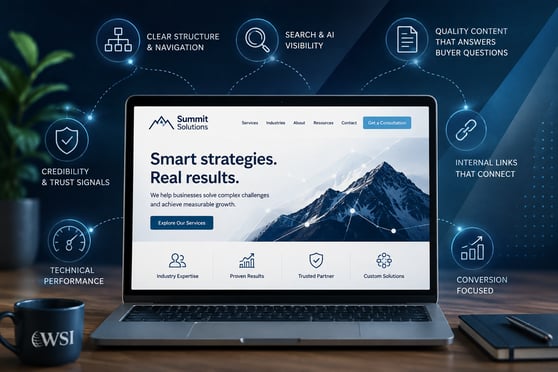
Clear positioning, well-structured service pages, useful internal links, credible proof, crawlable content, strong technical performance, and clear conversion paths all contribute to that readiness.
Open one of your highest-value service pages and look at it as if you have never seen the business before.
Can you quickly tell what the service is, who it is for, what makes the company credible, and what the next step should be?
Search engines and AI platforms are working through a related task. They need enough accessible, specific information to understand the page, connect it with the rest of the website, and determine when it is relevant to a search or question.
That makes AI readiness a website-wide issue spanning structure, content, authority, technical performance, and conversion.
Make Important Information Easy to Find and Use
Search platforms can only work with information they can access and understand. Google’s guidance for generative AI features in Search continues to emphasize many of the same fundamentals that support organic visibility: crawlable pages, original and useful content, clear site structure, internal links and a strong page experience.
Microsoft offers a useful way to think about what has changed. Its guidance on how search indexes are evolving to support AI-generated answers explains that traditional search is largely focused on finding relevant pages, while AI systems also need specific information they can use to support an answer. For a website, that increases the value of information that is clear, current, attributable, and backed by evidence.
Website owners are also getting a better view of whether that information is being surfaced. AI Performance in Bing Webmaster Tools shows citation activity across supported Microsoft AI experiences, including which website pages are being referenced.
OpenAI’s guidance for publishers explains that website content needs to be accessible to OpenAI’s search systems to be eligible for discovery, summaries, and citations in ChatGPT search. Perplexity similarly explains how websites need to remain accessible to its search systems if they want their content surfaced in results.
Important information needs a clear place to live, with related pages connected in ways that make sense to both people and search platforms.
WSI has seen the impact of this approach firsthand. After restructuring its own content to surface key information earlier, strengthen organization, and make evidence easier to find, AI referral traffic increased 290%, and blog traffic increased 32%.
Build Priority Pages Around the Decision They Need to Support
Different pages have different jobs. A homepage needs to orient the visitor quickly. A service page needs to help someone judge fit. A case study needs to prove capability. An industry page needs to connect sector-specific needs with relevant expertise.
That distinction matters because many websites ask one page to do too much, or give commercially important pages too little substance.
On a high-value service page, the first screen should establish the service, who it is relevant to, and the problem or opportunity it addresses. Further down, the page should answer the questions that shape evaluation: what is included, how the engagement works, what experience supports the offer, what affects timing or cost, and what outcomes a buyer can reasonably expect.
The structure should make those answers easy to find. Descriptive headings such as “What Does the Assessment Include?”, “Who Leads the Engagement?” or “How Long Does Implementation Take?” tell the reader exactly what they will learn.
Generic headings such as “Our Approach” or “Why Choose Us” place more work on the visitor.
A well-built service page can carry a serious buying conversation even when someone lands on it without first visiting the homepage.
FAQs also belong on high-value pages when they answer recurring questions about pricing, implementation, integrations, support, eligibility, or limitations. Use them to resolve genuine buying questions instead of repeating information already covered on the page.
Put Proof Close to the Claims It Supports
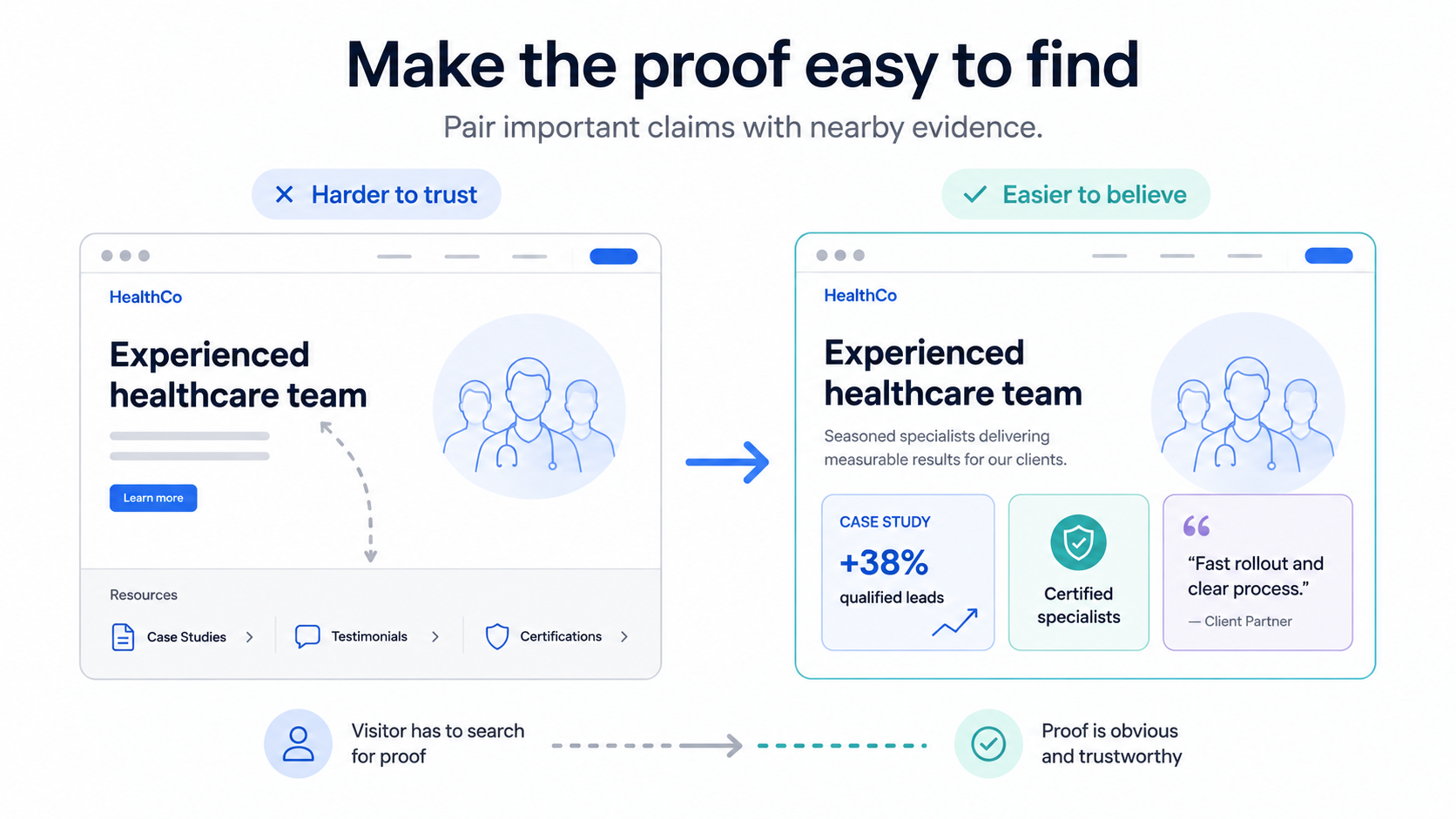
A strong page should make credibility easy to verify.
If you say your team has deep experience in healthcare, show the relevant case study, credential or specialist nearby.
If faster implementation is part of the value proposition, support it with a documented process, timeline or customer result.
Different claims call for different evidence:
- Industry expertise: Relevant case studies, certifications or specialist experience
- Results: Customer outcomes, benchmarks or documented performance
- Process: A clear methodology, implementation steps or delivery timeline
- Expertise: Named specialists, credentials, original research or first-hand insight
- Customer confidence: Reviews or testimonials tied to the service being evaluated
Placement matters. Proof buried on a separate page or left in the footer asks the visitor to connect the dots.
Bringing evidence closer to the claim helps answer a natural question at the right moment: Why should I believe this?
It also makes experience, expertise, authority, and trust visible through evidence instead of relying on broad claims.
Connect the Pages That Strengthen Each Other
A strong website should help visitors move naturally from a broad question to the information that helps them make a decision.
That means connecting related pages with purpose. For example:
- Service pages should link to relevant case studies, specialist profiles and deeper resources.
- Industry pages should connect sector-specific needs with the services that address them.
- Case studies should point back to the service or capability behind the result.
- Expert content should lead readers toward the next useful page when they are ready to evaluate a solution.
These relationships help visitors continue their research without having to hunt through the navigation.
They also give search platforms clearer signals about which topics, services, and areas of expertise belong together.
Internal linking should be descriptive too. “Read more” tells very little. A link such as “See our manufacturing automation case study” gives the reader and the search platform useful context before the click.
For priority pages, review whether each one connects naturally to the proof, expertise, and supporting information that makes the page more useful.
Technical Foundations Keep Important Pages Accessible
Strong content can lose visibility and leads when the website itself creates friction. A focused technical review should confirm that:
- Priority pages are discoverable: Core service, product and location pages can be crawled, indexed and found through the site structure.
- The mobile experience holds up: Navigation, forms, buttons and key information work comfortably across devices and screen sizes.
- Page performance supports the experience: Slow loads, layout shifts or heavy page elements are not getting in the way of research or conversion.
- Old and duplicate pages are managed properly: Visitors and search platforms can identify the current, authoritative version of important content.
- Structured data matches the page: Where relevant, schema should accurately reflect information visitors can see on the page.
- Accessibility is built into the experience: Heading structure, contrast, descriptive links, form labels, keyboard navigation and image descriptions are handled consistently.
- Important content is not being blocked: Search, security and crawler settings allow priority pages to be accessed by the platforms the business wants visibility from.
These checks protect the work already being done through content, page structure and authority. They also reduce the risk of a technically avoidable issue limiting visibility or creating friction at the point when a prospective buyer is ready to act.
Review the Pages Closest to Growth First
An AI-readiness review can uncover a long list of possible improvements. The useful question is which pages deserve attention first.
Start with the pages carrying the most commercial weight:
- Homepage: Position the business, establish category/market fit, surface priority services and route visitors.
- Service/product page: Establish fit, explain scope/capability, answer comparison questions, show proof and provide the next action.
- Industry or solution pages: Review the pages aimed at the markets you want to win
- High-traffic entry pages: Look for pages already attracting visitors but doing little to move them toward the right service or next step
- Proof pages: Case studies, reviews, credentials and specialist profiles that support important buying decisions
Three factors can help set the order:
- Commercial importance: How closely is the page tied to a service, product or market you want to grow?
- Visibility opportunity: Is it already attracting search traffic, referrals or AI-driven discovery?
- Decision readiness: Does it give a serious prospect enough information, proof and direction to keep moving?
A commercially important page with existing visibility and a weak buyer experience should usually move near the top of the list.
That keeps website investment focused on the pages most likely to influence qualified demand.
Your AI-Ready Website Checklist
Use this checklist on your homepage and highest-value service, product, and solution pages before expanding the review across the rest of the site.
Business clarity
- Can a new visitor quickly understand what the business offers?
- Is it clear who each priority service or product is designed for?
- Are the industries, use cases, locations or situations where the offer fits clearly explained?
- Does the page communicate what makes the business relevant without relying on generic claims?
Page structure and content
- Does each priority page have enough substance to stand on its own?
- Do headings clearly signal the questions or topics each section addresses?
- Are important details such as scope, process, timing, requirements and commercial considerations easy to find?
- Are FAQs used to answer genuine buyer questions that are not already covered elsewhere on the page?
Trust and expertise
- Are important claims supported with relevant evidence?
- Are case studies, customer results, reviews and credentials connected to the services they support?
- Can visitors identify the people and experience behind the advice or delivery?
- Is proof placed where it helps answer a buyer’s likely doubts?
Website structure and discovery
- Can visitors move logically between services, industries, proof, expertise and supporting content?
- Do internal links use descriptive language that explains where the visitor is going?
- Are priority pages easy to reach through the wider site structure?
- Can search and AI platforms access the content the business wants discovered?
Technical readiness
- Are priority pages crawlable and indexable?
- Does the site perform well across mobile devices?
- Are outdated, duplicate or competing pages being managed properly?
- Does structured data accurately reflect the information shown on the page?
- Are accessibility basics covered across content, navigation and forms?
- Are crawler, security or platform settings unintentionally blocking important content?
Buyer readiness
- Does the page answer the questions someone is likely to ask while comparing providers?
- Can a prospect understand pricing factors, implementation, requirements, limitations and support where relevant?
- Is there enough comparable proof for someone to judge fit?
- Does the next step match the level of commitment the page is asking for?
Conversion and measurement
- Is the primary call to action clear and easy to complete?
- Do forms and booking paths work properly across devices?
- Can website activity be connected with inquiries, qualified leads and sales opportunities?
- Are search visibility, AI referrals and lead quality being reviewed together?
A few isolated gaps may call for individual page improvements. Weaknesses that appear repeatedly across clarity, proof, structure and conversion usually point to a broader website strategy issue.
The checklist becomes more useful when each finding is tied to commercial priority: which improvement could make an important page easier to discover, easier to trust or more effective at generating the right next action?
Look for a Partner Who Can Connect the Whole Website
An AI-ready website touches several areas at once. Page design affects how information is presented. Search strategy affects whether priority pages are discovered. Content and proof shape credibility. Technical decisions affect accessibility and performance. Conversion paths determine whether that visibility produces qualified opportunities.
That makes the way a website partner prioritizes the work worth examining.
During evaluation, ask questions such as:
- Where would you start, and why? The answer should reflect commercial priorities, existing visibility and the biggest gaps in the buyer experience.
- How will website decisions connect to our growth goals? Priority services, markets and audiences should influence which pages receive investment first.
- How do search, content, design and conversion work together in your plan? Improvements made in isolation can easily shift a problem from one part of the journey to another.
- How will you measure success? Rankings and traffic provide useful signals, but qualified inquiries, lead quality and sales opportunities give a stronger view of commercial impact.
- How will the strategy evolve as search behavior changes? AI search is developing quickly, so the website needs a foundation that can adapt without chasing every new tactic.
WSI approaches website strategy from that wider growth perspective. Our role is to connect the disciplines involved, identify where improvement can create the greatest commercial value, and align website decisions with the outcomes the business is trying to achieve.
Turn Website Readiness Into a Growth Priority
An AI-ready website brings together the parts of digital marketing that too often get managed separately: website design, search visibility, content, technical performance, authority and conversion.
The strongest website opportunities sit where visibility, buyer confidence and commercial value intersect. A priority service page may need clearer positioning. Another may need stronger proof. Elsewhere, a technical issue may be limiting a page that already supports revenue.
Start with the pages that matter most to growth and identify the changes most likely to help your business get found, understood and chosen.
Talk to a WSI Consultant about where your website has the greatest opportunity to improve visibility, support buyer decisions and generate more qualified opportunities.