Key Highlights
- Informed visitors arrive with context before they reach your website. Search, AI tools, reviews, referrals, and competitor research often shape buyer expectations before the first visit.
- Every key website page should support a buyer decision. Homepages, service pages, blogs, landing pages, and location pages should help visitors confirm fit and decide what to do next.
- Strong conversion pages reduce uncertainty. Clear positioning, credible proof, visible trust markers, and relevant calls to action help buyers evaluate your business with more confidence.
- Small points of friction can cost qualified leads. Unclear messaging, weak differentiation, thin proof, poor navigation, and heavy forms can stop high-intent visitors from taking action.
- Conversion reviews should connect website performance to business outcomes. Lead quality, sales readiness, acquisition cost, and existing traffic value all help show where improvements can support growth.
Most marketing campaigns eventually send people to your website. What happens on those pages determines whether traffic becomes a lead, a missed opportunity, or another anonymous visit in your analytics report.
Search, paid media, referrals, email, social media, and AI-powered discovery can all bring people to your pages. Growth depends on what those pages do next. Do they help the right visitor confirm fit, understand your value, trust your business, and take a clear next step?
Qualified visitors rarely arrive with a blank slate. They may have compared providers, read reviews, scanned AI-generated answers, visited competitor websites, or asked peers for recommendations before they land on your site. By that point, they are not looking for vague claims or a long search for basic answers. They want quick confirmation that your business can solve their problem.
Google’s guidance for AI-powered search reinforces a familiar point: helpful, unique content and a strong page experience still influence how people discover and evaluate businesses online. Visibility may bring a visitor in, but conversion depends on clarity, proof, and ease of action.
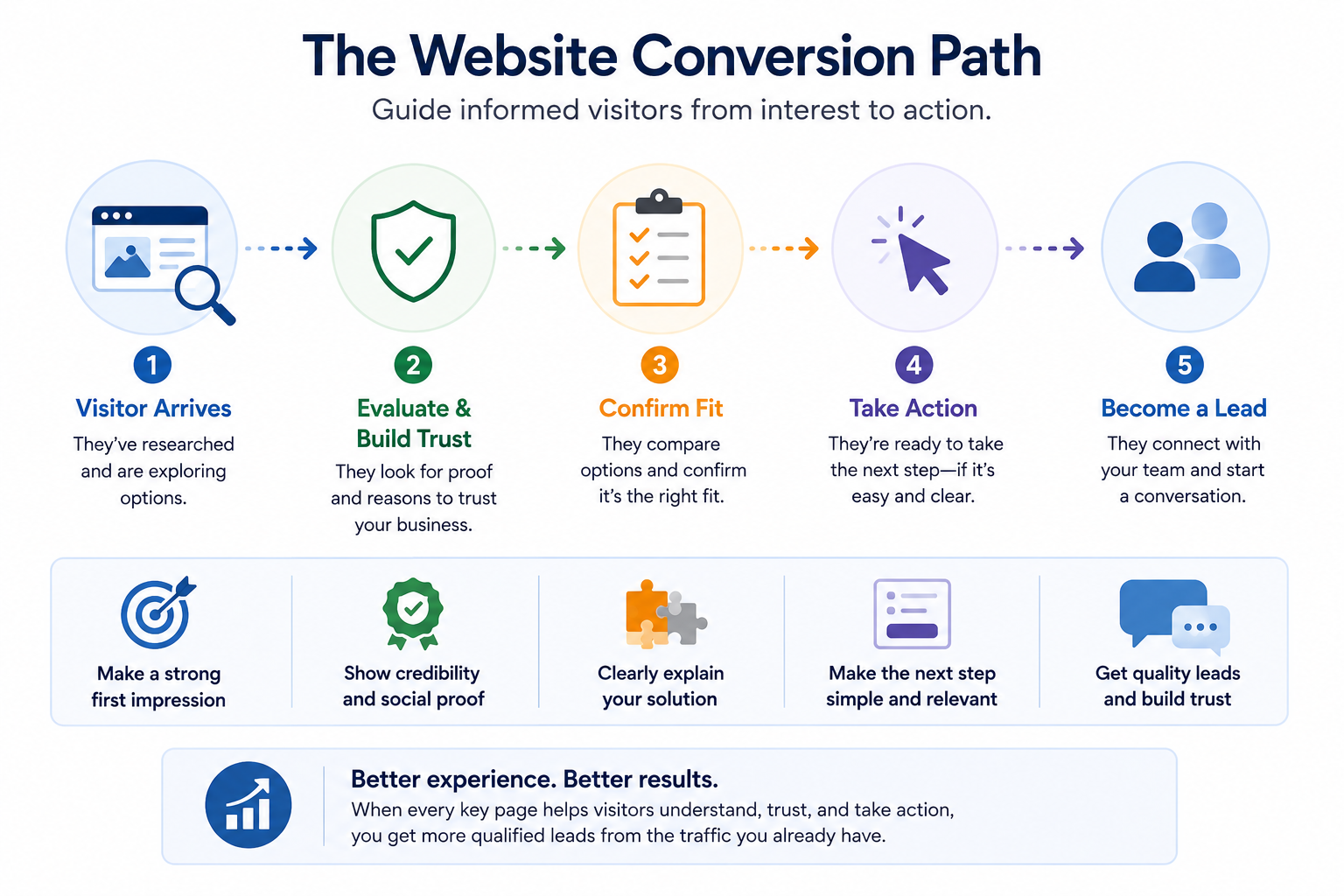
Website conversion strategy gives those pages a clear job. It helps turn key website pages into decision-support assets. Your homepage, service pages, landing pages, blog posts, and location pages should help visitors answer five questions fast:
What do you do?
Who do you help?
Why should I trust you?
What makes you the right fit?
What should I do next?
The best conversion strategies treat the website as a decision path. Each page should reduce doubt, answer the next logical question, and make action feel low-risk.
Why Informed Visitors Make Decisions Differently
Not every website visitor has the same level of intent. Some are researching early. Some are comparing options. Some arrive from a social post, ad, referral, search result, or AI-generated answer with only a loose idea of what they need.
The visitors most closely tied to growth are the ones already evaluating fit. They have a problem to solve, a shortlist forming, and a limited amount of patience for unclear pages.
High-Intent Buyers Arrive With Context
A qualified prospect may already know the problem they want to solve, the type of solution they need, who else offers it, what questions to ask, and what concerns they need resolved before speaking with your team.
At this stage, they are usually looking for confirmation.
- Do you understand their problem?
- Can you show relevant experience?
- Is your offer clear?
- Do your results feel credible?
- Is the next step worth their time?
When those answers are easy to find, sales conversations can start at a more productive point. The prospect already understands your value, has seen proof, and comes in with better questions.
When those answers are buried or missing, strong traffic can turn into silent exits. Rankings, clicks, and campaign results may look healthy, while the website quietly weakens pipeline performance.
Every Key Website Page Should Support a Buyer Decision
One web page cannot carry your full conversion strategy. If the homepage and contact page carry all the weight, prospects may drop off before they ever get there.
High-intent visitors often enter through service pages, blog posts, landing pages, or location pages. Each one needs to help them understand where they are, why your business is relevant, and what action makes sense next.
Different Pages Answer Different Buyer Questions
Your key pages should work together, but each page also needs a clear purpose.
- Homepage: What does this company do, and is it relevant to me?
- Service pages: Can they solve my specific problem?
- Blog articles: Do they understand the issue well enough to guide me?
- Landing pages: Is this offer worth my time?
- Location pages: Do they serve my market or area?
A visitor should not need five clicks to understand the basics. If someone lands directly on a service page, that page should carry enough context to stand on its own. If someone arrives through a blog post, the article should connect their question to a logical next step.
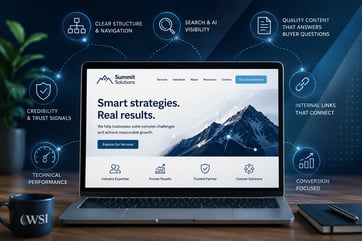
Good conversion-focused web design supports that path. Clear navigation, specific messaging, visible proof, and well-placed calls to action help visitors move forward without forcing them to hunt for answers.
For a deeper look at how campaign-specific pages support conversions, see the guide to building high-converting landing pages.
What Helps a Website Page Convert
Different pages serve different purposes, but the pages that consistently generate leads tend to answer the same core questions well. They reduce uncertainty, build confidence, and make the next step feel clear.
Four Things Strong Conversion Pages Get Right
Clear positioning
A visitor should understand what you do, who you help, and where you fit within seconds. General phrases like “trusted expertise” or “industry-leading solutions” rarely help someone make a decision. Specificity does. A manufacturing company looking for digital strategy has different concerns than a healthcare provider. Your positioning should make that obvious.
Proof that supports the promise
Claims carry more weight when backed by evidence. That could be a case study, client results, testimonials, review scores, certifications, or recognizable client logos. Saying you improve lead quality is one thing. Showing how a client reduced wasted spend or increased qualified enquiries gives a prospect something concrete to assess.
Visible credibility
Nielsen Norman Group’s research on trust points to familiar patterns: clear company information, transparent messaging, current content, and credible external references all help users decide whether a business feels legitimate. Credibility should not live on a single testimonial page. It should be built into the flow of the site. That includes author expertise, client stories, security markers, and clear business credentials.
A next step that fits the page
Not every visitor is ready for the same action. Someone comparing service providers may want to book a consultation. Someone reading a blog article may want a checklist, guide, or related resource first. Strong calls to action match the context of the page and the level of buyer intent. The next step should feel useful for where the visitor is in the decision process.
Where Qualified Buyers Drop Off
Getting the right visitor to your website is expensive. Search campaigns, content, referrals, and outbound efforts all carry a cost before someone clicks through.
Problems usually appear after the click.
A prospect may arrive with strong intent, but small points of friction can interrupt momentum and push them back into comparison mode.
Friction That Slows Down Conversion
Unclear messaging
If a visitor has to work to understand what you offer, they may not stay long enough to figure it out. Clear positioning shortens that gap. It helps people assess fit quickly and decide whether to keep moving.
Weak differentiation
Many websites describe similar services in similar ways. If your approach, expertise, or outcomes are hard to distinguish, the decision often comes down to price or convenience. That makes it harder to win on value.
Thin proof
Claims without evidence create hesitation. Case studies, customer results, testimonials, and practical examples help a prospect assess risk. They also make sales conversations easier because trust has already started forming.
Poor navigation
Nielsen Norman Group’s usability research has long shown that people scan before they commit. If navigation feels messy or key information is buried, visitors leave faster than most teams expect. Pages should guide people toward the information they need, not make them search for it.
Heavy lead capture
A form is often the final step before a conversation starts. Long forms, unnecessary fields, or vague follow-up expectations can create enough resistance to stop that action. The goal is to collect enough information to qualify the lead, without creating extra work for the prospect.
How to Review Your Website for Conversion Gaps
Most business owners keep a close eye on revenue, costs, and sales performance. Website performance deserves the same attention because it shapes how many qualified opportunities enter your pipeline.
A conversion audit does not need to start with a full redesign. It starts by looking at your highest-traffic and highest-intent pages with fresh eyes.
Five Questions Worth Asking
#1 Can a visitor understand your value quickly?
Within a few seconds, it should be clear what you do, who you help, and why your offer is relevant. If that takes too long to piece together, the page is doing extra work for the visitor.
#2 Is there enough proof to support your claims?
Review where you make important promises. Are those backed by customer results, testimonials, case studies, or measurable outcomes? Proof should sit close to the claim it supports.
#3 Is credibility visible throughout the page?
Trust should not depend on one isolated section. Look for places where you can reinforce expertise, experience, and credibility through client logos, certifications, reviews, or clear author attribution.
#4 Is the next action easy to spot?
Every page should guide the visitor toward a logical next step. That could be booking a consultation, downloading a resource, or exploring a related service. If the action feels hidden or disconnected, conversion rates often suffer.
#5 Does the page match why someone landed there?
Intent matters. A service page should help with evaluation. A blog post should answer a specific question and guide the reader toward a related next step. A landing page should keep focus tight and remove distractions. When the page matches the visitor’s goal, progression feels easier.
A useful conversion review connects page performance to business outcomes: lead quality, sales readiness, acquisition cost, and the value of traffic already being generated. That is where website strategy becomes a growth conversation, not a design preference.
Building a Website Conversion Strategy That Supports Growth
Website conversion usually improves when the full page experience works together.
Messaging, page structure, proof, credibility, and calls to action all shape how a visitor evaluates your business. When those elements are aligned, people find answers faster, understand your value more clearly, and move through the decision process with less hesitation.
In practice, conversion issues often appear when a page explains the service but fails to support the buyer’s decision.
Picture a commercial HVAC company that wants more maintenance contract leads. Its service page says, “Reliable HVAC solutions for businesses of all sizes.” The statement is clear enough, but it does not help a facilities manager or business owner understand why this provider is the right choice.
A stronger page would say who the service is for, what problem it solves, and what outcome the buyer can expect. For example: “Prevent costly HVAC downtime with planned maintenance programs for commercial buildings, offices, and multi-site facilities.”
From there, the page should support the claim with proof: response times, technician certifications, customer examples, service area details, maintenance plan options, and a clear CTA such as “Book a Maintenance Assessment.” The visitor can quickly confirm fit and understand what happens next.
For WSI, this is where strategy comes first. Traffic generation and conversion performance are connected. Bringing in more visitors has limited value if the pages they land on do not help buyers confirm fit, assess credibility, and take action.
The businesses that improve conversion consistently treat their website as part of the sales journey. They review where buyers hesitate, where trust weakens, and where pages fail to answer the next question.
Improving the pages you already have can raise the value of traffic you are already paying to attract.
A Better Website Should Make Better Leads Easier to Win
Your website has a direct role in how marketing spend turns into pipeline. When key pages are clear, credible, and easy to act on, prospects can move from interest to inquiry with less hesitation.
WSI helps business leaders identify where their website may be losing qualified prospects and build a practical plan to improve conversion performance across the pages that influence buying decisions.
A practical next step is to review the pages doing the heaviest lifting on your site. Explore WSI’s Website solutions to see how a more strategic website can support stronger lead quality and growth.
If your website should be doing more, speak with a WSI Consultant about where qualified leads may be dropping off.