Key Highlights
- AI search changes early visibility. Buyers now form impressions in summaries and AI-generated answers before they visit a website.
- Rankings no longer tell the whole story. Content also needs to be clear enough for readers and AI tools to interpret quickly.
- Structure now affects discoverability. Strong ideas lose value when the content is slow to surface the point or hard to navigate.
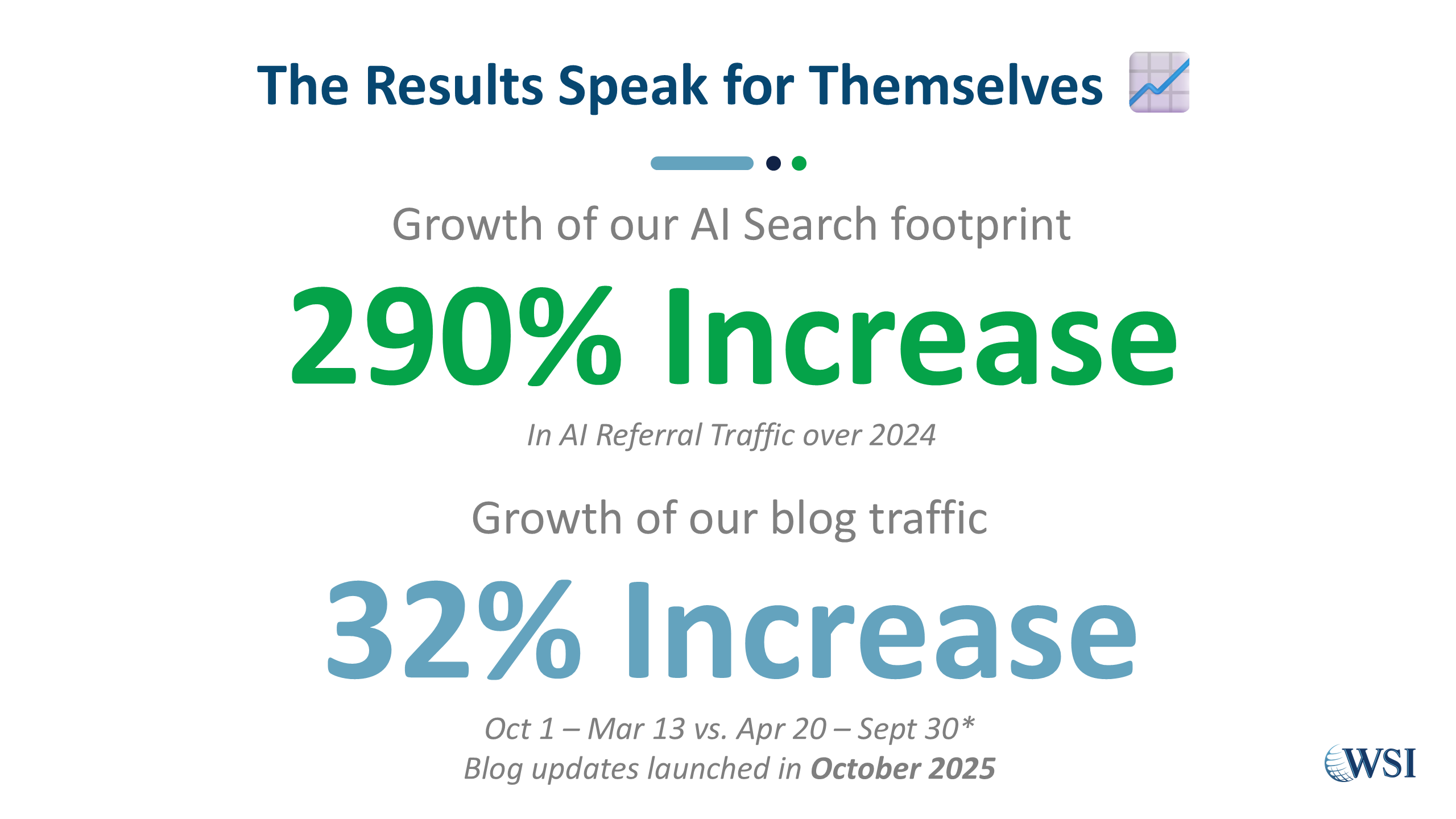
- Proven results from WSI’s own content. The result was a 290% increase in AI referral traffic and a 32% increase in blog traffic.
- Traffic was only part of the outcome. The bigger gain was stronger visibility earlier in the buying journey, when buyers begin narrowing options.
Search no longer happens only on the results page. Buyers are getting answers from Google summaries and AI tools before they ever visit a website, so your content can influence how they see your business earlier. For business leaders, the risk is clear. If your expertise is difficult to find or does not feel credible in those spaces, you may be losing attention before a prospect reaches your site.
We saw this happening in our own blog and changed how articles were structured so the main points were easier to find and easier to understand in search and AI tools. After those changes, WSI saw a 290% increase in AI referral traffic and a 32% increase in blog traffic.
The bigger risk is not losing traffic. It is losing consideration before your team ever knows a prospect was looking. If AI tools cannot clearly understand, trust, and surface your content, your business may be left out of the buyer’s shortlist before the first website visit happens.
Strong ideas still matter, but how you present them now has more impact on whether buyers notice them early. This article looks at what WSI changed and what other organizations can learn from it.
AI Search Is Changing How Businesses Get Discovered
For years, SEO performance was judged mainly by rankings, clicks, and traffic. When a page ranked well, it had a better chance of attracting visitors.
That is no longer the full picture. Google now answers more questions directly on the results page, and tools like ChatGPT, Perplexity, and Claude are shaping how people research providers before they visit a website. In many cases, a prospect forms an impression from a summary or AI-generated answer before reaching your site.
That matters because rankings no longer determine visibility on their own. A business can rank well and still miss early consideration if its content is hard to understand, light on proof, or difficult for AI tools to use in answers. Rankings still matter, but they do not carry the same weight they once did.
The new question is not only “Can buyers find us?” It is “Are we being included in the answers buyers trust?”
People want faster answers and quicker ways to compare options. AI tools are increasingly meeting that need, which means content now shapes discovery earlier in the process.
The Business Impact Behind the Shift
For business leaders, the impact reaches well beyond marketing. It affects pipeline quality and sales opportunities.
As buyers use AI to compare providers, they often decide who to contact before speaking to your sales team. By the time someone fills out a form or picks up the phone, some of that decision has already happened.
You do not always see the loss directly. It appears in proposals that never come in, shortlists you never make, and deals where a competitor got to shape the buyer’s thinking first. Your CRM will not clearly show that. What you see instead is a weaker pipeline and fewer high-quality opportunities.
This gap can keep growing. AI systems tend to pull from sources that answer questions clearly and support their claims. Companies that appear again and again in those responses gain familiarity and trust. Companies that do not are easier to miss.
What WSI Observed in Its Own Content Performance
This started with our own blog, where the team could see the issue firsthand.
Before October 2025, many posts followed a familiar B2B format. They were useful and often strong enough to perform in traditional search, but they were also heavier to read and slower to get to the point. That became a bigger issue as search shifted toward summaries and AI-generated answers that surface information quickly.
The blog was no longer judged only by where it ranked. It was also judged by how quickly a reader or AI tool could understand the point, pull out the useful parts, and connect one article to the next.
We saw that good ideas were not enough on their own. The content needed to introduce the point earlier, move more clearly from section to section, and make related topics easier to follow across the blog.
That is what prompted the next round of changes.
What WSI Changed in Its Content Approach
The goal was not to make the blog more technical. It was to make the content easier to follow and easier to use.
The structure became simpler and more consistent from one article to the next. Topics were introduced earlier, sections were easier to move through, and related ideas were tied together more clearly. That made the content work better for readers and easier for search and AI tools to interpret.
A few changes made the biggest difference.
1. Clearer Framing at the Start of Each Article
We made the opening of each article more direct so readers could see the point earlier and understand why it mattered to the business.
That meant using clearer titles, adding short summaries near the top, and rewriting openings so the main issue appeared sooner. Readers did not have to work through several paragraphs to understand the topic or why it deserved attention.
For business leaders, that matters for a simple reason: people make judgments quickly. If the value of your expertise is not clear early, you may lose the opportunity to influence how a buyer sees the issue.
|
BEFORE (Unclear, Delayed Framing) |
AFTER (Clear, Immediate Framing) |
|---|---|
| Many businesses are investing in digital marketing, but results can vary widely depending on the strategies used. With search continuing to evolve, it is important to stay updated on best practices and trends that can influence performance. | How AI Search Is Changing Buyer Visibility AI tools now shape how buyers evaluate your business before visiting your website. If your content is not clear early, you risk being excluded from consideration. This article shows how to structure content so it is easier to understand, trusted by AI systems, and more likely to influence decisions. |
2. A Structure That Helped Readers Move Faster
We made articles easier to get through.
Sections became tighter. Headings became clearer. Recap blocks brought important points back into view. The result was content that was easier to scan, easier to revisit, and easier to understand without reading every paragraph in order.
Buyers rarely read business content from top to bottom. They skim, look for proof, and move on fast when a page feels slow or hard to follow. Better structure helped the content stay useful even when attention was limited.
|
BEFORE (Dense, Hard-to-Scan Content) |
AFTER (Structured, Scannable Content) |
|---|---|
|
Digital marketing strategies can vary significantly depending on the business model, industry, and available resources. It is important to consider multiple factors when building an effective approach. (followed by long, unbroken paragraphs) |
Key Factors That Impact AI Search Visibility
Summary: If your content is easy to scan, it is easier to understand and more likely to be used by AI systems. |
3. Content Built Around Real Buyer Questions
We brought the blog closer to the kinds of questions buyers actually ask when they are trying to understand a problem, compare options, or decide what to do next.
Articles started answering those questions more directly, often through clearer subheadings and FAQ sections written in more natural language. That made the content more useful when readers were actively looking for clarity.
Content performs better when it matches how prospects think. Good content should do more than explain a topic. It should help a buyer feel more certain about the next step.
|
BEFORE (Generic, Topic-Led Content) |
AFTER (Question-Led, Buyer-Focused Content) |
|---|---|
|
Content marketing plays an important role in helping businesses educate their audience and build trust over time. A well-planned strategy can support long-term growth. |
How Do Buyers Evaluate Providers in AI Search? Buyers want clear answers to specific questions:
Answer: Content that directly addresses these questions is more likely to be surfaced, trusted, and acted on. |
4. Stronger Proof and Trust Signals
We made proof easier to see.
Articles used clearer attribution, stronger examples, and more concrete evidence to support their claims. In this article, the 290% increase in AI referral traffic and the 32% increase in blog traffic do that work. They give readers a clear reason to believe the changes led to a real result.
Buyers are making decisions faster and with less patience. They often decide quickly whether a source is credible enough to take seriously. Clear proof reduces doubt earlier and helps build trust before any conversation begins.
|
BEFORE (Vague, Unsubstantiated Claims) |
AFTER (Clear, Evidence-Backed Proof) |
|---|---|
|
Many companies have seen improvements in their digital marketing performance after making changes to their content strategy. Results can vary depending on execution and consistency. |
What Happened When We Applied This Approach This approach drove:
These results show how clearer structure and stronger proof improve visibility and trust early in the buying process. |
5. Broader Coverage Across Core Topics
We improved how articles connected across the blog.
Instead of treating each post as a stand-alone piece, related articles were grouped more deliberately around core topics and linked more clearly to one another. That gave readers a clearer path through the subject and made WSI’s view easier to follow.
Business trust rarely comes from one article alone. It builds when a company keeps showing depth in the areas that matter to its audience. Consistent coverage makes expertise easier to recognize and easier to trust.
|
BEFORE (Isolated, One-Off Articles) |
AFTER (Connected, Thematic Content) |
|---|---|
|
Businesses often create blog posts on a variety of topics to attract a wider audience. This can help increase visibility across different areas of interest. |
Building Depth Across Core Topics
Each article connects to the next, helping readers explore the topic and building trust over time. |
Put simply:
Before, strong ideas were sometimes buried inside traditional blog formatting.
After, the same expertise was packaged in a way that made the value easier to identify, extract, and act on.
The Strategic Takeaway
The format itself is not the point. What matters is the principle behind it. Content now plays a bigger role in how a business gets found and judged before a sales conversation begins.
The results improved because the content became clearer earlier, easier to follow, closer to the questions buyers actually ask, and better supported by evidence. The blog did a better job of helping readers understand the point quickly and giving search and AI tools something more useful to work with.
That is the adjustment more businesses need to make. Strong ideas still matter, but they need to be presented in a way that is easier to find, easier to trust, and easier to use.
What the Results Meant for WSI
WSI implemented these changes in its own content in October 2025 as part of its Adaptive SEO approach, focused on making content easier for AI systems to interpret and reuse. The results were clear:
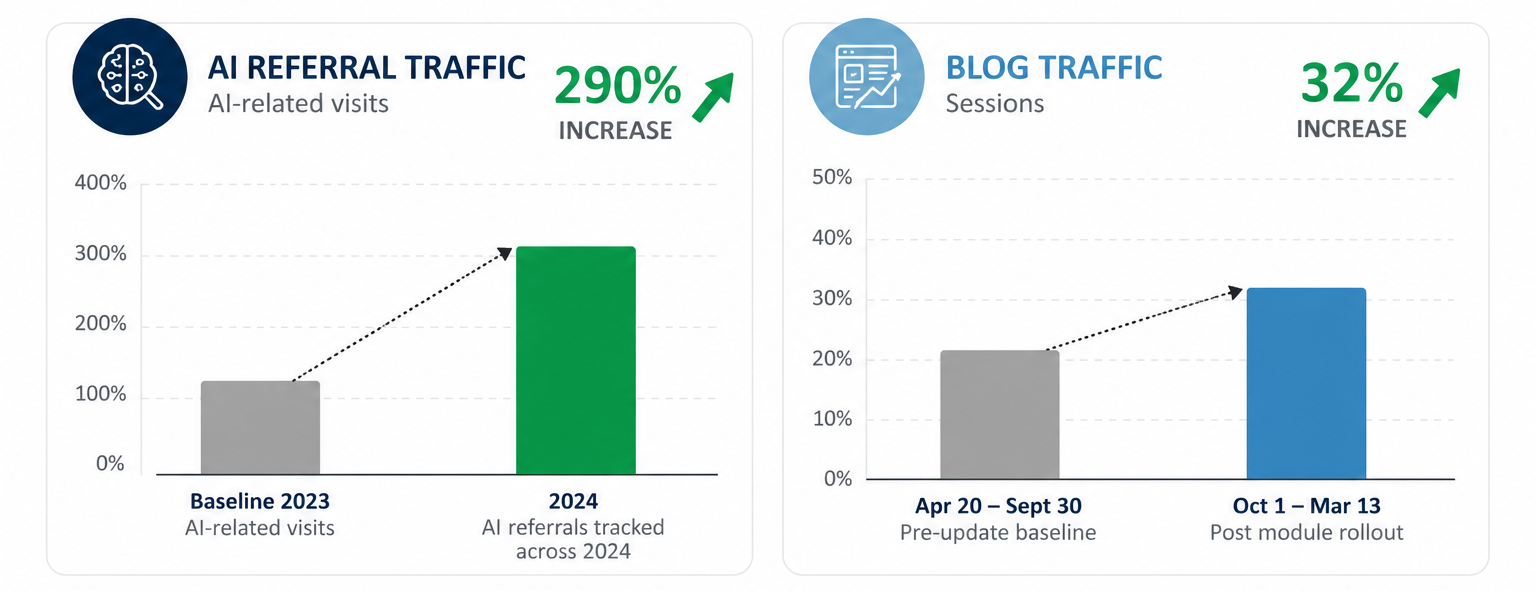 These results point to a bigger business change than traffic alone.
The rise in AI referral traffic showed that WSI’s expertise was becoming more visible during the early research phase, when buyers are deciding which companies deserve closer attention. The increase in blog traffic showed that the blog was also becoming a stronger entry point into the website, giving WSI more opportunities to build trust before a sales conversation began.
That changed the role of the blog for the business. It was no longer only a place to publish thought leadership. It was helping WSI turn expertise into earlier visibility, stronger consideration, and more meaningful website engagement.
WSI tested this approach on its own content first, then applied it more broadly with clients. It is now part of WSI AdaptiveSEO®. The ideas behind it are explored further in The AI Search Revolution: Adaptive SEO in the Age of AI.
Where to Start: A Quick AI-Ready Content Check
Before creating more content, review your existing blog posts against five questions:
-
Does the first 100 words clearly explain the topic, audience, and value?
-
Do the headings match real questions your buyers ask?
-
Can a reader scan the page and understand the main point in under one minute?
-
Is there proof, data, or experience that makes the advice credible?
-
Are FAQs included to answer natural, conversational search queries?
If the answer is “no” to most of these, publishing more content may not fix the problem. The better move is to make your best content easier to understand, trust, and use.
What Growth-Oriented Organizations Should Take From This
For business leaders, the main takeaway is simple: look at whether your content is helping people find and trust your business early in the buying process.
A few questions can help:
-
Is the point clear early, or does the reader have to work to figure out what the page is saying?
-
Are your most important pages easy to read and easy to trust?
-
Does your content answer the questions buyers actually ask when they are comparing options?
-
Are you building real depth in a few topics, or publishing articles that sit on their own and go nowhere?
Focus on a small number of topics where your business should be known. Review the pages that matter most and ask whether they help people discover you and move closer to action. Tighten the offer. Make the evidence easier to see. Clean up the structure so the main points are easier to follow. Then bring more discipline to how content is planned and updated.
The real job is to make the expertise your business already has easier for buyers to find and believe in.
Want to know where your content is being missed in AI search? Start with an AI Search Content Audit and see what AI systems understand, what they skip, and where your biggest visibility gaps are.