
Key Highlights
- AI recommends, it doesn’t just rank. Search has shifted from listings to recommendations, changing how businesses get discovered and selected.
- Credibility determines who gets chosen. AI evaluates trust signals, not just keywords, when deciding which businesses to recommend.
- Expertise must be visible and proven. Original insights, real results, and depth signal experience AI can recognize and prioritize.
- Third-party validation builds digital trust. Backlinks, media mentions, and partnerships confirm your credibility beyond your own claims.
- Consistency strengthens your entire presence. Aligned messaging across platforms helps AI clearly understand and trust your business.
- Engagement signals real-world relevance. User behavior, reviews, and interaction levels indicate whether your content delivers value.
- Structure helps AI interpret your content. Clear formatting and structured data make it easier for AI to extract and recommend your insights.
- Stronger signals lead to better opportunities. Businesses with clear authority signals attract higher-quality leads and reduce sales friction.
AI-powered search tools are already shaping how your prospects choose vendors. This isn’t a future shift—it’s happening now, and it’s already determining which businesses get seen and which get ignored. If your competitors are earning stronger authority signals, they will be recommended first—even if your services are comparable or better.
Optimization is no longer about keyword placement alone. Credibility determines whether your business is selected as the answer. That authority must be demonstrated through expertise, third-party validation, consistency, and measurable proof of performance.
Why Authority Now Determines Which Businesses Get Chosen
Traditional search engines generate lists. AI generates answers. That changes the stakes. AI platforms select and present a small number of trusted sources. If your business isn’t seen as credible, you don’t just rank lower—you’re excluded from the answer entirely.
Keywords still matter, but credibility determines whether you are chosen.
Here’s where most businesses get this wrong.
They treat authority like a content problem—publish more, optimize more, distribute more. But AI isn’t looking for more content. It’s looking for clearer signals of trust.
That’s why two companies with similar services and similar visibility can get very different outcomes. One gets recommended. The other gets ignored.
The difference isn’t effort. It’s how clearly their expertise is validated across their entire digital presence.
What This Shift Means for Your Leads, Revenue, and Visibility
This shift changes the goal—from generating traffic to earning trust. Instead of chasing unqualified clicks, authority positions your business to attract prequalified prospects who already see you as credible. When your business appears in AI-generated answers, buyers come to you already trusting your expertise and ready to move forward.
The result:
-
Shorter sales cycles
-
Less price resistance
-
Higher-quality leads
If you’re not building authority, you’re not just missing traffic. You’re giving away opportunities to competitors who are.
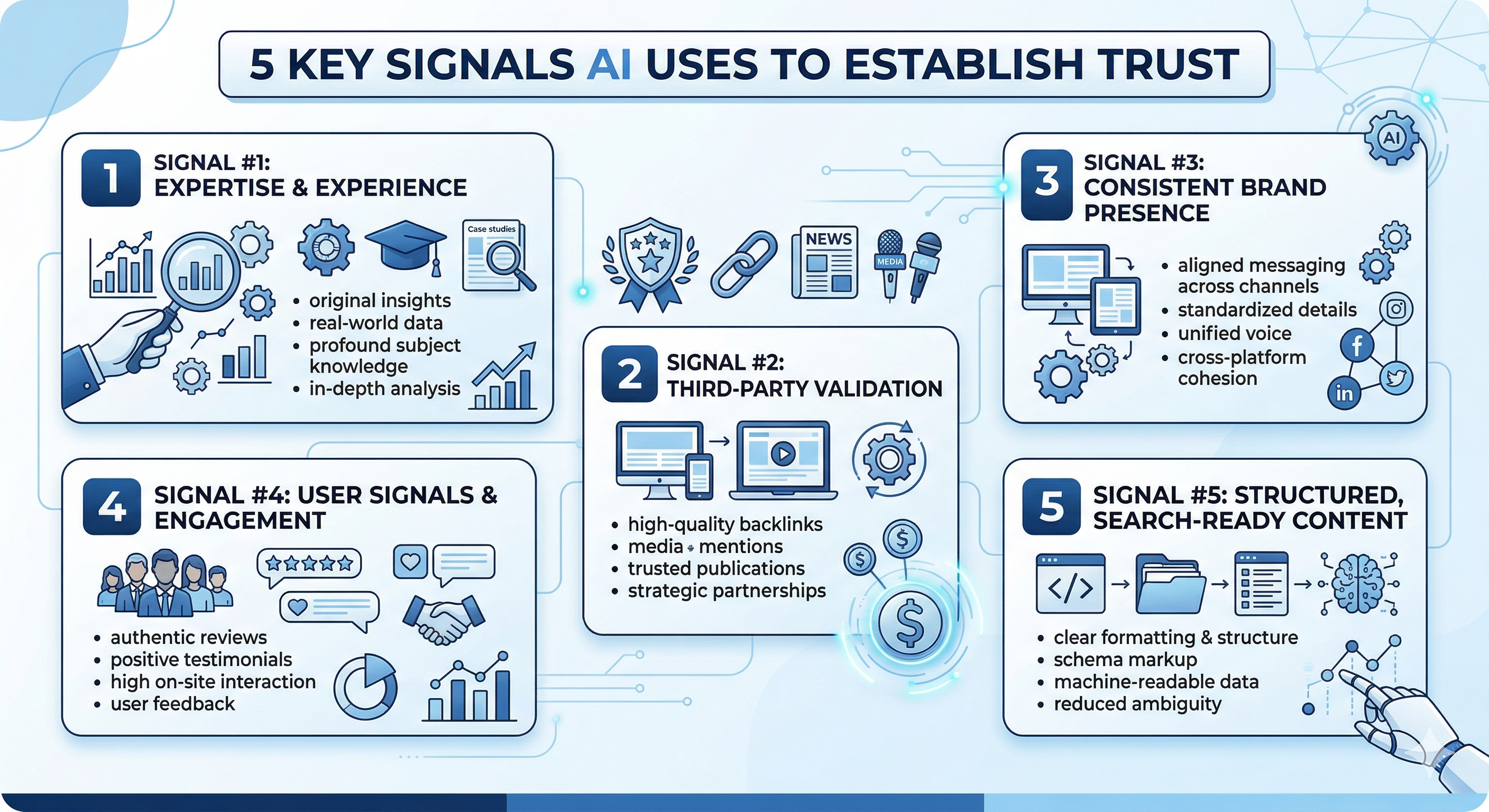
Signal #1: Demonstrated Expertise and Real-World Experience
Expertise and real-world experience are always strong differentiators. When it comes to AI search, this differentiating factor needs to be signalled clearly and instantly.
Search and generative platforms prioritize content that is:
-
Real-world experience—not generic information pulled from anywhere, featuring case studies, personal stories, and original data.
-
Referenced by other authoritative sources.
-
In-depth and original.
-
Demonstrates the author’s consistency across multiple platforms.
If your content sounds like everyone else’s, AI has no reason to choose you.
Showcasing Subject Matter Authority Through Original Insights
Winning visibility in AI-powered search is a matter of proving that your knowledge is distinct and grounded in experience. AI prioritizes “information gain”—content that adds something new, not just repeats what already exists.
To strengthen your authority:
-
Develop proprietary insights: Publish your own data, frameworks, and lessons from real client work.
-
Go deeper than competitors: Surface-level content is ignored. Detailed analysis and practical guidance stand out.
-
Structure for visibility: Use summaries, FAQs, and clear formatting so your insights can be easily extracted.
-
Use precise language: Industry-specific terminology helps AI understand your expertise.
- Show measurable outcomes: Metrics like “30% increase in pipeline” or “40% reduction in cost per lead” signal credibility.
Signal #2: Credible Third-Party Validation
AI does not rely on what you say about yourself. It looks at who else is validating your expertise. To make your content more appealing to AI, therefore, you need to signal that you are a source that other authorities trust. To achieve this, you need to earn high-quality backlinks, secure media mentions, and build strategic partnerships. If no credible source references your business, AI assumes your authority is unproven.
Many businesses still think authority comes from what they publish.
In reality, authority is what others are willing to associate with you. If no credible source is referencing your business, AI has very little reason to trust it—no matter how strong your content is.
Earning High-Quality Backlinks from Trusted Publications
Recommendation engines assess who is vouching for your business. When established publications link to your website, they pass credibility signals that reinforce your authority. Not all backlinks carry equal weight. A single link from a respected industry publication can influence trust far more than dozens of low-quality directory listings.
Shift your focus from volume to relevance and reputation. Contribute expert commentary, publish original research, or offer data-driven insights to well-known business and trade publications. These placements generate authoritative backlinks that AI systems interpret as meaningful endorsements.
Securing Media Mentions and Industry Features
When your business is featured in credible media or your leadership team is quoted, it signals authority at scale. This does more than build awareness. It creates trust signals that AI can validate across the web. If your competitors are visible in trusted publications and you are not, they will be seen as the safer choice—before a prospect ever contacts you.
Building Strategic Partnerships That Strengthen Digital Authority
Partnerships expand both reach and credibility. Joint content, co-hosted webinars, and collaborations create interconnected signals that reinforce your authority. AI maps these relationships and uses them to validate trust. Authority grows faster when it is supported by recognized names.
Signal #3: Consistent Brand Presence Across Channels
AI evaluates your entire digital footprint—not just your website. If your messaging is inconsistent across platforms, AI struggles to define your business. That confusion reduces visibility. Inconsistency weakens trust—with buyers and with AI. And in this environment, those are the same thing.
Maintaining Message Alignment Across Website, Social, and Directories
Consistency strengthens authority.
To maintain it:
-
Align your messaging across your website, social media, and directories
-
Standardize contact details and service descriptions
-
Ensure your content strategy reinforces a clear, consistent position
-
Keep social profiles and third-party mentions aligned
Before you go any further with your marketing campaigns, audit your digital presence this week. If your business is described differently across platforms, fix that before investing further in marketing.
Strengthening Executive Visibility and Thought Leadership
Founder-led thought leadership strengthens brand authority and differentiates your perspective from generic industry commentary. Your perspective—based on real experience—is what differentiates your business from generic content. Consistent, expert commentary builds recognition and increases the likelihood that your insights are surfaced in AI-generated responses.
If your expertise isn’t visible, it isn’t contributing to your authority.
Signal #4: Trustworthy User Signals and Engagement
AI evaluates how real users interact with your business. Reviews, testimonials, and engagement metrics signal whether your content delivers value. Low engagement signals that your content isn’t delivering value. Strong engagement reinforces authority.
Generating Authentic Reviews and Testimonials
Strong reviews require a deliberate process.
-
Ask for feedback consistently.
-
Automate follow-ups at key points in the customer journey
-
Respond to all reviews—positive and negative
A mix of reviews builds credibility. Thoughtful responses show accountability.
If your reviews are limited or outdated, AI doesn’t have much evidence on which to trust your business.
Improving On-Site Engagement and Content Depth
AI tracks how users behave on your site. If visitors leave quickly, it signals low value. If they stay and engage, it signals relevance.
Improve engagement by:
-
Creating detailed service pages and case studies
-
Providing clear navigation and strong calls to action
-
Publishing content that answers real buyer questions
If users don’t engage, AI won’t recommend your content.
Demonstrating Transparency Through Clear Policies and Contact Information
Trust increases when your business is easy to verify. Clear contact details, leadership information, and transparent policies signal legitimacy. These elements reduce friction for both AI and potential customers.
If your business is difficult to verify, both AI and prospects will hesitate.
Signal #5: Structured, Search-Ready Content That AI Can Interpret
Even strong content gets ignored if AI can’t interpret it. As AI selects its answers, this signal ensures your content is selected by reducing ambiguity and providing clear data, such as schema, lists, and tables. If your content isn’t structured clearly, even strong expertise can be ignored because AI cannot interpret it.
Organizing Content Around Clear Service Themes and Expertise
Structured data helps AI categorize your services and connect your authority signals.
When implemented correctly, it reduces ambiguity and increases visibility.
Confirm that your site uses structured data aligned with your core services. If not, you’re limiting how AI interprets your expertise.
Aligning Content With How Real Buyers Ask Questions
Authority requires focus. Your site should be built around core service areas, supported by related content that answers buyer questions and demonstrates expertise. This structure strengthens authority and guides prospects through the buying journey.
Authority Is a Strategic Asset, Not a Marketing Tactic
Authority compounds. Every backlink, review, mention, and insight strengthens your position. Over time, this reduces reliance on paid acquisition and increases control over visibility.
AI-driven search is not a temporary shift. Businesses that invest in authority now will gain a lasting advantage.
Those who delay will lose visibility—regardless of service quality.
Take control of how AI platforms represent your business. Start with an Authority Signal Audit.
-
Are you being cited, or ignored?
-
Are you consistent, or fragmented?
-
Are you trusted, or just visible?
If your competitors are becoming the default recommendation, now is the time to change that. Connect with WSI to strengthen your authority—and ensure your business is the one AI chooses to recommend.