
Key Highlights
- ChatGPT can know your name and still leave you off a buyer’s shortlist. The commercial value comes when it recommends your business for the services and customer needs you want to grow.
- Your customers’ questions should shape your content. If your website relies on internal service language, AI may miss the connection to the problems, industries, and requirements buyers actually describe.
- Your credibility should show up in more than one place. Reviews, customer stories, partner profiles, directories, and media mentions help confirm the claims made on your website.
- Test whether buyers can find you without using your brand name. Non-branded prompts reveal whether ChatGPT connects your business to the services, locations, and customer needs you want to be known for.
- The right citation matters more than a higher citation count. A citation to a commercially relevant service page is more valuable when it contributes to qualified inquiries, stronger sales conversations, and better-fit leads.
- AI visibility is a business-wide marketing issue. Your website, technical SEO, business profiles, and third-party proof need to support the same growth priorities across the web.
A buyer looking for a payroll provider, cybersecurity firm, commercial contractor, or marketing agency can now ask ChatGPT for a shortlist and get an answer in seconds. If your company isn’t included, the problem may have little to do with the quality of your work. ChatGPT may simply lack enough specific, trustworthy information to connect your business with the request.
That connection depends on specific service descriptions, consistent company information, visible evidence of experience, and pages that search systems can access and interpret.
There’s no single submission form that guarantees a business will be recommended by ChatGPT, Gemini, Perplexity, Claude, or another AI tool.
Visibility grows from a public record that explains who you serve, where you operate, the problems you solve, and the evidence behind your claims. Strong service pages, reliable company information, relevant proof, and sound technical SEO give these systems a better basis for deciding when your business belongs in the answer.
Being Known by ChatGPT Isn’t the Same as Being Recommended
Many companies begin by asking ChatGPT, “What do you know about our business?”
It’s a useful check. It can uncover an incorrect service description, old address, former employee, or outdated market focus. Yet a buyer who already knows your company name has moved past discovery.
The harder test is whether you appear when the name is missing:
“Which IT support companies work with accounting firms in Dallas?”
That question requires ChatGPT to connect several pieces of information: the service, customer type, location, and likely business need. Your website may mention all four, but scattered references are harder to interpret than one strong page that brings them together.
At WSI, we separate AI visibility into three levels:
- Recognition: ChatGPT can identify and describe the company.
- Citation: ChatGPT uses one of the company’s pages as a source.
- Recommendation: ChatGPT includes the company when a buyer asks for suitable providers.
Recommendation is the commercial target. It requires ChatGPT to connect your company with the services and customer groups that matter most to revenue.
ChatGPT Matches Businesses to the Details in the Prompt
ChatGPT Search can look across the web when current or outside information would improve an answer. OpenAI explains that ChatGPT Search may rewrite a user’s request into one or more targeted searches and send them to its search providers. It may refine those searches as it reviews the information it finds.
Consider this question:
“Which payroll companies support construction businesses with employees in several states?”
ChatGPT may search for information related to construction payroll, multistate compliance, certified payroll, and contractor support.
A provider with one broad “Payroll Solutions” page gives the system limited context. A provider with a construction payroll page, compliance guidance, relevant customer examples, and consistent business profiles offers a much closer match.
Your website needs to cover the language buyers use and the situations behind their questions. Internal marketing terminology may not match how customers describe the service or the problem.
Map Buyer Prompts to the Pages That Generate Revenue
Start with one valuable service rather than attempting to optimize the entire website at once.
Choose an offer with healthy margins, enough delivery capacity, and a clearly defined customer. Then list the ways a buyer may ask ChatGPT about it.
|
Buyer intent |
Example prompt |
Content needed |
|
Service discovery |
“Who provides warehouse automation consulting?” |
A focused service page with a clear description and delivery proof |
|
Customer fit |
“Which consultants work with regional food manufacturers?” |
Industry experience, customer examples, and relevant case studies |
|
Location fit |
“Who provides automation support near Cleveland?” |
Accurate service areas, location pages, listings, and local references |
|
Problem fit |
“Who can reduce picking errors in a busy warehouse?” |
Content connecting the service to the operational problem |
|
Comparison |
“What should I look for in an automation integrator?” |
Guidance on process, costs, timing, qualifications, and project risk |
Use discovery calls, proposals, CRM notes, and customer emails to capture the questions that influence fit, risk, and implementation. Organize those questions by sales stage to decide whether each answer belongs on a core service page or needs a deeper piece of content.
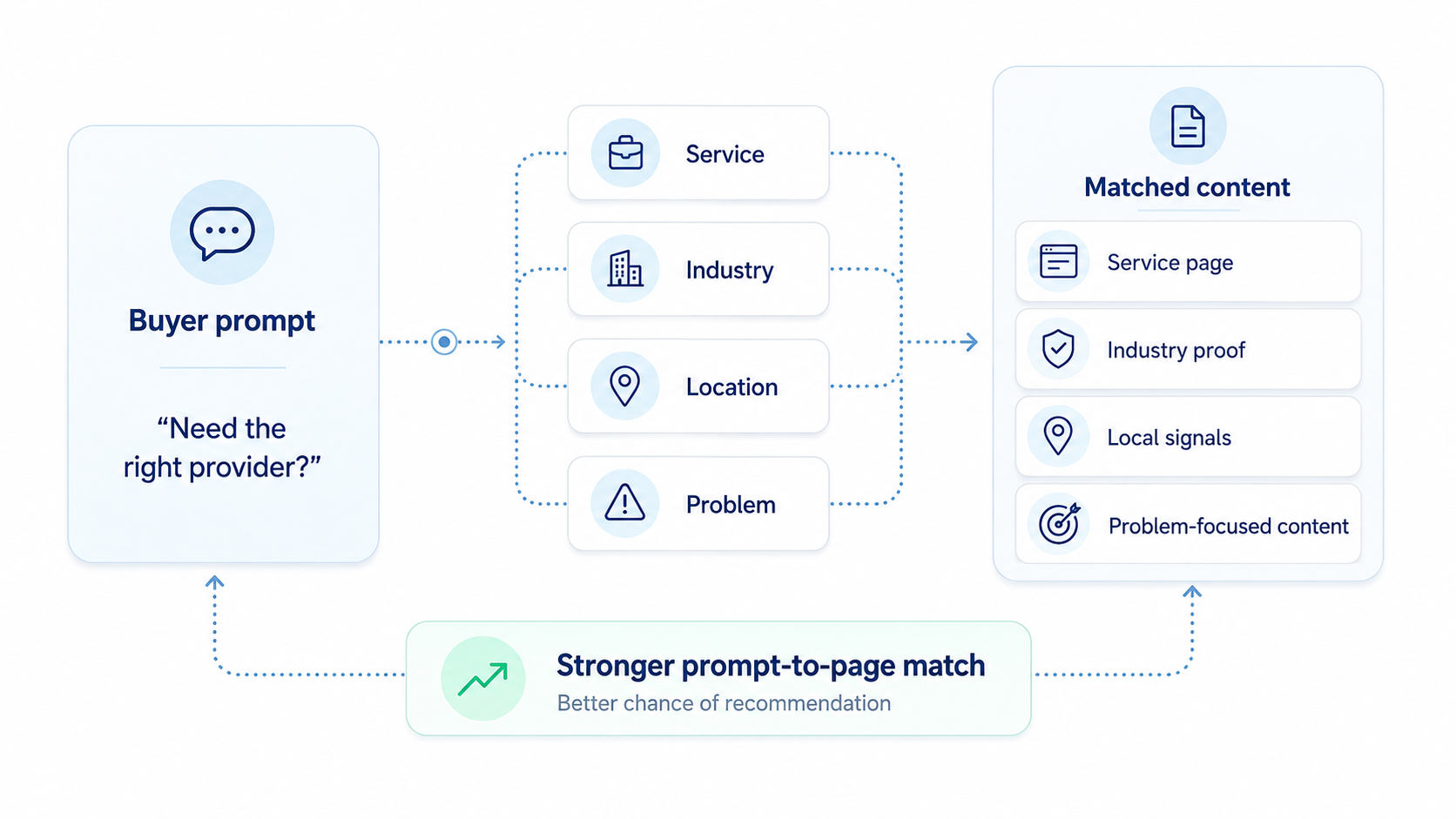
Make Each Important Service Page Easy to Understand
A visitor should know within a few sentences what the company provides and whether the service fits their situation.
Compare these descriptions:
“We provide tailored technology services that help organizations improve performance and support sustainable success.”
“We manage Microsoft 365 environments for accounting and legal firms with 25 to 250 employees across Texas. Our services include migration, security configuration, compliance planning, and ongoing user support.”
The second version gives ChatGPT, traditional search engines, and the prospective customer several useful facts. It names the platform, services, customer types, company size, and market.
Each priority service page should answer:
- What does the service include?
- Who is it designed for?
- Which problems does it address?
- Where is it available?
- How is the work delivered?
- What experience supports the company’s claims?
Keep major services on separate pages when they solve different problems or serve different buyers. A commercial insurance broker, for example, may need dedicated pages for cyber liability, commercial property, workers’ compensation, and industry-specific programs.
That focus gives ChatGPT a relevant destination for a precise question. It also gives the referred prospect a better page to land on.
Put proof close to the claim
“Experienced in manufacturing” is a claim. A linked case study explaining the client, project, constraints, and result is evidence.
Useful proof may include:
- A relevant customer story
- A measurable result with context
- A named specialist and accurate biography
- A professional credential
- A clear description of the company’s method
- Original research or firsthand observations
Keep the evidence on or near the page making the claim. Prospects shouldn’t have to search the website to find out whether you’ve completed similar work.
Keep One Accurate Version of Your Business Across the Web
ChatGPT may encounter your homepage, LinkedIn profiles, business listings, reviews, association pages, partner websites, and older press coverage.
These sources don’t need identical wording. They do need to agree on the facts.
Review your:
- Company name and contact information
- Core services and customer groups
- Office locations and service areas
- Leadership team
- Industry credentials
- Business description
- Official social profiles
Run this check after a rebrand, acquisition, office move, leadership change, or service expansion. Old information can remain visible long after the business has changed.
Your website should be the source of record for current business information. Outside references help confirm it. Reviews, expert profiles, credible directories, customer stories, and media mentions all contribute to the sources that build AI search credibility.
Concentrate that proof around the services you want to grow. Ten unrelated mentions may add less value than one respected industry source that describes your expertise accurately.
Make Sure ChatGPT Can Reach Your Pages
Good content can’t contribute to an answer when search systems can’t access it.
OpenAI uses a web crawler called OAI-SearchBot to find public pages that may appear in ChatGPT Search. A crawler is software that visits websites, follows links, and collects information for search systems.
OpenAI’s current publisher guidance says public websites may appear in ChatGPT Search and advises companies not to block OAI-SearchBot when they want their content discovered and cited.
Your SEO or web team should check that:
- OAI-SearchBot is allowed in robots.txt and isn’t blocked by the site’s CDN or firewall
- Important pages are open to search engines
- Old URLs redirect to the correct pages
- Broken links and server errors are repaired
- The site has an XML sitemap
An XML sitemap is a file that gives search engines a list of the website’s important pages. Think of it as a directory that helps crawlers find current service, location, and content pages.
The team should also review page titles, descriptive headings, internal links, and structured data. Structured data gives search systems explicit information about the company, services, articles, and locations. It can reduce ambiguity, but it can’t guarantee inclusion in a search or AI-generated answer.
Check what Bing can see
OpenAI identifies Bing as one of the search providers ChatGPT Search may use. Make sure your site is verified in Bing Webmaster Tools and that Bing can find the pages closest to revenue.
Microsoft’s AI Performance report, currently in preview, shows cited pages and sampled grounding queries, with newer views for intent, topics, citation share, and changes over time.
The report doesn’t indicate ranking, authority, placement, or whether a citation caused a sale. It can show whether commercially useful pages are contributing to AI answers or whether citations are concentrated on content with little connection to your services.
Test the Questions Buyers Ask Before They Know Your Name
A company-name search only tests recognition. Use non-branded prompts to examine discovery.
Choose five to ten prompts connected to one service. Include several types:
- “Who provides [service] for [industry] companies?”
- “Which [service] firms operate in [location]?”
- “Who can help a [company type] solve [problem]?”
- “What should I look for when hiring a [provider]?”
- “Compare providers that can meet [specific requirement].”
Run each prompt in a new conversation and record whether the company appears, how it’s described, and which sources support the answer.
Wording, location, available sources, and conversation context can affect the result. Look for repeated patterns instead of treating one answer as a permanent ranking.
A review of accuracy, citations, competitors, and visibility gaps across AI platforms can show where your company is being understood correctly and where the public record still needs work.
How Can You Improve Your ChatGPT Visibility in 30 Days?
|
Week |
Focus |
What to do |
|
Week 1 |
Choose where to compete |
Select one priority service, customer group, and market. Build a short list of realistic buyer prompts and record how ChatGPT currently describes or recommends your business. |
|
Week 2 |
Strengthen the main service page |
Clarify who the service is for, the problem it solves, where it’s available, how it works, and what qualifies your company to provide it. Check that related industry, location, and About pages support the same story. |
|
Week 3 |
Add proof and correct inconsistencies |
Link relevant case studies, expert profiles, reviews, and credentials to the service. Update outdated information across LinkedIn, directories, business listings, and partner profiles. |
|
Week 4 |
Check access and measure again |
Confirm that search crawlers can reach the page, then rerun the original prompts. Compare changes in recognition, citations, descriptions, and recommendations. |
Track the results that connect to growth: ChatGPT referral traffic, qualified inquiries, sales conversations, and lead quality. A mention has limited value if it doesn’t bring the right customer closer to a decision.
What’s the Right Next Step for Improving AI Search Visibility?
WSI AdaptiveSEO® prioritizes the services, markets, and buyer questions most likely to produce qualified demand. It then connects the content, credibility, and technical work needed to support them.
Your business doesn’t need to appear in every ChatGPT response. It needs to appear when the right customer asks the right question, with an accurate description and enough evidence to earn consideration.
Speak with a WSI Consultant to identify where visibility is breaking down and which improvements should come first.