
Key Highlights
- AI search visibility is becoming a credibility test. Businesses need public information that is clear, current, and supported beyond their own website.
- A strong website can no longer carry the full weight of discovery. Buyers and AI systems both look for outside validation before giving a business serious consideration.
- Credibility gaps create competitive openings. Outdated profiles, weak reviews, and inconsistent information can make a qualified business easier to overlook.
- AI search increasingly reflects real buyer behavior. The businesses that appear trustworthy across multiple touchpoints are more likely to earn attention before the sales conversation begins.
- Owned content, third-party validation, and market recognition work best together. When these layers support the same story, a business becomes easier to verify.
- Technical SEO gives credibility structure. It helps search engines and AI systems connect business details, services, locations, reviews, and expertise more accurately.
- The strongest source checks focus on priority gaps. Business leaders should look first at the issues most likely to affect buyer confidence, lead quality, and competitive visibility.
AI has changed how buyers discover and evaluate businesses. Search now acts more like a recommendation engine than a directory. AI-powered search pulls from websites, reviews, listings, media mentions, business profiles, and other trusted sources to decide which companies deserve attention.
Your website leads the story. Third-party validation helps determine how far that story travels. It defines your message, explains your services, and gives buyers a place to convert. But AI systems also look for outside validation. They compare your website against third-party sources to see whether your business information is credible, consistent, and supported elsewhere.
When those sources tell the same story, your business becomes easier to understand and recommend. When they are thin, outdated, or inconsistent, competitors with stronger proof can gain the advantage.
WSI’s AdaptiveSEO® framework helps business leaders strengthen the trusted sources that influence how AI systems assess relevance, credibility, and authority.
How AI Search Builds Answers From Multiple Sources
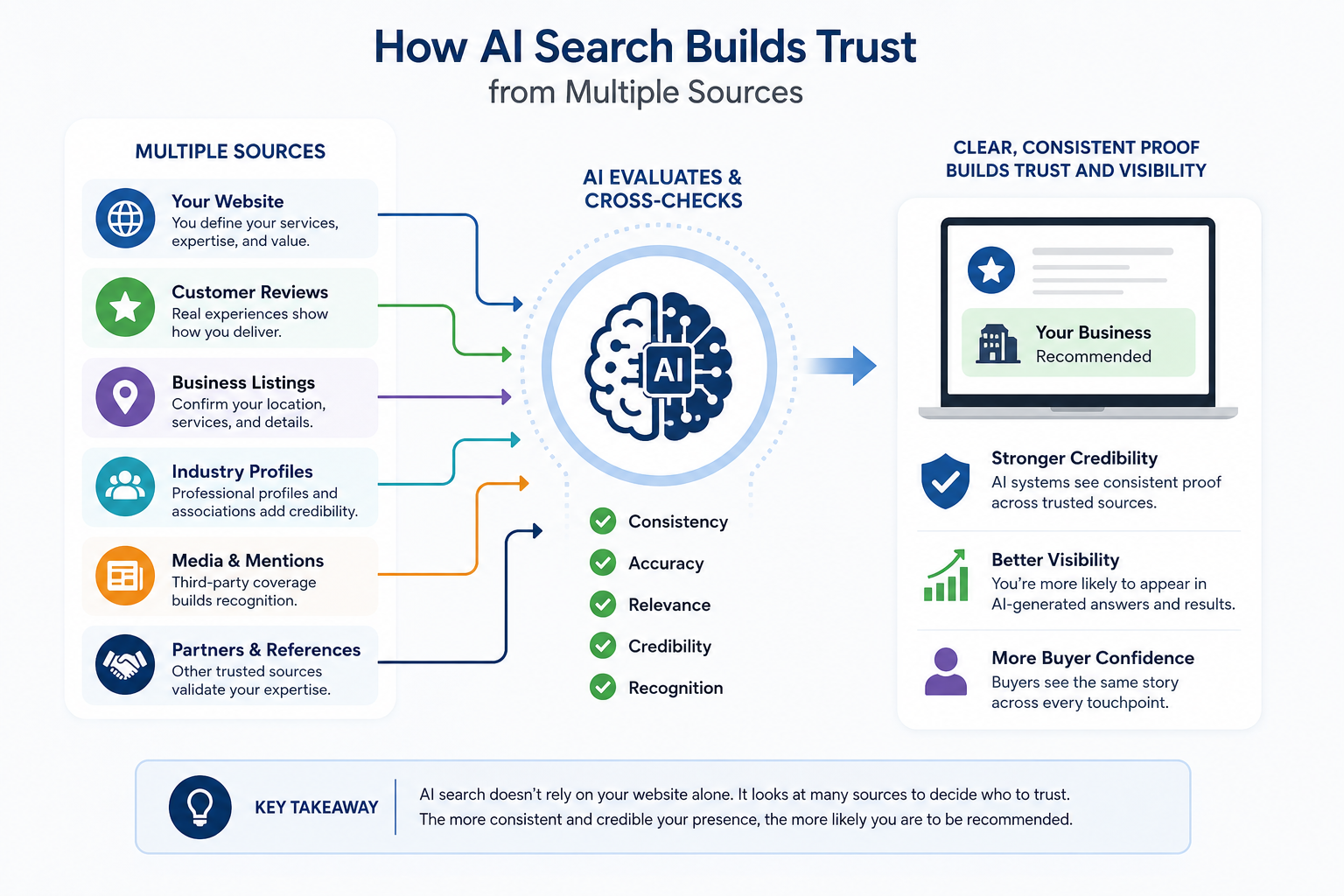
AI search builds answers by checking whether different sources tell a consistent story about a business.
Your website may explain what you do. Reviews show how customers experience it. Listings confirm your location, services, and contact details. Media mentions, industry profiles, and partner references can add credibility.
AI systems use those connections to decide whether a business is clear, credible, and relevant enough to include in a generated answer or recommendation.
That changes how visibility is earned. Keywords and backlinks still have a role, but AI search also looks for external validation from sources your business does not control.
When someone searches for a provider, AI systems may compare:
- What your business says about itself
- What customers and third-party sources say about it
- Whether your details match across platforms
- Whether your business shows signs of recognition in your market
The stronger and more consistent that proof is, the easier it becomes for AI systems to understand and recommend your business.
AI Search Now Mirrors Buyer Behavior
Buyers make decisions by comparing signals of trust across several places. They compare providers, read reviews, check case studies, look at profiles, and search for proof that a company can do what it claims.
AI search follows a similar pattern.
If your website says you specialize in a service, AI systems look for supporting evidence elsewhere. Reviews, industry listings, professional profiles, media mentions, and educational content can all help confirm that claim.
Strong content performs better when supported by outside sources. Without that validation, your business may be easier to overlook.
For example, a regional law firm may have strong service pages, but if its reviews are outdated, directory listings show different practice areas, and attorney profiles look incomplete, buyers have fewer reasons to trust the firm before reaching out. That same gap can affect AI search visibility because AI tools look for consistent, third-party validation when deciding which firms to surface.
In legal services, reviews are a major credibility marker: FindLaw reports that 82% of consumers who contacted an attorney after learning about them online used online reviews as part of their decision-making. Keeping reviews current, aligning directory listings, and updating attorney profiles helps the firm give both buyers and AI systems a clearer reason to trust it.
Why AI Needs More Proof Than Your Website Can Provide
Your owned channels still anchor your digital presence. They explain your value, define your services, and give buyers a place to take action.
But AI search does not evaluate your website in isolation.
It compares what you publish with what other sources confirm. If your listings are incomplete, reviews are weak, profiles are outdated, or third-party mentions are thin, your website has less support behind it.
That creates a credibility gap. Buyers may notice it. AI systems may notice it sooner.
Your website should remain the anchor. The opportunity is to surround it with trusted validation.
AI Looks Beyond the Sources You Control
Owned content still carries weight. Your website, blog, case studies, and service pages tell AI systems what your business wants to be known for.
But owned content needs support.
AI systems also look at sources such as:
- Customer reviews and ratings
- Professional profiles and company pages
- Industry directories and associations
- Media coverage and interviews
- Third-party educational content
- Partner and referral sources
These sources help confirm whether your business is active, credible, and recognized. When they align with your website, they build confidence. When they conflict, they create doubt.
Outdated listings, thin profiles, inconsistent service descriptions, or weak review activity can all make your business harder to trust. AI search visibility improves when your public footprint gives buyers and AI systems a clear, consistent reason to believe you.
Three Proof Layers AI Uses to Validate Your Business
AI search needs more than a clear website. It looks for proof that your business is credible, active, and recognized outside the places you control.
A strong AI visibility strategy usually depends on three proof layers.
1. Owned Authority
This is the content you control: your website, service pages, industry pages, case studies, and educational content.
Owned authority tells AI systems what you do, who you serve, and where your expertise sits. It should be clear, specific, and tied to the problems your buyers are trying to solve.
2. Independent Validation
This is the proof that comes from outside your business.
Reviews, testimonials, industry directories, associations, media mentions, awards, and PR coverage help confirm that your claims are supported by others.
This layer is especially important because AI systems look for consistency between what a business says and what credible third-party sources confirm.
3. Market Recognition
This shows whether your business is visible in the conversations and channels that shape your category.
LinkedIn activity, expert content, webinars, speaking opportunities, partner mentions, and industry commentary all help show that your business has a real presence in the market.
When these three layers support the same story, AI systems have more reason to trust what they find. When they are thin or fragmented, your business becomes harder to verify.
How Trust Signals, Citations, and Technical SEO Work Together
AI search visibility improves when credibility, consistency, and technical clarity work together. That is the role of AdaptiveSEO®: to connect the sources AI systems use to understand, verify, and recommend a business.
Build a Clear Trust Framework
- Start with consistency. Your business name, contact details, locations, services, and positioning should match across your website, directories, profiles, and third-party references.
- Small inconsistencies can create friction. A mismatched service description, outdated profile, or conflicting address gives AI systems less confidence in what they are reading. It also makes buyers pause, which is rarely good for lead flow.
- Citations help confirm legitimacy. A mention on a trusted website, directory, association page, or partner platform gives AI systems another point of reference. Quality matters more than volume.
- Brand mentions add another layer. When respected organizations reference your business, they help validate your expertise and market presence.
- Technical SEO makes that information easier to interpret. Structured data can clarify services, locations, reviews, and business details. Site architecture, crawlability, performance, and usability help AI systems and search engines access and understand your content.
- Content quality ties it all together. Clear, useful content based on real expertise gives AI systems stronger material to evaluate. Keyword-stuffed content has less value when AI is looking for proof, context, and credibility.
When these pieces align, your business becomes easier to verify. When they conflict, AI systems have less reason to surface you in recommendations.
How to Check Whether Your Trusted Sources Are Helping or Hurting Visibility
You do not need to start with a complicated audit. Start by checking whether the sources around your business are clear, current, and consistent.
Use these questions to spot the gaps:
- Where does information about our company appear online?
Review your website, Google Business Profile, directories, review sites, media mentions, partner platforms, and professional profiles. - Do our details match across those sources?
Check your business name, locations, services, descriptions, and contact details. Small mismatches can create doubt for buyers and AI systems. - Which third-party sources validate our expertise?
Look for reviews, testimonials, case studies, association listings, awards, media coverage, and partner references that support your positioning. - Where do competitors have stronger proof?
Compare their reviews, profiles, content footprint, media mentions, and industry recognition against yours. - What should we strengthen first?
Prioritize the gaps most likely to affect buyer confidence: outdated listings, weak review activity, missing service details, thin profiles, or limited third-party validation.
The goal is to focus on the sources most likely to shape buyer confidence and AI recommendations.
Strengthen Your AI Search Visibility Before Competitors Fill the Gap
AI search is changing how businesses earn consideration. Before a buyer reaches your website, AI systems may already be comparing your credibility against competitors.
That comparison depends on the evidence available across trusted sources.
Owned content explains your business. Reviews, citations, profiles, industry mentions, expert content, and technical SEO help confirm whether that story holds up across trusted sources.
Businesses that manage these sources deliberately are easier to understand, verify, and recommend. Those that leave gaps give competitors room to become the clearer choice.
Make AI Search Work From Stronger Evidence
Businesses that are easy to understand and verify are better positioned for search experiences where AI systems compare information across multiple sources.
WSI AdaptiveSEO® provides a structured approach to Adaptive Search Everywhere Optimization, helping businesses improve visibility across Google, AI search tools, and the trusted sources buyers rely on when comparing providers.
Reach out to a WSI Consultant for a review of your AI search presence. You’ll see which sources are supporting your visibility, where credibility gaps may exist, and what to strengthen first.