Key Highlights
- Discovery is becoming a trust test. Buyers use every search result, review, mention, and AI answer to decide who feels credible.
- Busy marketing hides weak systems. More campaigns can mask broken handoffs between content, channels, conversion, and revenue.
- Your website is no longer the starting line. Buyers may meet your brand through AI, reviews, social proof, or competitor comparisons first.
- Authority is earned in public. Mentions, citations, reviews, and expert content shape whether people and platforms take you seriously.
- Every page carries revenue responsibility. Any article, listing, or landing page could be the moment a qualified buyer decides to move forward.
Growth gets harder to predict when your visibility is scattered.
You add campaigns. You test new channels. You increase your marketing spend. Some numbers improve, others stall, and the pipeline still feels inconsistent. The problem usually comes down to structure: how your business is found, evaluated, trusted, and chosen.
That matters because your next customer may judge your credibility from the first result, mention, review, or AI-generated answer they see. Each touchpoint either builds confidence or creates doubt.
For growing businesses, this changes the job of SEO. Ranking well still matters, and so do AI visibility, content quality, trust signals, and clear conversion paths. To scale with confidence, you need an AI SEO strategy built around a connected visibility system that helps the right buyers find you, trust you, and take the next step.
That is how growth becomes more consistent: by building a smarter system for being discovered in the places that matter. Businesses that scale well connect search, AI visibility, content, authority, and conversion so every discovery moment has a better chance of becoming a business opportunity.
The Visibility Problem: Growth Depends on Being Found in the Right Places
Google still matters, but discovery now happens across a wider set of decision points. AI assistants, social media, review sites, retail platforms, industry directories, comparison pages, and niche communities all shape what buyers notice and trust.
The numbers show how much that discovery path has changed. Research from GWI shows that consumers now discover products across an average of about six sources. Search engines remain important, with 32.8% of consumers aged 16+ using them to find brands and products. Social media ads follow closely at 29.7%, while brand websites account for 25.8%.
Search behavior has also changed. A Bain & Company study found that roughly 60% of searches now end without a click, shaped by AI-generated summaries, featured results, and other zero-click experiences.
For growing businesses, this creates a practical challenge: discovery has to work across the full path to purchase. A strong Google ranking still helps, but buyers may also encounter your business through an AI answer, a third-party review, a LinkedIn discussion, a marketplace listing, or a competitor comparison.
When your business shows up in only one or two places, demand becomes harder to control. Strong performance in one channel can still leave gaps elsewhere. And those gaps matter, because every missing or inconsistent touchpoint gives buyers another reason to pause, question, or choose someone else.
A stronger AI SEO strategy connects the places where buyers search, compare, and decide. That means optimizing for search engines, improving visibility in AI-driven search, strengthening content across social and community platforms, and building credible signals across the channels your customers already use.
The goal is simple: make your business easier to find, easier to trust, and easier to choose when buyers are ready to act.
Why More Marketing Activity Stops Driving Growth
For years, scaling digital marketing followed a familiar playbook: publish more content, reach more people, generate more leads.
That playbook breaks down when activity grows faster than strategy.
The impact shows up quickly. Marketing activity increases, but the results do not always move with it. One channel performs well while another underdelivers. Leads come in, but quality varies. Reporting shows activity, while the bigger question remains unanswered: is this helping us grow more efficiently?
Search and discovery now reward consistency, credibility, and context across multiple signals. Your content, website, listings, reviews, social presence, and authority signals all need to work together.
When they do, growth becomes easier to manage. Costs become clearer. Returns become easier to improve. Marketing shifts from reactive activity to a structure that can support scale.
Adaptive SEO: How Growing Businesses Build Search, AI, and Trust Together
Adaptive SEO gives that activity a structure. After decades of helping businesses adapt through major shifts in digital marketing, WSI starts with the business goal, then builds the search, content, AI visibility, and conversion structure around it.
Traditional SEO focused heavily on keywords, rankings, and content volume. Those foundations still matter, but today’s buyers and search systems evaluate a wider set of signals across search, social, review, and industry platforms. They look for signs that your business appears credible, consistent, relevant, and useful across the places where decisions are shaped.
Every business already has a discovery footprint. It includes your:
-
Website
-
Search rankings
-
AI search presence
-
Content
-
Reviews
-
Listings
-
Social channels
-
Third-party mentions
- Conversion paths
The question is whether that footprint has been designed intentionally.
WSI AdaptiveSEO® approach helps growing businesses build that system with purpose. It connects how your business is discovered, evaluated, trusted, and chosen across search engines, AI platforms, and the wider digital spaces your customers use.
The result is a clearer path from discovery to decision, with content and authority signals that help buyers move forward with confidence.
The Three Signals That Make Visibility Work
A stronger discovery path depends on three signals working together: content, presence, and authority.
Content helps buyers understand your expertise. Presence makes sure they encounter that expertise in the right places. Authority gives those messages credibility.
When these signals work together, your business becomes easier to find, easier to evaluate, and easier to choose. That is where momentum builds: each useful answer, credible mention, strong review, and relevant platform presence strengthens the next one.
The Five Principles Behind Adaptive SEO
Scaling marketing takes structure. As channels multiply, disconnected campaigns become harder to manage, measure, and improve. More campaigns, more content, and more tools only help when they work toward the same business goal. Without that connection, teams stay busy while performance stays uneven.
Adaptive SEO helps growing businesses create that connection. It brings search, AI visibility, authority, content, and conversion together around five key principles:
#1 Technical SEO is still foundational.
Your website still needs to be easy for search engines to crawl, understand, and index. Site speed, structure, schema, mobile performance, and clean technical foundations all support stronger discovery. Technical SEO remains essential and now works as part of a broader growth strategy.
#2 Search Everywhere Optimization expands where you can be found.
Buyers look for answers across Google, AI tools, social platforms, review sites, directories, and industry-specific channels. Search Everywhere Optimization helps your business show up across those decision points with consistent, useful, and credible content.
#3 Citations and mentions strengthen credibility.
Clicks still matter. References from trusted sources now also play a bigger role in how buyers and AI systems evaluate authority. Quality mentions, backlinks, reviews, listings, and third-party references help reinforce that your business is a credible choice.
#4 Trust and authority shape who gets chosen.
As AI summaries and answer engines influence search results, buyers need clear signals that your business has real expertise. Consistent messaging, expert content, customer proof, reviews, and strong brand presence all help build confidence before a buyer reaches out.
#5 Every important page should support conversion.
A potential customer may enter through a blog post, service page, article, directory listing, or AI-generated summary. Each touchpoint should make your value clear, answer the next likely question, and guide the buyer toward a meaningful next step.
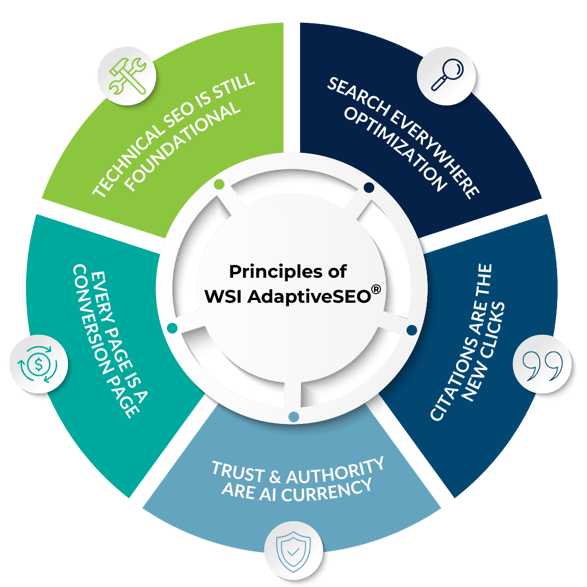 Adaptive SEO gives these pieces a shared purpose. It helps marketing move from scattered activity to a system that is easier to measure, improve, and scale.
The Business Impact of Adaptive SEO
When the system works, marketing becomes easier to manage, measure, and improve.
- Customer acquisition becomes more efficient because buyers can find you across the places they already search and compare.
- Conversion rates improve because each touchpoint gives buyers more reasons to trust your business.
- Reach expands across key channels as search, AI platforms, content, reviews, and social signals support one another.
- Performance compounds over time because each campaign builds on the authority and visibility already created.
- Growth becomes more measurable because marketing activity connects back to clear business outcomes.
The result is marketing that is easier to diagnose, easier to improve, and better equipped to support the next stage of growth.
Build the Growth System Your Business Needs Next
Growth becomes easier to scale when buyers can find you, understand your value, and trust your business across the full decision journey.
That takes a connected AI SEO strategy built around how people search, compare, and choose today.
With Adaptive SEO, WSI connects search, AI visibility, content, authority, and conversion around a clear business goal: creating more qualified demand that can be measured and improved over time.
If marketing activity has increased but results still feel inconsistent, start with the structure behind your growth. A strategic review can reveal how buyers are finding you, where trust is breaking down, and how Adaptive SEO can turn scattered activity into sustainable growth.