
Key Highlights
- SEO drives visibility. Thought leadership drives decisions. You need both to build real market authority.
- The real problem isn’t effort—it’s separation. When content and SEO operate independently, results don’t compound.
- Access + Influence = Authority. Being found is only half the equation. Winning happens when your perspective shapes decisions.
- AI is changing how buyers evaluate options. Inclusion in answers now matters more than just ranking in results.
- Generic content attracts attention. Perspective builds trust. Buyers don’t just want information—they want insight grounded in experience.
- Consistency builds recognition—and momentum. Authority comes from repeated exposure to clear, focused thinking over time.
- SEO turns expertise into a scalable growth lever. When aligned with intent, it connects what you know to when buyers need it.
- Most strategies generate activity, not momentum. Traffic without conviction doesn’t move pipeline.
- A system beats isolated tactics. Aligning SEO and thought leadership creates a repeatable engine for visibility, trust, and growth.
In many organizations, content and SEO evolve on separate tracks.
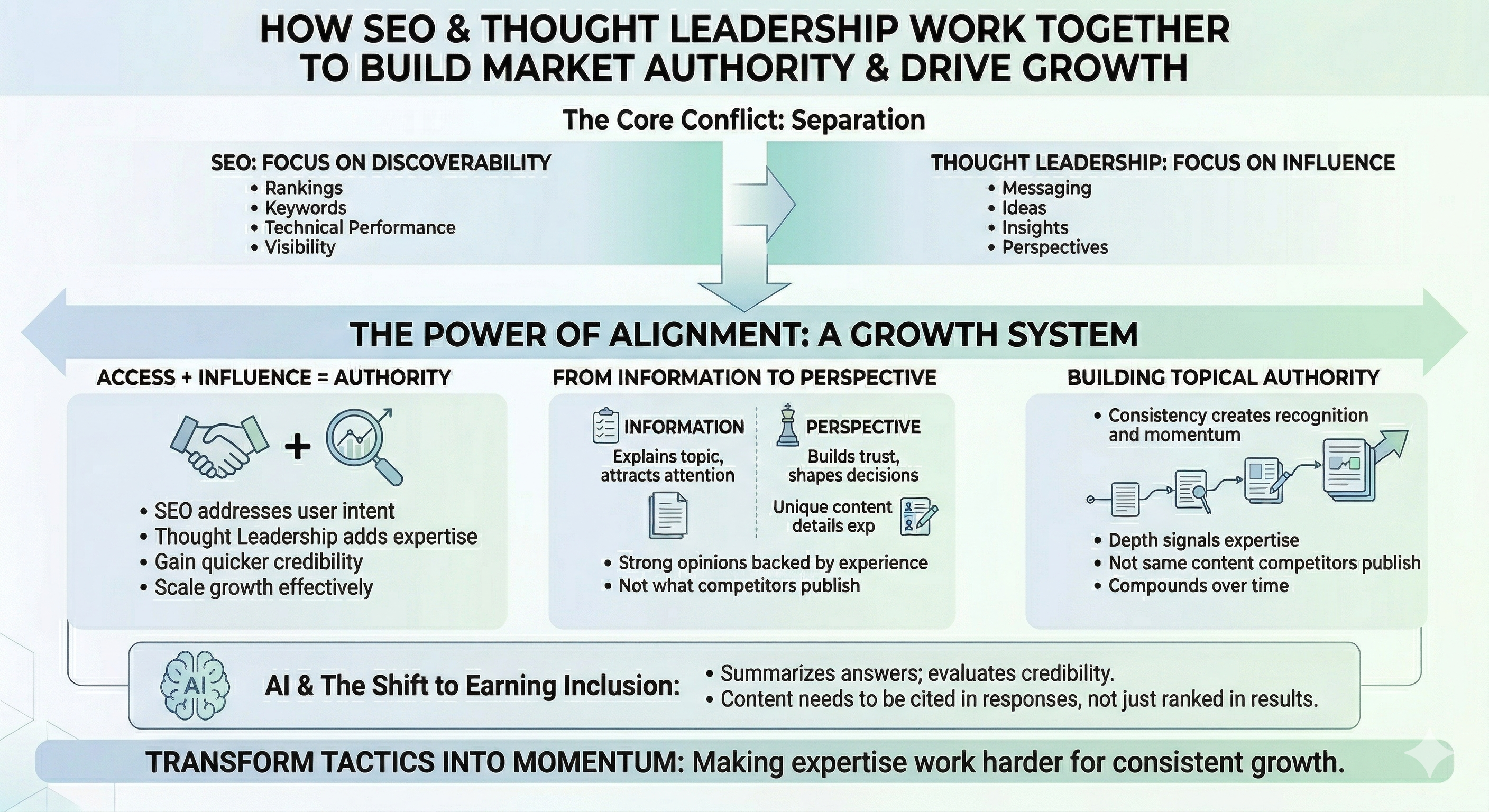
SEO efforts focus on rankings, keywords, and technical performance. Content focuses on messaging, ideas, and consistent publishing.
Both can show progress in isolation. But the impact on pipeline and growth often falls short of the effort behind them.
Content is published without a clear path to discovery. SEO drives traffic to pages that don’t fully demonstrate the depth of the business’s expertise.
Over time, this misalignment reduces both effectiveness and return on effort.
When these functions are aligned, the outcome changes. Expertise becomes easier to find, easier to understand, and more likely to influence decisions.
This isn’t just a tactical issue. It’s structural.
The Real Problem Isn’t SEO or Content. It’s Separation
Most businesses don’t struggle with SEO or content quality in isolation. They struggle because these functions are designed to operate separately.
SEO teams optimize for visibility. Content teams focus on messaging and publishing.
Neither owns the outcome that actually matters: influence on decisions.
That gap shows up in familiar ways:
- Traffic that doesn’t convert
- Content that doesn’t rank
- Activity that doesn’t compound
Until SEO and thought leadership are designed as a single system, results will always plateau.
Why Thought Leadership and SEO Need to Work Together
Thought leadership, in this context, is not about publishing more content. It’s about capturing real expertise, insights shaped by experience, client work, and real decisions, then making that expertise visible.
SEO addresses a different need. It ensures that expertise is discoverable at the right moment, when a potential buyer is actively looking for answers.
To make this more concrete:
|
Strong insights that aren’t aligned with search behavior remain difficult to find. Well-optimized content without original thinking may attract traffic, but rarely holds attention or builds confidence.
What drives results is how well they work together.
When expertise is structured around how buyers search, content is easier to find and more useful once someone lands on it. It starts to answer real questions in language the market already uses.
That’s when it starts influencing decisions instead of just generating visibility.
Recent research reinforces this. The Edelman–LinkedIn B2B Thought Leadership Impact Report found that 73% of decision-makers consider a company’s thought leadership a more reliable way to assess its capabilities than traditional marketing materials.
Insight builds trust, but only when it’s visible at the moment a decision is forming.
Visibility Gets You Found. Insight Gets You Chosen.
Search engines are effective at surfacing answers. But they don’t decide which business wins. That happens when a buyer evaluates credibility.
This is where many companies start to lose momentum.
They invest in SEO, generate traffic, and assume growth will follow. But if the content doesn’t demonstrate clear thinking or real experience, it fails to move the buyer forward.
Strong insights without search alignment also fail to reach the right audience.
The goal isn’t just traffic or content. It’s making what you know line up with what your buyers are actively trying to solve.
The Shift From Ranking Content to Earning Inclusion
Buyers don’t move through pages the way they used to. More of the evaluation now happens before a click, through summarized answers, recommendations, and comparisons generated by AI.
Here, ranking is only part of the equation.
What matters more is whether your perspective gets included, referenced, or cited in the answer itself.
This only happens when your content consistently shows:
- Clear expertise
- Depth of thinking
- Relevance to real-world problems
SEO helps you get considered. Thought leadership determines whether you’re included. That raises the standard for the content you publish.
Thought Leadership Turns Experience Into Market Influence
Your business is already generating insights through client work, challenges solved, and decisions made.
The issue isn’t a lack of expertise. Most of it never makes it into content.
Instead, many companies default to safe, generic topics that sound familiar but don’t differentiate.
That approach limits impact.
Move From Information to Perspective
There’s a difference between explaining a topic and advancing a point of view.
Information tells the reader what’s happening. Perspective tells them what it means and what to do next.
That’s what buyers are looking for.
Strong thought leadership:
- Interprets trends instead of repeating them
- Shares lessons from real execution
- Offers clear opinions backed by experience
If your content could be published by a competitor without edits, it’s not building authority.
Consistency Builds Recognition (and Compounding Value)
Authority doesn’t come from one standout article. It builds through repeated exposure to clear, consistent thinking.
When your content regularly addresses:
- The same core challenges
- The same audience segment
- The same strategic themes
You become easier to recognize—and easier to trust.
Over time, this consistency starts to compound, leading to:
- Returning visitors
- Higher engagement
- Faster buyer confidence
That’s when content starts contributing to pipeline, not just awareness.
SEO Makes Expertise Actionable at Scale
Expertise has limited business impact if it’s difficult to find.
This is where SEO becomes a growth lever, not just a technical exercise. It ensures your insights show up in the moments that matter, when buyers are actively researching, using their own language, and moving closer to a decision.
That connection, between what you know and when it’s discovered, is what turns content into a consistent source of pipeline.
Align Content With Real Buyer Intent
Keyword research isn’t about volume. It’s about intent.
The goal is to understand:
- What problems your buyers are trying to solve
- How they describe those problems
- What stage of decision-making they’re in
In practice, this is where many strategies fall short. Content gets created around topics the business wants to talk about, not the way buyers actually search.
When thought leadership is aligned with real search behavior, it becomes immediately more relevant. A strong internal perspective on operational efficiency, for example, has far more impact when it reflects how buyers actively look for solutions in that space.
That alignment reduces friction between discovery and engagement, making it easier for the right audience to recognize value.
Structure Drives Both Visibility and Clarity
Even strong insights can underperform if they’re difficult to interpret.
Search engines and AI systems rely on structure to understand content, but the same structure also shapes how buyers engage with it. When ideas are clearly organized, they are easier to follow, easier to evaluate, and easier to act on.
This comes down to a few basics:
- Clear headings
- Logical progression of ideas
- Defined topic focus
For business leaders, the benefit goes beyond rankings. Well-structured content is easier to scan, easier to apply, and more likely to hold attention in time-constrained situations.
It also increases the likelihood of being surfaced in AI-generated responses, where clarity and structure directly influence what gets included.
Structure doesn’t just support SEO. It determines how well your expertise is understood, and how quickly it can be put into action.
Building Topical Authority Over Time
One article won’t establish authority.
Search systems evaluate how consistently you cover a subject area. The more depth and continuity your content demonstrates, the stronger your authority signals become.
In practice, this means moving beyond isolated blog posts to a more connected body of work, where each piece builds on the last.
When that happens:
- Visibility increases
- Credibility strengthens
- Acquisition costs decrease over time
As coverage builds, each new piece of content becomes easier to discover and more effective once found.
This is where SEO starts to compound, shifting from a channel into a long-term growth asset. But even with the right building blocks, many businesses still struggle to turn this into consistent results.
Where Most Businesses Lose Momentum
The breakdown usually isn’t effort. It’s how that effort is applied.
In many cases, content and SEO continue to operate in parallel, without reinforcing each other in a meaningful way.
You see it in patterns like:
- Content created around keywords rather than real buyer questions
- SEO and content managed as separate workflows
- Volume prioritized over depth
- Opinions shared without grounding in real experience
Individually, none of these seem critical. Together, they create drag.
Content gets produced. Visibility may improve. But the impact on pipeline remains uneven, and the effort behind it doesn’t compound.
You can see it in a common pattern:
|
Turning Thought Leadership and SEO Into a Scalable Growth System
When thought leadership and SEO are aligned, content stops behaving like a series of outputs and starts functioning as a scalable growth system.
This is where most marketing strategies fall short.
They execute tactics—SEO, content, AI—without integrating them into a system designed to drive consistent outcomes.
A system does three things:
- Connects visibility to business goals
- Builds trust before sales conversations begin
- Compounds results over time
This is the difference between activity and growth.
This shift requires more than better execution. It requires a strategy-first approach, where content and SEO are designed together around how buyers actually evaluate decisions.
Making Expertise Work Harder for Growth
Your business already has the expertise.
What’s often missing is the system that turns that expertise into consistent visibility, trust, and pipeline.
When thought leadership and SEO are aligned under a clear strategy, content stops being a cost center and starts becoming a growth driver.
Not through volume. Not through shortcuts.
Through clarity, consistency, and compounding impact.
If your content is generating activity but not momentum, a WSI consultant can help identify where SEO and thought leadership are disconnected—and what it would take to turn them into a true growth system.