Key Highlights
- What zero-click searches are and why they matter for SMBs.
- Why 68% of Google searches now end without a single click.
- How AI Overviews, snippets, map packs, and business profiles affect organic traffic.
- Why ranking well is no longer enough to win search visibility.
- How local businesses can stay visible in a zero-click world.
- What content changes can help your business appear in AI-powered search results?
- Which SEO metrics matter when website traffic is no longer the full story?
Editor's Note: This post was originally published in September 2025 and has been updated with additional content about different types of landing pages in August 2026.
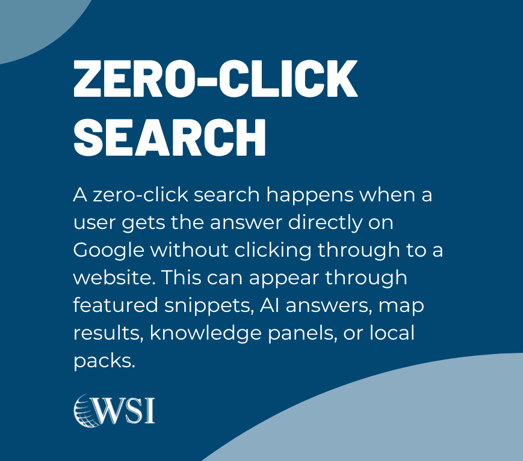
Zero-click searches now account for 68.01% of Google activity, signalling a tectonic shift in how people engage with search results and how the landscape of online visibility has fundamentally changed. Small and midsize businesses (SMBs), as well as top-ranked listings, are facing an unprecedented challenge in driving traffic to their website as AI Overviews, rich snippets, visual answers, and map packs dominate the results page.
A new AI-powered research report from WSI reveals the escalating challenge of online visibility in the AI search era, particularly for local service providers and B2B SMBs.
If you’re wondering how this plays out in practice, imagine a local bakery that shows up first in Google search for “gluten-free cupcakes near me.” In the past, that search might have driven dozens of clicks a day. Now, users see the bakery’s hours, photos, reviews, even its best-selling items, all without clicking through. The visibility is there, but the traffic is gone.
This shift, where users get what they need directly on the results page, is forcing a new conversation around what it really means to “show up” in search. This should create alarm, but not panic. People still click when they need proof, detail, pricing, comparison, or a direct next step.
What is a Zero-Click Search?
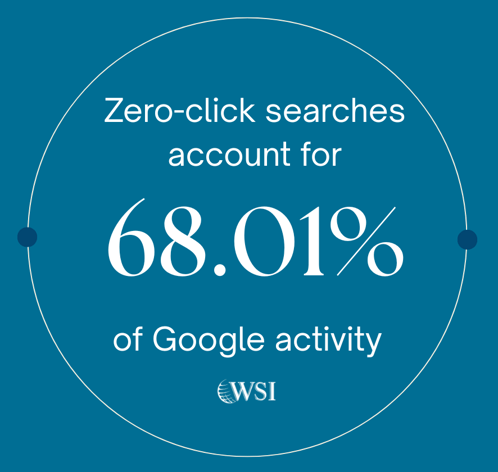
A zero-click search is a search in which the user gets the answer directly on the search results page and does not click through to any website.
Google may show the answer at the top of the page through a featured snippet, knowledge panel, map result, calculator, AI answer, or local pack. The user gets what they need without visiting a website.
For businesses, this matters because rankings alone may not bring traffic. Your content can appear in search results, but users may not click if Google answers the question directly.
This creates a new measurement problem. A business may gain visibility, calls, requests for direction, and recognition while still seeing a decline in traffic in analytics.
Key Findings from the Report:
- Data reveals that 68.01% of Google searches now end without a single click to external websites
- AI-driven SERP features, such as AI Overviews, are absorbing user attention and reducing engagement with traditional “blue” links
- Local businesses and B2B SMBs are seeing the sharpest drops in organic engagement in years
"This profound shift underscores a new reality for online visibility," said Cheryl Baldwin, Director of Marketing & Communications at WSI. "Ranking well is no longer enough. Your ability to be found online now depends on relevance, adaptability, and showing up across the evolving search experience—not just in the top ten results."
| 68% of Google searches now end without a click to an external website. That means your business can appear in search results, but still see fewer website visits. |
Why Zero-Click Searches Are Increasing
Zero-click searches are increasing because Google is giving users more answers directly on the search results page. Instead of sending users to a website for basic information, Google now displays summaries, business details, reviews, maps, product information, images, videos, and AI-generated answers within the search experience itself.
This shift is changing how people find and evaluate businesses online. Users can often get enough information to take their next step without clicking a traditional website result.
Several factors are driving the increase in zero-click search results.
Google Is Answering More Questions Directly
Google has expanded the number of search features that provide instant answers. These include:
- Featured snippets
- Google's AI Overviews
- Knowledge panels
- People Also Ask boxes
- Local map packs
- Business profiles
- Shopping results
- Image and video results
- Review summaries
- Calculators, definitions, weather, and quick facts
When these features answer the user’s question on the results page, there is less need to click through to a website.
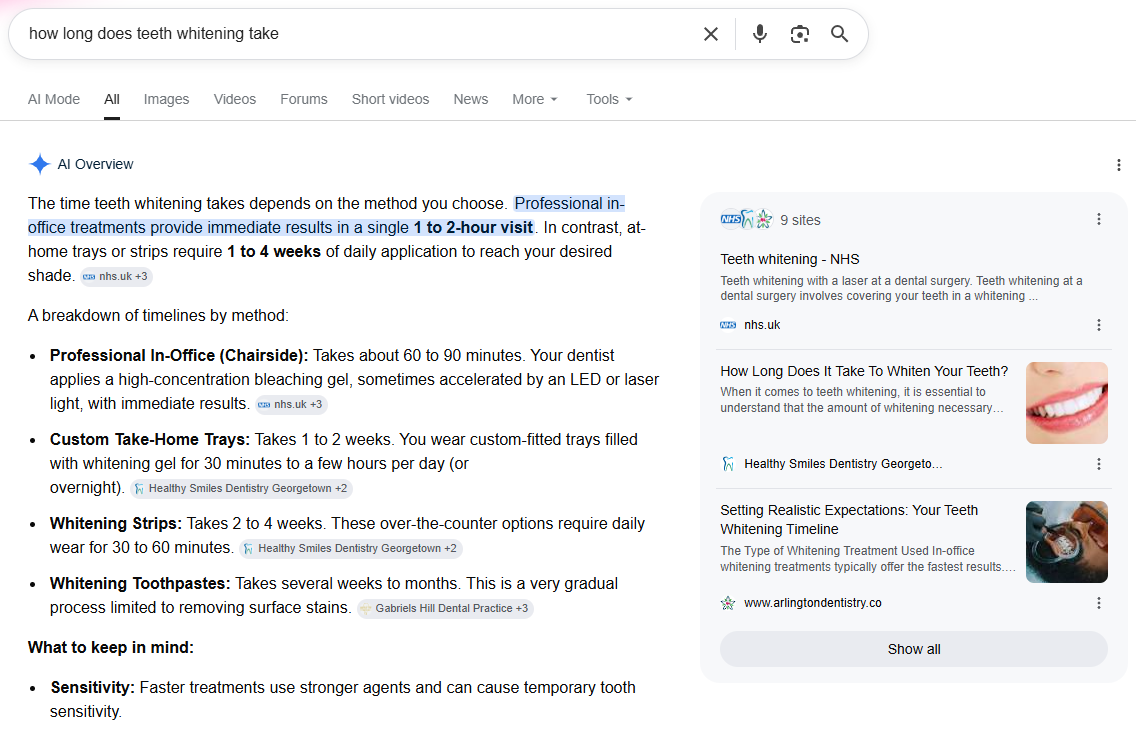
For example, someone searching “how long does teeth whitening take” may see a direct answer at the top of Google. Someone searching “best accountant near me” may see a map pack with ratings, phone numbers, hours, and reviews. In both cases, the user can get what they need without visiting a website.
AI Overviews Are Changing Search Behaviour
AI Overviews make it easier for Google to summarize information from multiple sources. Instead of showing only a list of links, Google can provide a direct response to the user’s question.
This affects SEO because users may read the AI-generated summary and stop searching. They may only click if they want more detail, need to compare options, or are ready to take action.
For businesses, this means content needs to be clear, useful, and easy for search engines and AI systems to understand. Long pages with vague explanations are less likely to perform well in this environment. Pages that answer specific customer questions clearly have a better chance of being used in AI-driven results.
| Write content that answers specific customer questions early and clearly. Use short sections, helpful headings, FAQs, and plain language that search engines can understand. |
Local Search Often Solves The User’s Need Without A Click
Local searches are a major driver of zero-click behaviour. When someone searches for a nearby business, Google often shows the most important decision-making details right away.
This can include:
- Business name
- Location
- Opening hours
- Phone number
- Directions
- Reviews
- Photos
- Popular times
- Services
- Questions and answers
- Booking links
A user searching for “emergency plumber near me” may call directly from the search result. A user searching for “Italian restaurant open now” may check reviews, view photos, get directions, and make a decision without visiting the restaurant’s website.
This is why local visibility matters so much. Your Google Business Profile, reviews, photos, and directory listings now play a direct role in whether customers choose you.
Mobile Users Want Faster Answers
Mobile search has changed user expectations. People searching on phones often want quick information, especially when they are on the move or making an immediate decision.
Common mobile searches include:
- Store hours
- Directions
- Phone numbers
- Prices
- Availability
- Reviews
- Nearby services
- How-to answers
Google designs many search results to satisfy these needs fast. That creates more zero-click searches because users can act directly from the results page.
For SMBs, this means your search presence needs to support quick decisions. Your contact details, service information, location data, and reviews need to be accurate everywhere they appear.
| Your Google Business Profile needs to be complete and current. Check your hours, phone number, services, photos, reviews, booking links, and business description. |
Users Are Asking More Specific Questions
Search behaviour has become more conversational. People now search using full questions, especially as AI tools and voice search become more common.
Examples include:
- “How much does a small business website cost?”
- “What is the best CRM for a local service business?”
- “How do I know if my website is ADA compliant?”
- “Do I need SEO if I already run Google Ads?”
These searches often trigger direct answers, People Also Ask boxes, AI Overviews, or featured snippets. Google tries to answer the question immediately, which reduces clicks to individual websites.
This makes question-based content more important. Businesses should create content around the real questions customers ask before they buy.
Search Results Are More Visual And Interactive
Google results are no longer just blue links. Many results now include images, videos, maps, ratings, product cards, FAQs, and comparison details.
These features help users evaluate options without leaving Google. For example, a user comparing local bakeries may look at photos, reviews, opening hours, and map locations before choosing one. A user researching software may see summaries, review ratings, and comparison snippets before clicking any website.
This creates more competition for attention on the results page. Businesses need to think beyond ranking position and consider how their brand appears across the full search result.
Google Wants To Keep Users Within Its Search Experience
Google benefits when users stay within its search environment. The more complete the search results page becomes, the more users rely on Google as the destination, not just the starting point.
This does not mean websites no longer matter. It means websites must work alongside other visibility assets, such as business profiles, review platforms, social channels, directory listings, and structured content.
Your website remains the home of your brand’s expertise. But users may first discover and assess your business in places outside your site.
How SMBs Can Adapt to the Zero-Click Search World
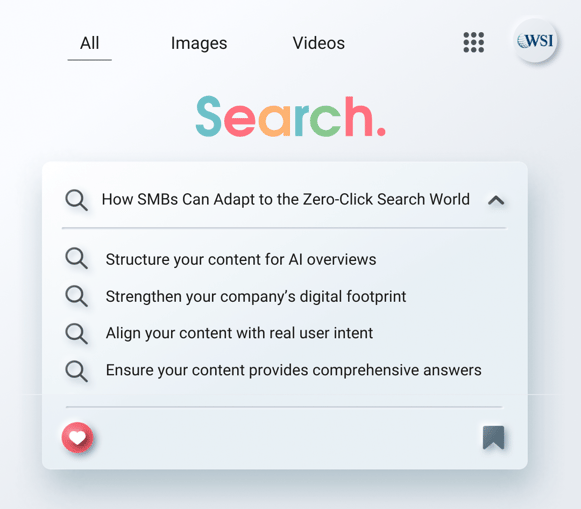
The report outlines three practical steps small and medium-sized businesses can take to stay visible as AI-driven search reshapes how users find information online:
- Start Structuring Your Content for AI Overviews: Drop the paragraphs and paragraphs of text when you're writing a blog post or web page. Instead, structure website content to answer common customer questions clearly and directly. Use schema markup, FAQ formats, listicles, and concise language that AI models and search engines can easily extract and display.
- Strengthen Your Company’s Digital Footprint Across the Web: Visibility now depends on more than just your website. Businesses must cultivate a strong presence on social media, industry directories, review platforms, online aggregators, and emerging chat-based interfaces, all of which feed into how AI systems assess credibility.
- Align Your Content with Real User Intent, Not Just Keywords: Move beyond keyword density. Create content that mirrors how people search and anticipates user questions. Ensure your content provides real, comprehensive answers. This will increase the chances of being cited by AI engines like ChatGPT and Perplexity.
You can dive deeper into these learnings in our blog post, AI Search Is Reshaping SEO: How SMBs Can Win in the Zero-Click Era.
You can also dive deeper into this in our recent press release.
Where GEO Fits Into Zero-Click Search
Generative Engine Optimization, or GEO, is the practice of improving how your business appears in AI-generated answers, summaries, and recommendations.
For SMBs, GEO is not separate from traditional SEO. It builds on the same foundations: useful content, clear website structure, strong local signals, reviews, trusted mentions, and accurate business information.
How GEO Differs From Traditional SEO
Traditional search focused mainly on rankings, clicks, and website visits. In AI-powered search, users may get an answer from an AI Overview, local pack, review summary, or chatbot response before they ever visit your website.
This means businesses need to think beyond traditional rank tracking. Ranking still matters, but brand visibility now also depends on whether your business is understood, trusted, and included in AI-generated results.
A Practical GEO Framework For SMBs
A practical GEO framework should focus on three goals:
- Answer each customer query clearly and directly.
- Build brand authority through expert content, reviews, and trusted third-party mentions.
- Keep your business information consistent across your website, Google Business Profile, directories, social platforms, and review sites.
Some marketers call this AI citation optimization. The goal is to improve your chances of being cited in AI Overviews and other AI-powered search results.
Why GEO Should Support SEO, Not Replace It
GEO should not be treated as a shortcut or a replacement for SEO.
The strongest approach combines traditional SEO with generative engine optimization. Your website still needs clear pages, helpful content, technical health, and local SEO basics. At the same time, your wider digital footprint must support trust, accuracy, and brand authority wherever AI systems gather information.
Ready To Be Found In The Zero-Click Search Era?
If 68% of Google searches now end without a website visit, your SEO strategy needs to account for more than rankings and clicks.
WSI can help you understand where your business appears across Google, AI Overviews, local packs, review platforms, directories, and other search features. We’ll assess your current visibility, identify gaps, and build a clear zero-click strategy to help your business show up where customers are making decisions.