
Key Highlights
- Better AI starts with better business context. Customer data, CRM activity, and company knowledge shape the quality of the output.
- CRM quality now affects more than reporting. More complete records can improve follow-up and give AI better information to work with.
- AI assistants are becoming more useful inside everyday workflows. Breeze Assistant can work from CRM history, pipeline activity, scheduled prompts, and agent routing.
- AI agents can take on more of the work between data and action. Nurture, prospecting, and deal progression show how AI can support research, prioritization, and follow-up.
- Choose the use case before the technology. Focus first on where better follow-up, less repetitive work, or stronger CRM data could improve a measurable business result.
Our team spent four days at HubSpot UNBOUND 2026, HubSpot's flagship event for marketing, sales, customer experience, operations, and AI. Across Partner Day, product demos, and three days of sessions, HubSpot kept coming back to the same idea: AI gets better when it knows more about the business using it.
You could see that thinking in the self-updating CRM, Context Home, Breeze Assistant, and the new AI agent updates. Each relies on customer history, CRM activity, sales conversations, company knowledge, and workflows to do more useful work.
We narrowed the event down to five developments with the clearest implications for lead follow-up, CRM value, and the amount of manual work teams still carry.
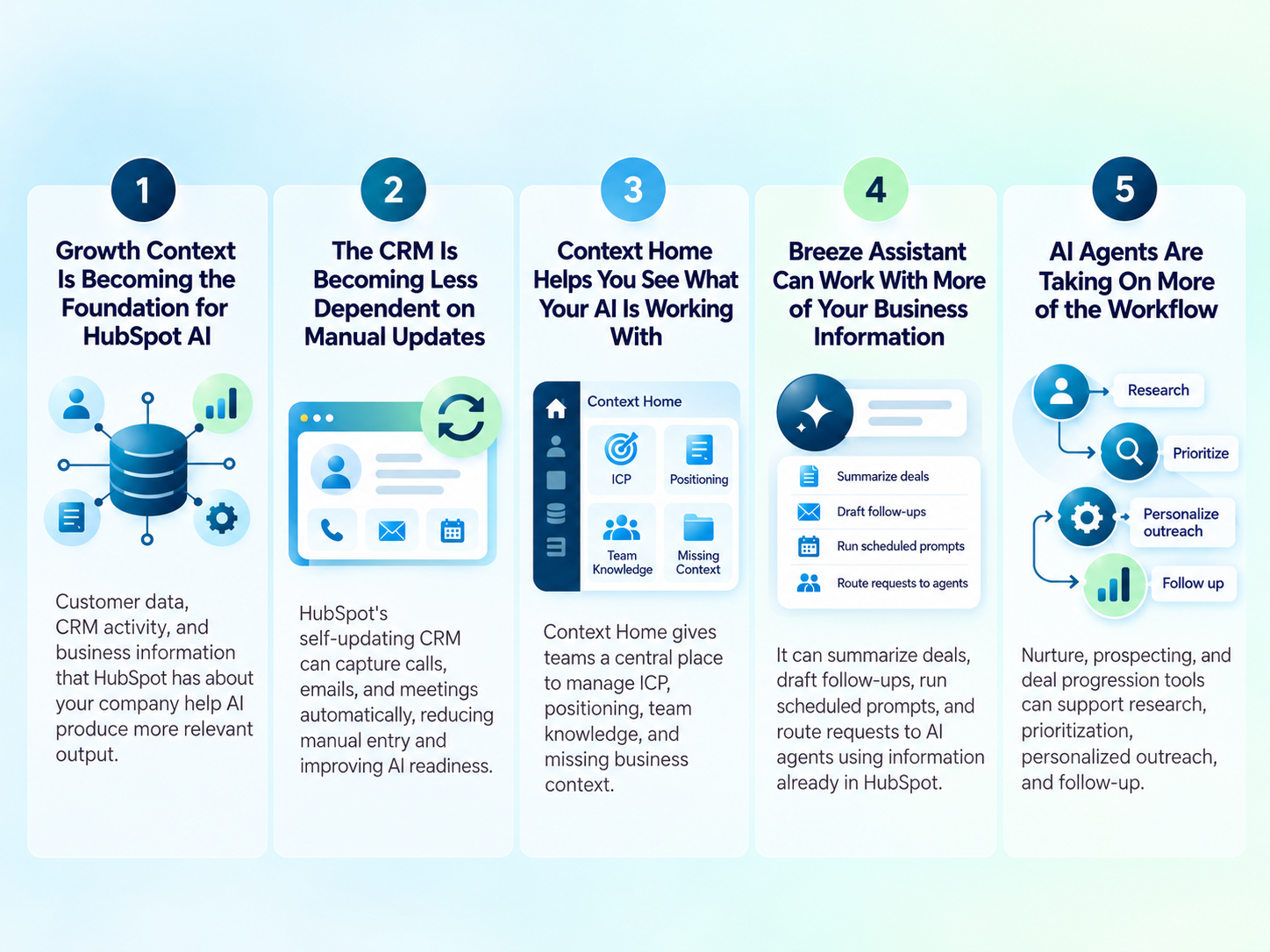
1. Growth Context Is Becoming the Foundation for HubSpot AI
HubSpot calls it Growth Context: the knowledge its platform has about your company, including customers, prospects, team activity, CRM records, and other business information that updates as new interactions happen.
At UNBOUND, HubSpot shared that customers using AI with high-quality context saw 5 times more MQLs, 4.7 times more deals closed, and 6.8 times more tickets resolved compared with customers using low-quality context.
The quality of the data is becoming central to the value businesses get from AI.
Even a capable AI model can produce weak work if it knows little about your customers, sales process, ideal customer profile, or past interactions. Before comparing feature lists, ask a better question: How much relevant information about my business can this AI actually use?
2. The CRM Is Becoming Less Dependent on Manual Updates
Anyone who has used a CRM knows how quickly it can become incomplete.
HubSpot's self-updating CRM is designed to capture calls, emails, and meetings automatically, reducing reliance on someone remembering to log an interaction later.
A prospect stops responding. A customer raises an objection. Someone promises a follow-up next Tuesday. When you capture those details, they can shape the next conversation, the next task, and the AI working with that account.
A neglected CRM used to create reporting problems. Now it can also weaken the quality of the AI working from that data.
3. Context Home Helps You See What Your AI Is Working With
HubSpot also introduced Context Home, a central place to manage information such as your ideal customer profile, team, and positioning. It also shows how complete that business context is, making missing or outdated information easier to spot.
The value is control. If AI is helping qualify leads, draft outreach, prepare follow-ups, or recommend next actions, you need to know what information is guiding that work.
Customer data, positioning, ICP information, and internal knowledge all affect the quality of the result.
4. Breeze Assistant Can Work With More of Your Business Information
HubSpot rebuilt Breeze Assistant to work more directly with customer records, previous conversations, and pipeline activity.
Ask it to summarize a deal or prepare a follow-up, and it can use information already stored in HubSpot. It can also route requests to AI agents, run scheduled prompts, and support voice input on mobile.
A pipeline review can start with a current summary. A recurring analysis can run on schedule. A follow-up can draw on what has already happened with the account.
The assistant becomes more useful because it can work from information the business already has instead of starting fresh each time.
5. AI Agents Are Taking On More of the Workflow
Marketing and sales teams have personalized nurture and outreach for years. AI agents can now handle more of the work between identifying an opportunity, using the available data, and taking the next action.
HubSpot's Nurture Agent can use CRM data and web research to tailor subject lines, CTAs, and email copy for individual contacts. Its Prospecting Agent can monitor target accounts for buying activity, compare them with your ideal customer profile, identify relevant contacts, and prepare outreach.
HubSpot is carrying the same idea further into active deals. Deal Progression can analyze emails, calls, and meetings to suggest next actions, draft follow-ups, and update CRM records.
Less manual research is one benefit. The more interesting possibility is giving people a better starting point: which account deserves attention, what has already happened, and what action makes sense next.
At WSI, we assess capabilities like these against the business result: can they improve follow-up, reduce repetitive work, or help people focus on better opportunities?
Choose the use case first. Then choose the technology.
What This Means for Your CRM and Marketing Stack
UNBOUND points toward a more connected CRM and marketing setup. Customer information stays current, sales and marketing activity is captured, and AI can work from the same business context across follow-up, prospecting, reporting, and customer engagement.
That makes one question especially useful: Is your current setup giving AI enough accurate information to help?
Start with the outcome you want to improve, then look at the data and workflows behind it. Better follow-up, less manual work, and smarter use of customer information all depend on that foundation.
Want to know where AI could save time, improve lead follow-up, or make better use of the customer data you already have? Talk to a WSI expert about where to focus first.