
Key Highlights
- How CRM systems contribute to business growth by enhancing customer relationships, boosting sales, and streamlining operations.
- The types of CRM systems and which is right for your business needs: Operational, Analytical, and Collaborative.
- Best practices for maximizing CRM benefits, including data quality, user adoption, and integration with other business systems.
- CRM’s impact on customer insights, team collaboration, and sales performance.
- How to overcome common CRM challenges and ensure successful CRM implementation.
Experts predict the global Customer Relationship Management (CRM) market will reach $275.3B USD by 2034—an impressive CAGR of 13% and a testament to the value CRMs bring to businesses of all sizes. Did you know that these complex platforms allow you to manage and analyze customer interactions and data throughout the customer lifecycle—all in one place?
Thanks to all these platforms’ perks, most professionals will agree that adopting a CRM is a no-brainer. But simply using a CRM isn’t enough. You need to maximize CRM benefits by implementing best practices that ensure effective data management, utilization, and integration into your overall operations, and you need to realize that what works for one company might not work for yours.
Here are a few CRM best practices to help make your chosen platform work for you.
What is CRM?
Customer Relationship Management (CRM) software is an information technology solution that businesses use to record and analyze interactions with both customers and prospects. By bringing all customer data together in one place, CRMs give a clear overview of the customer journey, from initial contact all the way to long-term retention.
With CRM, businesses can streamline communication, track customer interactions, automate repetitive tasks, and gain valuable insights into customer behavior and preferences. This not only strengthens relationships with current customers but also helps attract new ones by providing more personalized and effective experiences. In short, there are many benefits of using CRM for businesses aiming to grow, enhance customer satisfaction, and ensure long-term success.
Who is CRM for?
A Customer Relationship Management (CRM) system is designed for businesses of all sizes and across various industries, whether you're a small startup or a large enterprise. It’s particularly useful for:
- Sales Teams: CRMs help sales professionals track leads, manage opportunities, and streamline the sales process, making it easier to convert prospects into customers.
- Marketing Teams: Marketing professionals use CRMs to segment audiences, create targeted campaigns, and analyze data to improve outreach and engagement.
- Customer Service Teams: CRMs allow customer support teams to access customer histories, resolve issues quickly, and enhance the overall customer experience.
- Business Owners and Managers: CRMs provide valuable data-driven insights into customer behaviors, allowing business owners and managers to make informed decisions and improve business strategies.
Essentially, any team that interacts with customers, manages data, or looks to improve relationships can benefit from using a CRM.
How Does a CRM Add Value to a Business?
There are several benefits of customer relationship management for business, which include:
- A Customer Relationship Management (CRM) system brings substantial benefits to a business in several key areas:
- Improved Customer Relationships: By centralizing customer data, CRMs enable businesses to deliver timely and personalized communication, fostering stronger and more loyal customer relationships.
- Enhanced Efficiency: CRMs automate routine tasks like data entry and follow-ups, allowing employees to focus on high-priority tasks, which boosts overall operational efficiency.
- Better Data Management: With all customer interactions stored in one place, businesses gain real-time insights into customer preferences, pain points, and behaviors, leading to more informed decision-making.
- Increased Sales: CRMs help businesses track leads throughout the sales funnel, generate detailed reports, and streamline follow-up processes, which ultimately leads to better conversion rates and increased sales.
- Targeted Marketing: CRMs allow businesses to create highly targeted marketing campaigns by segmenting customers effectively, improving engagement, and maximizing return on marketing investments.
- Improved Customer Support: With quick access to relevant customer data, customer service teams can resolve issues more efficiently and respond faster, which significantly boosts customer satisfaction.
To truly leverage CRM for business growth, make sure you’re focusing on data quality, user adoption, and integration with other essential business tools (e.g., marketing automation, email platforms). These strategies ensure seamless operations and data accuracy, maximizing your CRM’s potential.
Types of CRM Systems
When choosing CRM systems, there are 3 types you should know about. Each one serves different needs depending on a business's size, industry, and goals:
Operational CRM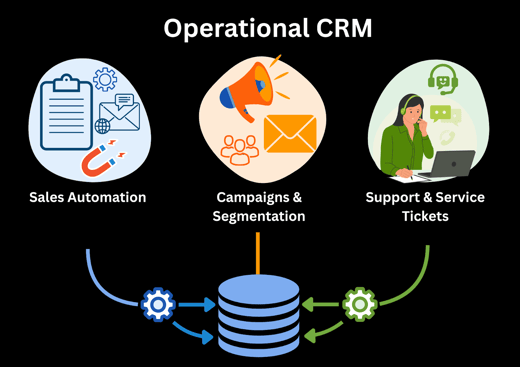
- Focuses on automating and improving customer-facing business processes like sales, marketing, and customer service.
- Helps businesses streamline tasks such as lead management, contact management, and marketing automation.
- Features include sales automation, marketing automation, and customer support management.
Best for: Businesses looking to improve operational efficiency and customer-facing processes.
Analytical CRM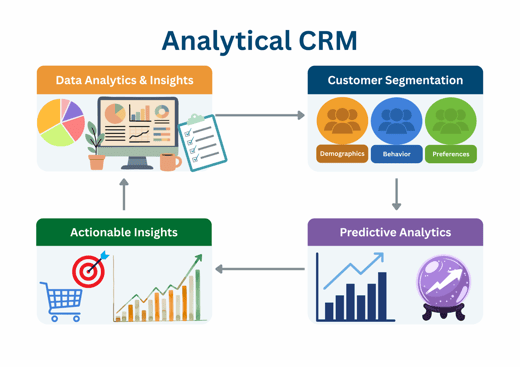
- Focuses on analyzing customer data to gain insights and make better business decisions.
- Uses data mining, customer segmentation, and predictive analytics to identify trends, behaviors, and opportunities.
- Provides actionable insights to optimize marketing efforts, sales strategies, and customer service.
Best for: Businesses that want to gain deep insights into customer behavior and improve decision-making through data analysis.
Collaborative CRM
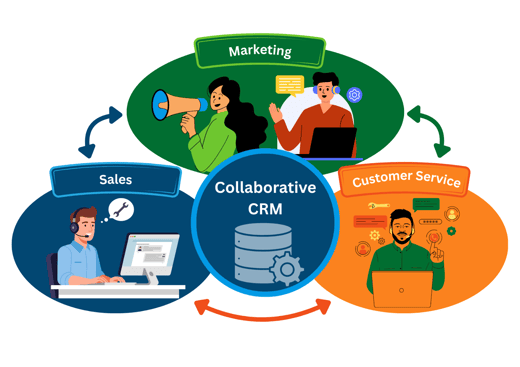
- Facilitates communication and collaboration across different departments, ensuring a seamless flow of customer information.
- Encourages real-time sharing of customer data between sales, marketing, and support teams to offer more personalized customer experiences.
- Features include shared calendars, document sharing, and customer interaction history.
Best for: Businesses that require multiple departments to work together and share customer information to improve service and satisfaction.
The Foundation for Growth
The concept of a “single source of truth” is the core of successful CRM utilization. This means consolidating all customer data into a centralized repository within the CRM so that you can get rid of data silos and ensure everyone in your organization has access to the same accurate and up-to-date information.
If you manage this, you’ll all be using the same platform and on the same page. This immediately leads to better collaboration and communication while empowering your company’s decision-makers to make informed calls based on a comprehensive understanding of your customers.
Streamlining Sales and Enhancing Customer Insights
70% of sales representatives believe that CRMs help them make more sales, particularly because they streamline sales processes—a massive USP (unique selling point).
By automating routine tasks, providing real-time visibility into sales pipelines, and facilitating lead nurturing, CRMs give sales teams everything they need to focus on what they do best: building relationships, closing deals, and improving that all-important bottom line.
Beyond sales, CRMs allow your team to get to know your customers intimately, a recipe for evolving alongside them and their demands. By tracking customer interactions, preferences, and purchase history, your team will better understand your target audience and be able to personalize all marketing efforts, tailor your product offerings, and deliver the types of experiences that keep your customers coming back.
Best Practices for Maximizing CRM Benefits
Now that you have a good idea of what a CRM can do for your business, it’s time to unpack how to make the most of those benefits:
- Data Quality in CRMs: The quality of a CRM’s data dictates its effectiveness. As the saying goes, "garbage in, garbage out." With that in mind, strive to regularly clean and update your CRM data to ensure accuracy and completeness. Implementing data validation rules and standardizing data entry processes to reduce errors and inconsistencies is also good.
- CRM User Adoption and Training: CRMs only work if everyone’s on board, so encourage widespread adoption of the CRM across all relevant departments by providing comprehensive training. Employees who feel confident using CRM effectively are more likely to implement it in their daily processes.
- Integration with Other Systems: While it’s a fantastic standalone tool, you can further boost your CRM with other essential business systems, such as marketing automation platforms, email marketing tools, and accounting software. The result? Seamless data flow and reduced human error – no more manual data entry!
- Customization and Automation: No “one CRM fits all” exists in business. Take the time to tailor your CRM to your company’s processes and workflows. Most importantly, embrace automation features to streamline repetitive tasks, such as lead assignments, follow-up emails, and data entry.
- Regular Reporting and Analysis: Use your CRM’s reporting and analytics capabilities to track key performance indicators (KPIs), identify trends, and gain actionable insights into customer behavior and sales performance.
These well-known best practices are key to getting the most out of your CRM… but here are a few bonus insider secrets—guaranteed to give you more value:
- Segmentation and Targeting: Go beyond basic segmentation and create highly targeted customer segments based on demographics, behavior, and preferences. This allows you to hyperpersonalize your marketing campaigns to build stronger customer connections.
- Social Media Integration: Integrate your CRM with social media platforms to track customer interactions, sentiment, and brand mentions. This will provide valuable insights into customer opinions and help identify potential leads and opportunities.
- Mobile CRM Access: Empower your sales team with mobile CRM access, enabling them to stay connected and productive on the go. They’ll get real-time updates, access to customer information, and the ability to close deals from anywhere.
| Garbage in, garbage out — your CRM’s effectiveness depends on the accuracy of your data. Make a habit of regularly cleaning your CRM data, implementing validation rules, and standardizing data entry processes. This will reduce errors and increase your CRM’s reliability and value. |
Common CRM Challenges
Implementing and managing a Customer Relationship Management (CRM) system can come with a variety of challenges. Some of the challenges of customer relationship management include: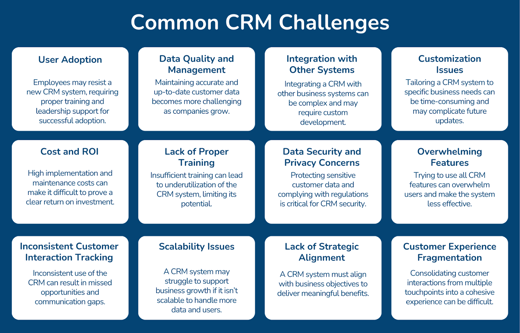
User Adoption:
- Many employees may resist using a new CRM system, especially if they’re used to older methods of tracking customer data (like spreadsheets). Proper training, engagement, and leadership support are necessary to encourage adoption.
Data Quality and Management:
- Maintaining accurate and up-to-date customer data can be difficult, especially as companies scale. Poor data quality, such as missing or inconsistent customer information, can reduce the effectiveness of the CRM.
Integration with Other Systems:
- CRM systems often need to integrate with other business systems like marketing automation tools, ERP systems, or email platforms. This integration can be complex and may require custom development or APIs.
Customization Issues:
- While CRM systems are designed to be customizable, tailoring a system to meet specific business needs can be time-consuming and costly. Over-customization can also lead to system complexity and make future updates challenging.
Cost and ROI:
- The cost of implementing and maintaining a CRM system can be high, and businesses may struggle to demonstrate a clear return on investment (ROI). Tracking the financial benefits from improved customer relationships, sales, or marketing effectiveness is not always straightforward.
Lack of Proper Training:
- If employees don’t fully understand how to use the CRM system, they may not utilize it to its full potential. Continuous training and support are necessary to ensure effective use.
Data Security and Privacy Concerns:
- With so much sensitive customer data in CRM systems, ensuring the security of that data is crucial. Companies need to follow best practices for data protection, comply with regulations (like GDPR), and prevent unauthorized access.
Overwhelming Features:
- Many CRM systems come with a wide range of features that may not be necessary for every business. If a business tries to use every feature, it can become overwhelmed and overcomplicated, making the system less user-friendly.
Inconsistent Customer Interaction Tracking:
- Ensuring consistent tracking of all customer interactions can be challenging, particularly if teams don’t use the system consistently. This could result in communication gaps or missed sales opportunities.
Scalability Issues:
- As businesses grow, their CRM systems must be able to handle increased data and users. If a CRM system isn’t scalable, it can become sluggish or unable to support future needs.
Lack of Strategic Alignment:
- A CRM system must align with the company’s overall strategy. If CRM goals are not aligned with the business objectives, the system may not provide the intended benefits.
Customer Experience Fragmentation:
- Multiple touchpoints for customer interactions (website, email, phone, in-person, etc.) can lead to fragmented data. CRM systems need to consolidate these interactions to provide a seamless experience, which can be difficult to achieve.
Addressing these challenges in CRM implementation requires careful planning, proper training, clear processes, and often the right technology solutions to ensure the system is a tool that helps, rather than hinders, business growth.
| User Adoption is one of the biggest obstacles to CRM success. To overcome this, provide your team with ongoing training, offer leadership support, and emphasize the importance of using the CRM daily. This ensures greater utilization and maximizes the CRM’s impact on business growth. |
Enhancing the Customer Journey with CRM Solutions
The customer journey is more complex than ever, and CRM solutions are essential for helping businesses map out and optimize every interaction. A CRM system can benefit your business by providing insights into how customers interact with your brand across multiple touchpoints, allowing you to personalize and improve the customer experience at every stage. One key benefit of CRM software is that it enables businesses to segment their customer base, tailoring communications and offers based on individual behaviors and preferences.
By setting up a CRM system that integrates with your existing business software, such as email marketing or e-commerce platforms, your business will benefit from seamless data flow and more accurate tracking of customer interactions. CRM systems also allow for greater visibility into customer support, ensuring that your customer service team can resolve issues quickly, improving both the customer journey and customer satisfaction. Whether you’re a small business or a larger company, a CRM will help you grow your business by providing actionable insights that enhance the overall customer journey and encourage customer loyalty.
Contact Us for Business Growth!
In conclusion, leveraging a CRM is essential for any business to streamline operations, enhance customer relationships, and drive growth. Among the myriad options available, HubSpot stands out as one of the leading CRMs. Its comprehensive suite of tools, user-friendly interface, and robust integration capabilities make it an invaluable asset for businesses of all sizes.
Regardless of your choice, by adopting best practices and utilizing best-in-class platforms for your business, you can unlock the full potential of your CRM and propel your business to new heights.
If you want to learn more about all the tried and tested tools available to help you manage customer interactions, sales processes, and marketing efforts, just speak to an expert. Our team of Consultants is here to support you with CRM benefits.