Key Highlights
-
Google’s AI Search updates raise the stakes for brand accuracy. Buyers are increasingly using AI-powered answers to compare options, check credibility, and decide which businesses deserve a closer look.
-
Visibility is no longer enough. If AI describes your business using outdated profiles, old positioning, or incomplete third-party sources, you can be found and still lose the buyer.
-
Your website is only one part of the picture. Reviews, directories, videos, forums, social profiles, and comparison articles can all shape how AI systems understand and describe your business.
-
Branded prompts are becoming a shortlist risk. Buyers may ask AI how your business compares, what you cost, what complaints exist, or whether you integrate with tools they already use.
-
AEO helps protect the version of your brand buyers see. Clear, accurate, and consistent sources make it easier for AI tools to understand your business and represent it correctly.
-
WSI AdaptiveSEO® connects AI visibility to growth. It brings together brand accuracy, Search Everywhere Optimization, trust signals, and buyer-focused content so businesses can stay visible, credible, and chosen.
Most of the conversation around AI search has centered on a single question: does AI mention your business?
That framing misses the bigger issue: does AI describe your business accurately when buyers are deciding who makes the shortlist?
At Google I/O 2026, that question became harder to ignore. Google described its latest Search updates as “a new era for AI Search” and introduced an AI-powered Search box, calling it Search’s biggest upgrade in more than 25 years.
For business owners, the risk is no longer being invisible. It is being visible for the wrong reasons.
Buyers using AI assistants to evaluate vendors are not always clicking through to your website to verify every detail. They may use an AI-generated answer to compare options, check credibility, and decide whether your business is worth a closer look.If that answer is built from outdated profiles, old positioning, or third-party sources you have not reviewed in years, the buyer may never know the difference.
You will.
An inaccurate AI representation can cost you a conversation, a shortlist spot, or a qualified lead.
At WSI, we see AI search accuracy as a growth issue. Earning the click still matters, but so does earning the right description before the click happens. That starts with making sure AI-powered search experiences can understand your business, trust the sources describing it, and reflect the version of your company you are selling today.
Answer Engine Optimization (AEO) is one part of WSI AdaptiveSEO®: our framework for helping businesses stay visible, trusted, and accurately represented as AI changes how buyers search. You may also see related industry terms like Generative Engine Optimization, or GEO; AI Search Optimization; and traditional SEO. Search Everywhere Optimization is a core principle of WSI AdaptiveSEO®, focused on building visibility across the platforms and sources buyers already trust.
How AI Decides What to Say About Your Business
AI tools build answers from more than your website. Reviews, social profiles, forums, videos, directory listings, comparison articles, and older pages can all shape how your business is described.
That matters because buyers may treat the AI-generated answer as a shortcut. If the sources behind that answer are outdated or incomplete, your brand can be misrepresented at the exact moment a buyer is comparing options.
This creates three practical risks for business owners:
1. AI may trust sources you do not control
A product review from two years ago, a LinkedIn company page with outdated positioning, an old landing page that was never removed, or a third-party comparison article can all influence how your business is described.
These sources often carry weight because they look independent. AI systems may treat them as credibility signals, especially when your owned content does not answer the buyer’s question clearly.
2. YouTube may influence more than your video views
Video, reviews, social profiles, directory listings, comparison pages, and forum discussions can all contribute to how AI systems understand your category, expertise, and positioning.
According to Ahrefs research, YouTube mentions had a 0.737 correlation with ChatGPT visibility, the strongest signal in the study. That does not mean every business needs to become a full-time video publisher overnight. It does mean your videos, transcripts, descriptions, and spoken keywords may contribute to how AI systems understand your brand.
YouTube can also become part of the evidence AI uses to describe your business.
3. Inconsistent signals can create confident but wrong answers
Search Engine Journal’s coverage of entity authority in AI search makes a related point: AI systems build understanding through associations. Your brand is connected to categories, attributes, services, people, locations, reviews, and third-party mentions.
When those signals are inconsistent or outdated, AI can produce an answer that sounds credible but sends buyers in the wrong direction.
Auditing What AI Says and Tracing It to the Source
The best starting point is a structured brand audit across the AI platforms your buyers are most likely to use.
Run a set of branded prompts through ChatGPT, Gemini, and Perplexity with web search enabled. Then evaluate the responses against three criteria:
-
Accuracy: Does AI describe your products or services correctly? Does it reflect your current pricing model, feature set, service area, or target audience?
-
Completeness: What is missing? Are there capabilities, differentiators, integrations, or use cases that AI consistently leaves out?
-
Positioning alignment: Does the description match how you want to be positioned in the market, or is AI repeating how you used to describe the business?
When you find a discrepancy, trace it back to the source. Most AI tools with web access will surface the pages they retrieved. If they do not, the issue usually falls into one of four buckets:
1. An outdated third-party article
Fix: Contact the publisher with a specific correction or updated description.
2. A stale social media or directory profile
Fix: Update the profile directly, starting with LinkedIn, Google Business Profile, YouTube, and major industry directories.
3. An old landing page that was never removed
Fix: De-index, redirect, or update the page so current pricing, services, and positioning are clear in accessible HTML.
4. A hallucination caused by missing information
Fix: Create a clear source that answers the question directly, such as an FAQ, help center article, comparison page, or blog post.
For businesses with a larger web presence, track this in a simple spreadsheet. Include the source, the issue, the recommended fix, the owner, and the status.
That turns AI brand accuracy from a one-off cleanup into a repeatable growth process.
At WSI, we recommend treating this as an ongoing visibility discipline, not a one-time AI check. The real value is knowing which inaccuracies can affect sales conversations, competitive positioning, and pipeline. 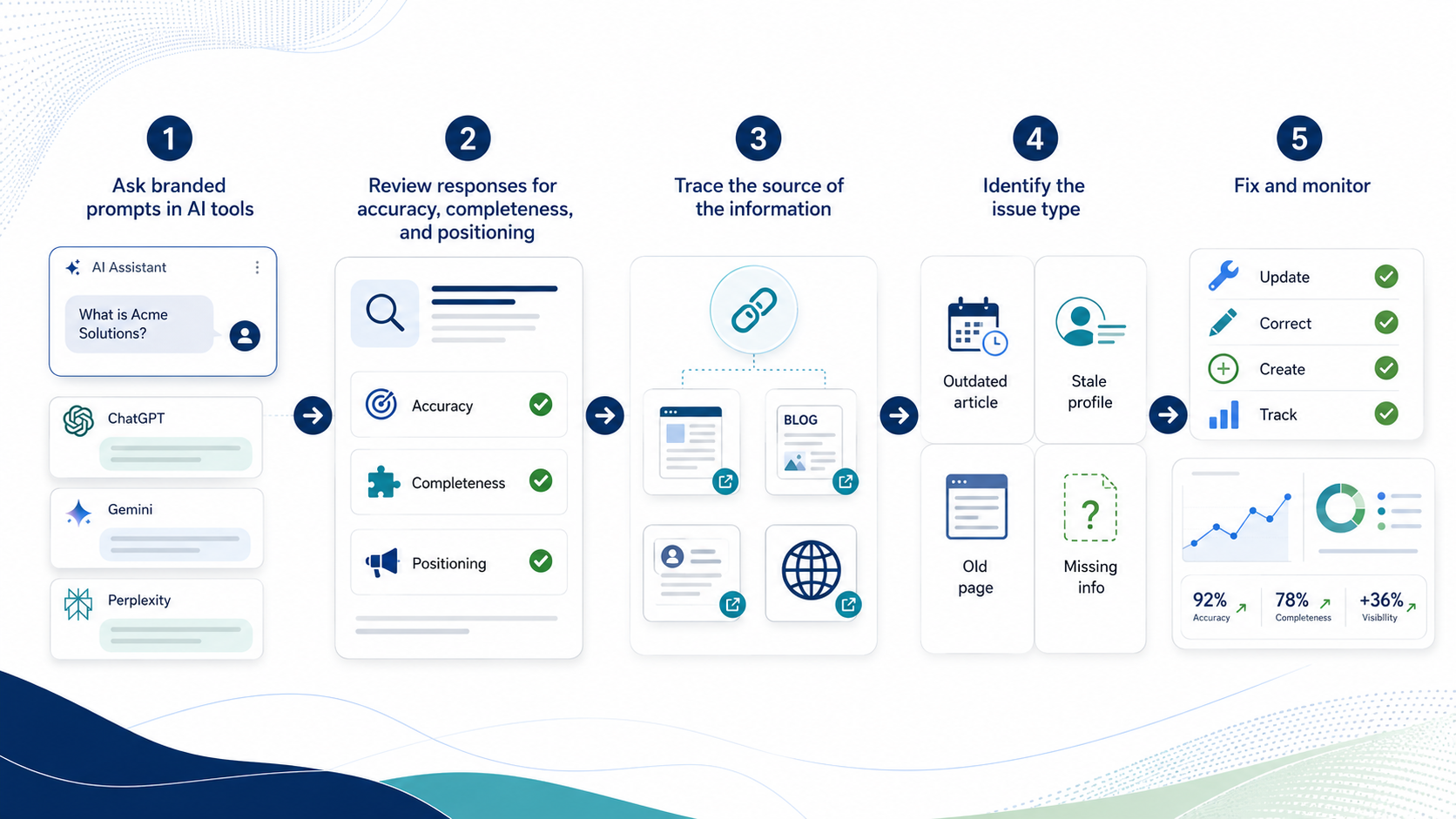
Building a Brand Footprint AI Can Trust
Fixing inaccurate sources addresses the immediate problem. The longer-term goal is to make sure your business appears consistently, accurately, and in the right context across the places AI systems are likely to look.
Ahrefs data on mention sources points to a useful hierarchy:
-
Third-party editorial content: Industry publications, review sites, authoritative comparison posts, and credible YouTube reviews.
-
User-generated content: Forums and communities such as Reddit and Quora, where buyers often discuss real experiences, complaints, recommendations, and alternatives.
-
Owned properties: Your website, YouTube channel, LinkedIn content, podcast, Google Business Profile, and other profiles you control.
Here’s the practical point: if your website is the only place explaining who you are, AI is working with a limited view of your business.
Brands are easier for AI to understand when the same message shows up across all three tiers. This is where Search Everywhere Optimization matters: your website is still your home base, but AI also learns from the places your buyers already trust.
Start with what you control:
Audit and update your owned profiles. Prioritize your LinkedIn company page, YouTube channel description, Google Business Profile, and any social accounts that appear in search results. These can usually be updated quickly and often provide clear signals for AI tools with web access.
Then fix the third-party pages AI already sees:
Identify the comparison posts, review articles, directories, and listicles AI is already citing for your brand or category. If your business is missing, outdated, or described inaccurately, prioritize outreach to those publishers. One accurate mention on a trusted comparison page can be more useful than ten new blog posts that only live on your own site.
Build your video presence with search in mind:
YouTube does not need to become a full production studio. Start with useful videos that answer specific buyer questions. Use keyword-specific titles, clear descriptions, timestamps, and spoken phrases that reflect how buyers search and compare options.
You do not need to be everywhere. You need consistency in the places buyers and AI systems already check.
 Go deeper:
Brand accuracy is only one part of the AI search shift. Read The AI Search Revolution: Adaptive SEO in the Age of AI, where we unpack the full WSI AdaptiveSEO® framework and show how businesses can stay visible, trusted, and chosen as search becomes more AI-driven.
Branded Prompts: The Query Set Most Businesses Are Not Monitoring
One of the most overlooked elements of AI brand management is the range of questions buyers are actually asking about your business.
Most businesses, when they think about AI visibility, focus on category-level queries: “best [service type] in [city]” or “top [product category] for [use case].”
Those queries are useful. But buyers who are already evaluating your brand are asking a different set of questions.
They are asking:
- How does [your brand] compare to [competitor]?
- Does [your brand] integrate with [tool they already use]?
- Is [your brand] worth the price?
- What are the most common complaints about [your brand]?
- How long does [your brand] take to implement?
These are not awareness prompts. They are shortlist prompts.
If AI gives buyers inaccurate, incomplete, or unfavorable answers to these questions, they may eliminate your business from consideration before ever visiting your website. You may never know it happened.
Google’s guidance reinforces that AI search does not replace SEO fundamentals. Google says its generative AI features are rooted in core Search ranking and quality systems, and that pages must be indexed and eligible to appear with a snippet to show as supporting links in AI Overviews or AI Mode.
Give AI tools and buyers a clear, accurate source to work from.
A useful source of these questions is your own sales team. Buyers who find your business through AI assistants often arrive with the conversation already in progress. Asking inbound leads what they prompted, and what AI told them, surfaces the exact query patterns worth optimizing for. It also reveals where AI is giving buyers incorrect information that your sales team then has to correct.
How to Measure AI Brand Accuracy
Total brand mentions and AI impression counts are easy to track, but hard to connect to revenue.
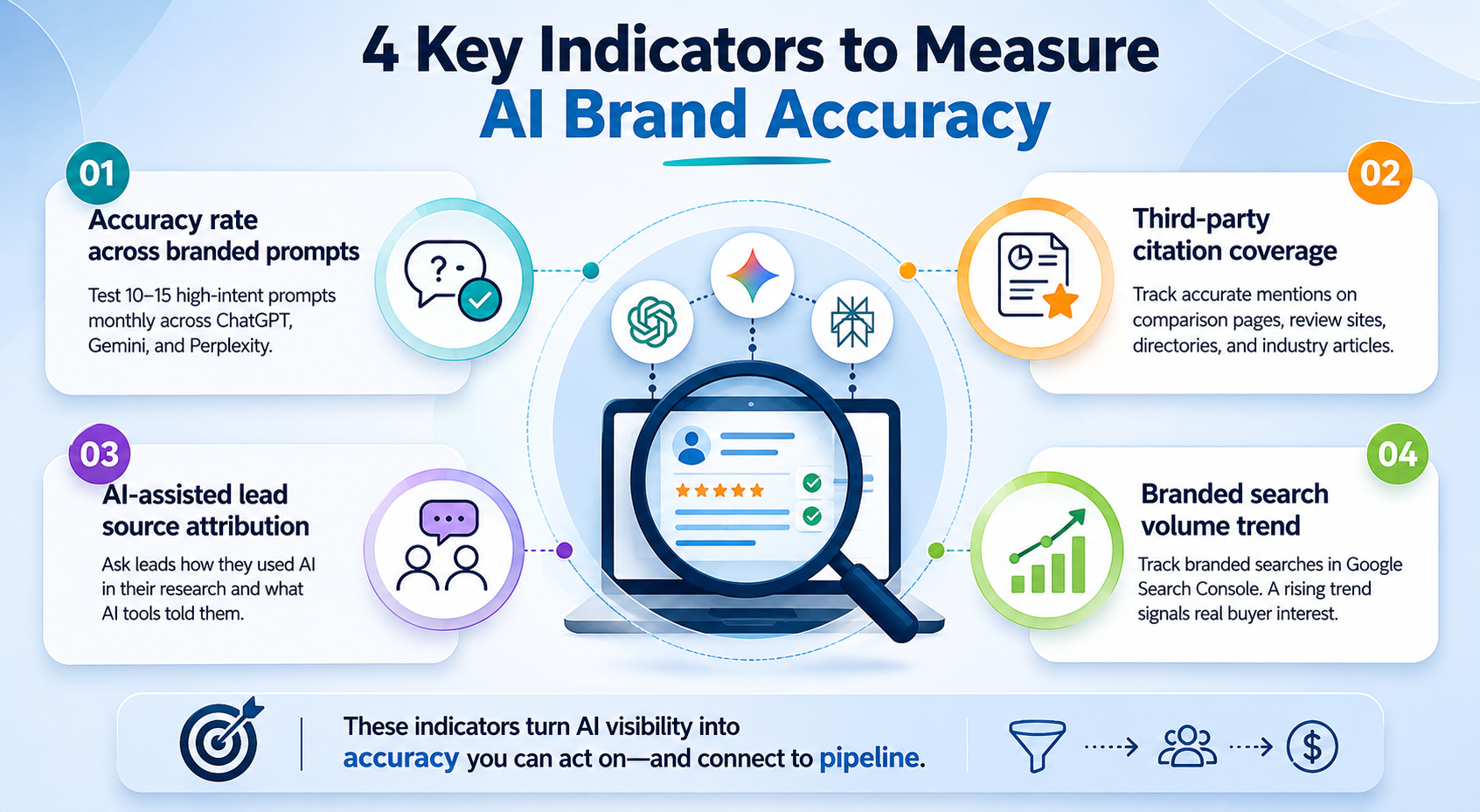
For AI brand accuracy, these four indicators are more useful:
1. Accuracy rate across branded prompts
Run a consistent set of 10 to 15 high-intent branded prompts across ChatGPT, Gemini, and Perplexity each month.
Track how many responses accurately reflect your current positioning, services, features, differentiators, and locations. This helps reduce the risk of buyers being misdirected before they ever reach your sales process.
2. Third-party citation coverage
Track how many authoritative comparison pages, review sites, directories, and industry articles include an accurate mention of your business.
This is easier to act on than trying to measure every AI citation directly. It also shows whether the sources AI is likely to trust are reinforcing the right version of your brand.
3. AI-assisted lead source attribution
Ask inbound leads whether they used AI tools during their research and what those tools told them.
This connects AI-assisted discovery to actual pipeline. It can also reveal where your sales team is having to correct outdated, incomplete, or inaccurate information.
4. Branded search volume trend
When AI accurately represents your business and buyers want to learn more, many will follow up with a direct branded search.
Track branded search volume in Google Search Console. A rising trend can be a downstream signal that your AI brand presence is creating real buyer interest, not just passive mentions.
See What AI Is Saying Before Buyers Do
AI platforms are already shaping how buyers evaluate vendors before the first conversation.
Start by finding out what they say about your business, your competitors, and the questions buyers ask before they reach out. Then fix the sources that are outdated, incomplete, or sending buyers in the wrong direction.
A WSI visibility assessment can help identify where your brand appears in AI-assisted search, which sources are shaping those answers, where competitors are gaining ground, and which fixes can improve how buyers find and evaluate your business.
Ready to see what AI is saying about your brand before buyers act on it? Request a WSI visibility assessment.