Key Highlights:
- How AI-driven personalization and predictive analytics are revolutionizing marketing strategies.
- Why voice search optimization and (GEO) are now essential for SEO success:
- The rise of immersive content (AR/VR) and its impact on customer decision-making.
- The shift from influencer marketing to creator-led content and micro-community engagement.
- How AI-driven automation is transforming PPC campaigns, from bidding strategies to ad copy creation.
If 2025 felt fast, 2026 is shaping up to be a sprint.
AI is maturing, search is transforming, and customer expectations keep climbing.
Growth-oriented businesses and marketing leaders aren’t just juggling new tools — they’re redefining how digital marketing actually works. And while the landscape feels crowded with “next big things,” a few trends are standing out as must-haves for teams that want measurable growth, not just new buttons to push.
At WSI, we look at trends through a single lens: How will this help a business grow predictably and profitably?
After working with thousands of companies over three decades, we’ve learned that any tactic is only as good as the strategy it supports.
Below are the five digital marketing trends for 2026 that you cannot ignore—with deeper guidance, WSI-level insights, and practical next steps grounded in real client experience.
AI Trends in 2026
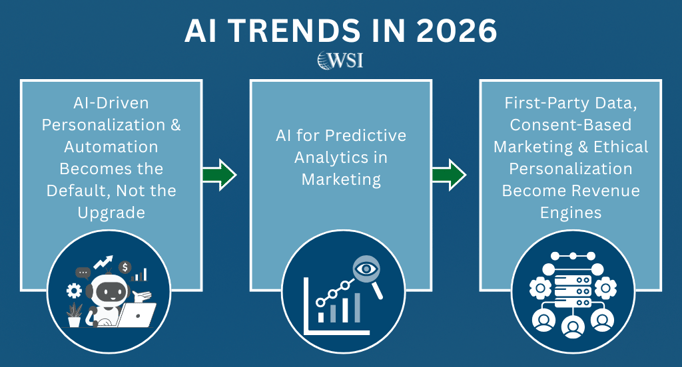
AI-Driven Personalization & Automation Becomes the Default, Not the Upgrade
The AI conversation in 2024 and 2025 was full of excitement, confusion, fear, and (let’s be honest) a whole lot of experimentation. But as we move into 2026, AI is quietly shifting from “shiny object” to “standard operating procedure.”
Businesses are no longer asking if they should use AI—they’re asking where it makes the most impact without overwhelming their teams.
🔮 What’s changing in 2026
AI tools are becoming more embedded, more intuitive, and more vertically specialized. You’ll see tech platforms roll out deeper automation — not just for content, but for segmentation, conversion modeling, lifecycle marketing, and predictive analytics.
At WSI, we’re already seeing AI deliver measurable lift when used within a strategy — not outside one. A recent WSI client in the B2B professional services space saw a 34% decrease in cost per lead simply by using AI-powered segmentation and automated lead-nurture flows that reflected real buyer behavior.
⚠️ Why it matters
- Customers expect Amazon-level personalization — even from small and midsize businesses.
- AI levels the playing field by helping lean teams act like large marketing departments.
- Companies using AI for personalization and workflow automation are widening the performance gap.
🗺️ What you should do (WSI guidance included)
- Start with the profit centers, not the tools. At WSI, we always map AI opportunities back to ROI drivers: lead quality, sales velocity, customer retention, and conversion rate. This prevents teams from wasting time automating the wrong things.
- Begin with a contained, high-impact pilot. Examples:
- AI-assisted ad creative testing
- Automated segmentation for email or CRM
- Predictive lead scoring
- Build human oversight into any AI workflow. AI accelerates. Humans align. Every successful AI program we’ve deployed includes checkpoints where specialists review, optimize, and correct the course.
AI for Predictive Analytics in Marketing
🔮 What’s changing in 2026
Predictive analytics powered by AI is transforming marketing decisions. Marketers are now able to use AI to forecast customer behavior and optimize campaigns ahead of time, rather than reacting to trends after they’ve emerged.
⚠️ Why it matters
- AI-driven predictions allow businesses to stay ahead of the curve and anticipate market shifts, creating proactive rather than reactive marketing strategies.
- Leveraging this capability not only saves time but also ensures that businesses remain aligned with customer preferences, increasing engagement and conversions.
🗺️ What you should do
- Invest in AI-powered analytics tools to predict behavior based on customer data.
- Test different predictive models, from lead scoring to content recommendations, to identify which drivers are most likely to influence customer actions.
- Always combine AI-driven insights with human intuition to ensure that predictive analytics align with real-time shifts in customer sentiment.
First-Party Data, Consent-Based Marketing & Ethical Personalization Become Revenue Engines
The privacy wave isn’t slowing down — and it’s reshaping how marketers collect, use, and measure data. The companies thriving in 2026 aren’t the ones scraping the most data. They’re the ones building trust-based, mutually valuable data exchanges.
🔮 What’s changing in 2026
- Third-party data is almost gone.
- Consent requirements are tightening.
- Customers expect transparency and control.
- “Value-exchange marketing” is becoming standard.
WSI teams have helped clients turn privacy changes into growth moments. When we redesigned a healthcare client’s data strategy around first-party consent and value-based lead capture, they increased qualified leads 27% year-over-year — despite losing third-party audience data.
⚠️ Why it matters
- First-party data is now one of the most valuable assets a company can own.
- Ethical data practices are becoming a competitive differentiator.
- Consent-based audiences convert better and cost less to remarket to.
🗺️ What you should do (WSI guidance included)
- Redesign your data capture with value in mind. WSI often builds these as “digital health checks” tailored to the client’s industry. Offer:
- Tools
- Calculators
- Personalized recommendations
- Exclusive content
- Upgrade your CRM strategy. Data is only valuable if it’s organized, modeled, and activated.
- Communicate your privacy philosophy clearly. Trust earns more data than aggressive tactics ever will.
| AI is now a fundamental part of every marketing strategy — making personalization and automation accessible to all businesses. Get ahead by using AI to optimize lead nurturing and segmentation. |
SEO Trends in 2026
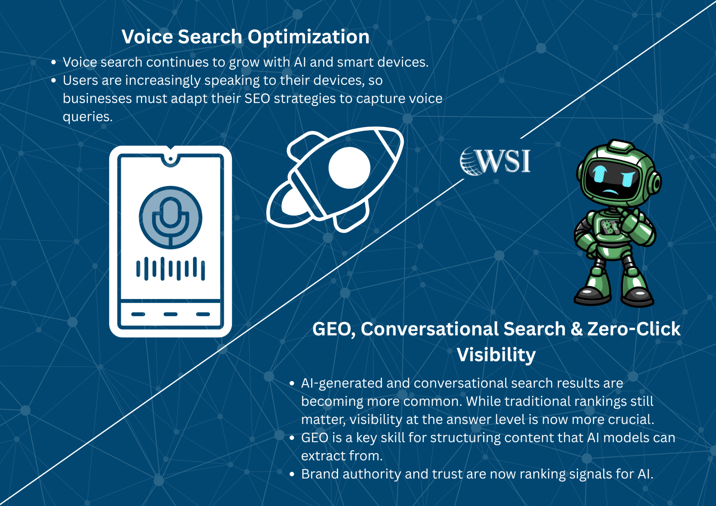
Search Transforms Again: GEO, Conversational Search & Zero-Click Visibility
Search is undergoing its biggest shift since mobile. Generative AI is changing how people discover information — and how businesses get found.
🔮What’s changing in 2026
- Search results are increasingly AI-generated and conversational.
- Traditional rankings still matter, but answer-level visibility matters more.
- “Generative Engine Optimization” (GEO) is becoming a core skill: structuring content so AI models pull from it.
- Brand authority and trustworthiness are now ranking signals for AI.
WSI consultants are already adapting SEO programs to include GEO-friendly structure. A recent B2B industrial client saw a significant lift in featured-snippet capture after we re-optimized their content with conversational context and structured FAQs.
⚠️Why it matters
- AI engines are becoming gatekeepers between users and websites.
- If your content isn’t structured for answer extraction, you risk being invisible.
- Companies that master GEO early will dominate zero-click environments.
🗺️ What you should do (WSI guidance included)
- Build content that directly answers qualified questions. We help clients create “Answer Hubs” — pages designed for:
- FAQs
- How-to clarity
- Conversational queries
- Schema markup
- Prioritize expertise and brand signals. AI models reward content with clear authority markers:
- Case studies
- Real examples
- Author bios
- Transparent data
- Treat GEO as an evolution, not a replacement. SEO + GEO together future-proof visibility.
Voice Search Optimization
🔮 What’s changing in 2026
With the rise of AI and smart devices, voice search continues to grow, and the way people search is changing. More users are speaking to their devices instead of typing, prompting businesses to rethink their SEO strategies for voice queries.
⚠️ Why it matters
- Voice search is becoming an integral part of consumer behavior, especially for mobile and home assistant devices.
- Voice queries are typically longer and more conversational, meaning traditional SEO methods need to adapt to capture this growing segment of search.
🗺️ What you should do
- Focus on natural, conversational keyword optimization.
- Ensure that your website’s content is structured in a way that makes it easy for voice search to extract quick answers (think FAQs, concise responses).
- Use schema markup and structured data to make your content more likely to be pulled in voice-based searches.
| Voice search is transforming how people find information online. Make sure your SEO strategy evolves to include conversational queries and optimized answers. |
Content Marketing Trends in 2026
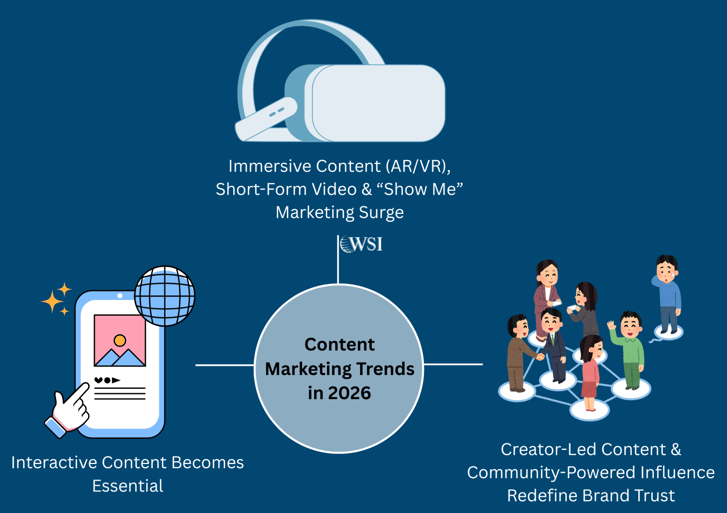
Immersive Content (AR/VR), Short-Form Video & “Show Me” Marketing Surge
Static content is losing ground — not because it’s bad, but because customers want faster paths to understanding.
The next phase of digital experience is highly visual, interactive, and friction-free.
🔮What’s changing in 2026
Short-form video continues its dominance, but now we’re seeing:
- More AR try-on and try-before-you-buy experiences
- Lightweight VR or mixed-reality demos
- Real-time video Q&A and shoppable streams
- Micro-learning videos replacing long explainer pages
At WSI, we’ve seen video-first strategies outperform text-only strategies by significant margins. One retail client who shifted 30% of their content budget to short-form video saw a 4X boost in engagement and a measurable increase in product-assisted conversions.
⚠️ Why it matters
- Consumers trust what they can see, experience, and “test drive” digitally.
- Video and AR accelerate decision-making — particularly for B2C, lifestyle, and higher-consideration e-commerce.
- Interactive content generates richer behavioral data (what viewers clicked, hovered on, replayed, etc.).
🗺️ What you should do (WSI guidance included)
1. Build a repeatable video engine: the goal is consistency, not perfection. At WSI, we help clients build lightweight systems:- Monthly video scripts
- Production templates
- “Always-on” social video calendars
- AR product demos
- 360° views
- Interactive landing pages
- Watch time > views
- Interactions > impressions
- Conversions > clicks
Creator-Led Content & Community-Powered Influence Redefine Brand Trust
Influencer marketing is evolving again — away from pure reach and toward genuine expertise, niche communities, and long-term co-creation.
🔮What’s changing in 2026
- Micro-communities are more powerful than mass audiences.
- Brands are partnering with creators as collaborators, not just broadcasters.
- Creators are involved earlier in the storytelling process — even in product development.
At WSI, we’ve seen niche creators outperform big influencers. A small creator with 12,000 followers drove more revenue for a hospitality client than a celebrity-style partner with 300,000. Why? Relevance and trust.
⚠️ Why it matters
- Buyers trust people who feel real — not overly polished brand voices.
- Creator partnerships generate content at a scale many internal teams can’t match.
- Communities amplify each other, improving reach and conversions without ballooning ad spend.
🗺️ What you should do (WSI guidance included)
- Think in terms of ecosystems, not one-off posts. We help clients build “Creator Ecosystem Plans” including:
- Tiered creators
- Community advocates
- Co-created assets
- Measurement frameworks
- Value engagement over follower count. Look at:
- Comment quality
- Save/share ratios
- Community discussions
- Set clear co-creation guidelines. Creators need space to sound authentic — but within a strategic framework.
Interactive Content Becomes Essential
🔮 What’s changing in 2026
Interactive content, including quizzes, polls, and calculators, is now a must-have for engagement. As the demand for personalized experiences grows, marketers are turning to interactive tools to better capture and retain their audience’s attention.
⚠️ Why it matters
- Interactive content fosters deeper engagement by actively involving users, making the experience more memorable and shareable.
- It also provides valuable insights into customer preferences, which can guide further content creation and marketing decisions.
🗺️ What you should do
- Start by incorporating simple interactive elements like polls or quizzes to personalize the user experience.
- Track engagement and responses to these tools to gather insights into customer preferences.
- Test interactive content for specific stages in the buyer’s journey—from lead generation to product selection.
| Building trust-based data models isn't just about compliance—it's about winning customer loyalty. Prioritize first-party data and ethical practices to enhance conversions. |
Social Media Trends in 2026
Social Commerce Becomes a Dominant Sales Channel
🔮 What’s changing in 2026
Social commerce is no longer a future trend — it's already a growing segment. Platforms like Instagram, TikTok, and Facebook are transforming from merely promotional spaces to direct shopping experiences.
⚠️ Why it matters
Social commerce allows for seamless, in-app purchasing, reducing friction in the buying process.
It’s an excellent way to capture impulse buys and reach a younger, more mobile-first audience who prefer shopping directly on social platforms.
🗺️ What you should do
- Ensure your products are shoppable directly within social platforms. Utilize features like Instagram's shopping tags and TikTok’s shopping integration.
- Focus on building shoppable content that is authentic and aligned with user-generated content to increase credibility.
- Track social commerce ROI with more granular measurement tools to continuously optimize your strategy.
Augmented Reality (AR) and Virtual Reality (VR) Integration in Social Media
🔮 What’s changing in 2026
As AR and VR technologies continue to advance, social media platforms are integrating these immersive experiences more seamlessly into their interfaces. Users will be able to try on products virtually, experience interactive brand activations, or explore virtual environments without leaving their social feed.
At WSI, clients who began integrating AR into their social media marketing campaigns reported higher engagement rates, particularly in the beauty, fashion, and furniture industries, with customers spending more time interacting with their products.
⚠️ Why it matters
- AR/VR allows brands to deliver highly interactive, memorable experiences that increase engagement, trust, and product adoption.
- These technologies enable customers to visualize products in real life or explore immersive brand experiences, leading to increased purchasing confidence.
🗺️ What you should do
- Start small by incorporating AR filters or "try-on" features into your social media strategy, especially on platforms like Instagram and Snapchat.
- Test VR-based brand activations, such as virtual showrooms or immersive brand experiences, for deeper customer engagement.
- Measure metrics like interaction time, product trial completion, and customer sentiment to assess the effectiveness of your AR/VR campaigns.
| Elevate your social media strategy with AR and VR. Users want to interact with products in real-time, making immersive experiences the new standard in engagement. |
PPC Trends in 2026
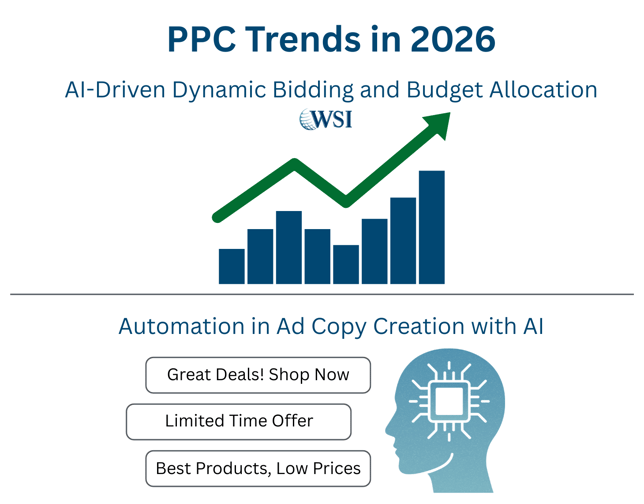
AI-Driven Dynamic Bidding and Budget Allocation
🔮 What’s changing in 2026
With AI integration, paid search platforms are now using dynamic bidding strategies that automatically adjust in real-time based on performance, audience, and other variables. This takes the guesswork out of budget allocation and maximizes ad spend efficiency.
⚠️ Why it matters
- Dynamic bidding allows advertisers to be more agile with their budgets, ensuring maximum return without manually adjusting bids.
- AI enables precision targeting, allowing businesses to avoid overspending on low-converting segments while focusing on high-performing areas.
🗺️ What you should do
- Switch to AI-driven bidding models like Google’s Performance Max to allow for automatic budget and bid adjustments.
- Regularly review AI recommendations but ensure human oversight to refine and optimize based on business goals.
- Test different bidding strategies in A/B campaigns to see which ones perform best with your target audience.
Automation in Ad Copy Creation with AI
🔮 What’s changing in 2026
AI is making its way into ad copy creation, where platforms like Google Ads are utilizing machine learning to automatically generate multiple ad variations based on inputs and data from past campaigns. These AI tools optimize messaging in real-time to drive the best possible results.
⚠️ Why it matters
- AI-generated ad copy allows for rapid testing of multiple creative variations, speeding up optimization and improving performance.
- By automating copy generation, brands can free up resources to focus on other strategic areas while the AI handles real-time ad testing and refinement.
🗺️ What you should do
- Leverage platforms with AI-powered ad copy generation, such as Google Ads' responsive search ads, and let the system test multiple variations of headlines and descriptions.
- Focus on providing high-quality inputs that match your brand’s voice and target audience, allowing AI to optimize the copy accordingly.
- Monitor performance and refine targeting or input criteria to ensure the AI-generated copy stays aligned with your campaign objectives.
| AI isn’t just for bidding — it’s transforming ad copy. Automate and optimize your messaging to ensure real-time relevance and improve performance. |
Bringing It All Together for 2026
If 2025 was about experimentation, 2026 is about integration. The companies that will grow the fastest are the ones that:
- Combine AI with a human-led strategy
- Balance immersive content with foundational SEO
- Build trust-based data models
- Partner with communities rather than speaking at them
- Invest in content that answers real questions
- Measure success with revenue, not vanity metrics
And perhaps most importantly, they don’t chase everything—they choose intentionally.
That’s where having a partner matters. At WSI, we work with business owners and marketing leaders who want clarity, structure, and measurable growth, especially in an environment that feels like it’s shifting weekly.
If you’d like to discuss which of these five trends fits your business most or how to build an action plan around them, let's connect here.