Key Highlights
- Why SMBs believe AI matters but still struggle to act
- What the AI Adoption Paradox means for business planning
- Where AI adoption is growing, and where gaps remain
- Why waiting on AI can cost time, performance, and confidence
- What blockers stop SMBs from moving from interest to action
- How to start small with AI, reduce risk, and measure progress
- Why training, ownership, and clear goals matter more than tool choice
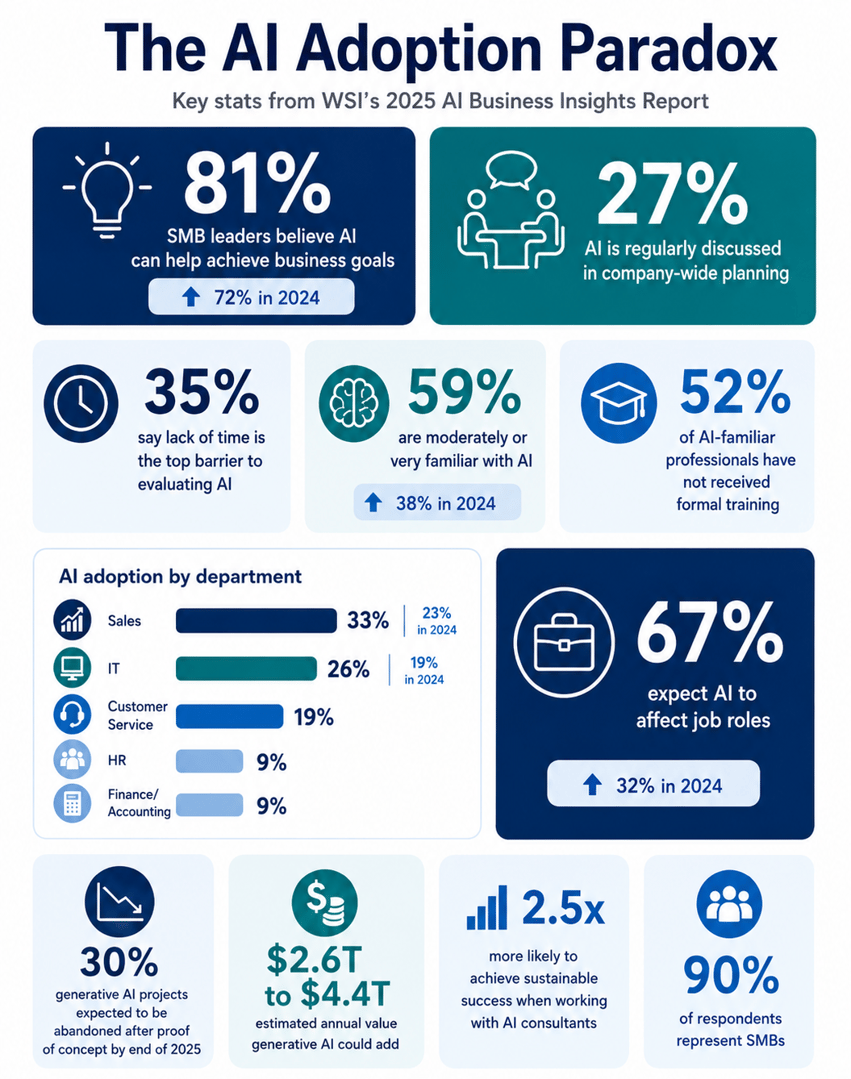
A significant gap is emerging between how small and medium-sized businesses (SMBs) talk about artificial intelligence (AI) and how they actually use it. According to a new global report, 81% of SMB leaders believe AI can help achieve their business goals, up from 72% in 2024. Yet only 27% say AI is regularly discussed in company-wide strategic planning.
|
81% of SMB leaders believe AI can help achieve business goals, but only 27% say AI is regularly discussed in company-wide planning. That gap shows the difference between interest and real adoption. |
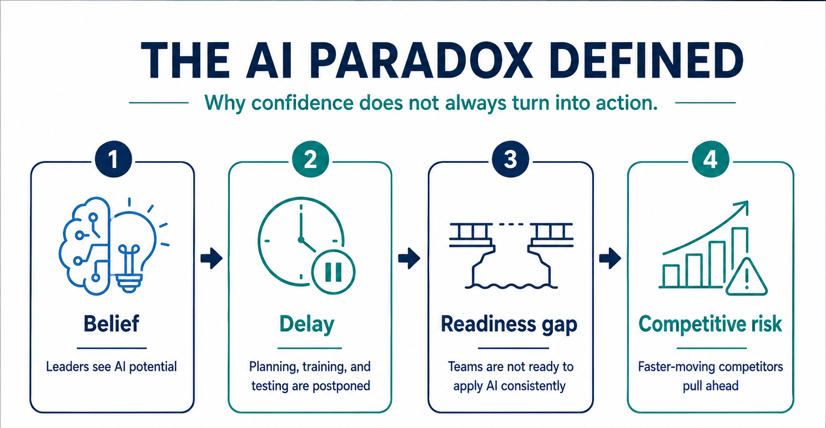
The AI Paradox Defined
The AI paradox is that SMB leaders believe AI matters, but many are not treating it as a business priority. They see the opportunity, yet they delay planning, training, testing, and internal adoption. This creates a gap between AI confidence and AI readiness.
This disconnect highlights a rising paradox: while confidence in AI is growing, its real-world implementation remains inconsistent. Many businesses see AI as important, yet they have not made it part of regular planning, training, or operations.
Based on input from over 600 business leaders, the 2025 AI Business Insights Report illuminates the critical challenges hindering businesses worldwide.
WSI’s AI Report
The comprehensive report highlights several key areas where AI's potential is not yet translating into widespread business transformation:
- Confidence Rising, Strategy Lags: 81% of business leaders are confident that AI can help achieve their objectives, yet only 27% report that AI is a frequent topic in formal company-wide strategic discussions. This points to a significant disconnect between belief and concrete action.
- Time Still the Top Barrier: A lack of time to thoroughly evaluate AI's benefits and drawbacks remains a primary obstacle for 35% of businesses—a figure unchanged from 2024—indicating a hesitation in dedicating resources to AI initiatives.
- Self-Taught Surge, But Training Still Sparse: Despite a surge in AI familiarity, with 59% of professionals now moderately or very familiar with AI (up from 38% in 2024), over half (52%) of those familiar with AI have not received any formal training. Most familiarity stems from self-guided learning rather than structured education.
- AI Adoption Growing—But Not Everywhere: While AI adoption is rising in departments like sales (up to 33% from 23% in 2024) and IT (up to 26% from 19%), crucial customer-facing and administrative functions such as HR (9%), Finance/Accounting (9%), and Customer Service (19%) show significantly lower adoption rates, creating internal "AI silos" that limit holistic business transformation.
- Job Impact Expectations Are Climbing: A growing majority of businesses (67%, up from 32% in 2024) now expect AI to impact job roles, underscoring the urgent need for proactive workforce planning and upskilling initiatives.
|
AI familiarity is rising, but many professionals are learning on their own. Without role-specific training, teams may use AI inconsistently or avoid it altogether. |
What It Means for Small and Medium-Sized Businesses
While early adopters are already using AI to automate tasks, enhance customer experiences, and make data-driven decisions, many SMBs are still stuck in "AI interest mode." Competing priorities, limited guidance, and internal bandwidth constraints are common roadblocks.
The Cost of Waiting on AI Implementation
For a business, waiting on an AI-powered workflow usually costs you in six ways:
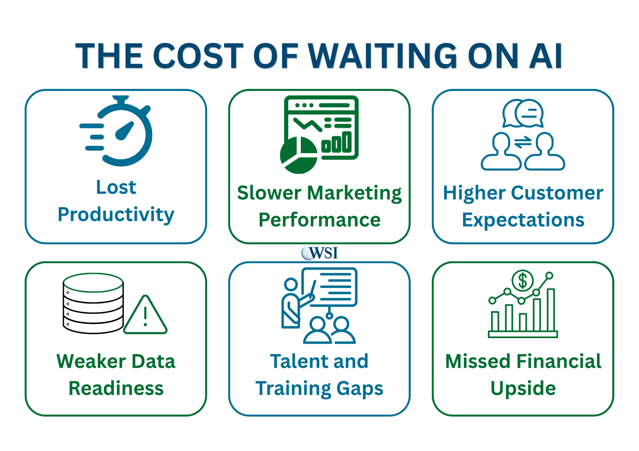
1. Lost Productivity
Your team keeps spending time on work AI could help speed up, such as research, reporting, first-draft content, customer emails, ad testing, meeting notes, and internal knowledge searches.
2. Slower Marketing Performance
AI can help your organization with:
- Paid search testing
- SEO research
- Content planning
- Email segmentation
- Lead scoring
- Landing page analysis
- Customer journey reviews
The risk is not that competitors “have AI.” The risk is that they test more, learn faster, and improve campaigns before you do.
3. Higher Customer Expectations
Customers now expect faster replies, better personalization, and more useful content. Businesses that wait may look slower and less helpful, especially in service, e-commerce, B2B lead generation, and local search.
4. Weaker Data Readiness
Many AI projects fail because the business did not prepare its data, processes, and controls. Gartner reported that at least 30% of generative AI projects were expected to be abandoned after proof of concept by the end of 2025 due to poor data quality, weak risk controls, rising costs, or unclear business value.
Waiting does not remove that risk. It often makes the clean-up harder.
5. Talent and Training Gaps
Teams need time to learn how to use AI well. Prompting, reviewing outputs, protecting data, and applying AI to daily work are learned skills. The longer you wait, the longer it takes your people to catch up.
6. Missed Financial Upside
McKinsey has estimated that generative AI could add $2.6 trillion to $4.4 trillion in annual value across analyzed business use cases.
That does not mean every AI project will pay off. It means the opportunity is real, but only for companies that connect AI to clear business goals.
| The cost of waiting is not only missed savings. It can also mean slower learning, weaker customer response, lower campaign performance, and a larger gap between your business and competitors that are already testing AI. |
Why SMBs Struggle to Move from Interest to Action
Many small and mid-sized businesses are interested in AI, but interest often stalls before action.
The blockers are practical:
- No clear owner for AI planning
- Limited time to compare tools
- Little role-specific training
- Concerns about data privacy and risk
- No agreed way to measure ROI
- Too many tools and too little guidance
This is where many SMBs get stuck. They know AI could help, but they are unsure where to start, who should lead it, and how to prove it is worth the investment.
That gap creates risk. Competitors that start testing AI in focused areas, such as marketing, sales, customer service, reporting, and operations, begin learning faster. Over time, that learning compounds.
The solution is to start small and stay focused.
Choose one business problem. Assign one owner. Set one measurable goal. Then test AI in a controlled way before expanding it across the business.
|
SMBs do not need to start with a large AI plan. Start with one repeated task, one clear owner, and one measurable result. Then review what worked before expanding. |
Turning Insight into Action with AI Integration
To help businesses move from AI interest to impactful implementation, the report recommends four strategic steps:
- Make AI a Core Conversation: Bring AI into regular leadership and departmental planning—not as a side experiment, but as a strategic lever.
- Start Small, Prove ROI: Launch targeted pilots tied to existing KPIs like lead conversion or campaign efficiency.
- Build Targeted Fluency: Offer role-specific AI training and guided learning tailored to your industry.
- Work with Expert Partners: Companies working with AI consultants are 2.5 times more likely to achieve sustainable success.
About the Report
The 2025 AI Business Insights Report, published by WSI, reflects the voices of over 600 global professionals, with 90% representing small and medium-sized businesses. It provides a grounded snapshot of how AI is being approached today, from confidence levels and departmental usage to training habits and barriers to adoption.
Explore the full 24-page report, including strategies, training tips, and cross-department case examples.
You can also dive deeper into this in our press release here.