
Key Highlights
- How AI is already shaping guest experiences across the hospitality industry
- Where AI improves operations like pricing, staffing, and energy use
- How AI supports digital marketing and increases direct bookings
- Practical use cases like chatbots, predictive analytics, and dynamic pricing
- What changes do you need to make to stay competitive
- How to start using AI without overcomplicating your setup
When you hear “AI in the hospitality industry,” do you picture a humanlike robot dressed in a maid’s uniform offering you a hot towel?
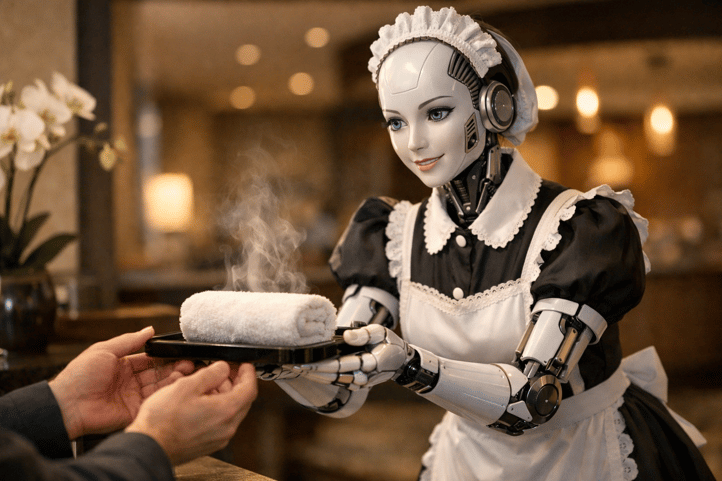
While this isn’t exactly what this blog covers, it does hint at how the hospitality industry is embracing AI for customer experiences. And you know how much the hospitality sector – from opulent restaurants to quiet bed and breakfasts - relies on providing outstanding experiences to stay afloat.
Because it is shaping the future of the hospitality industry in previously unheard-of ways, adopting AI also requires a change in your digital marketing tactics.
What is AI in Hospitality?
AI in hospitality refers to the use of artificial intelligence technologies to improve how hotels, restaurants, and travel businesses operate and serve guests.
It involves using data, hotel automation, and machine learning to handle tasks, support decision-making, and improve the guest experience.
In simple terms, AI helps hospitality businesses work more efficiently and respond better to guests' needs.
Practical Examples of AI in Hotels
- A hotel chatbot answering booking questions 24/7
- A pricing system adjusting room rates based on demand
- Email campaigns that change based on guest interests
- Smart room controls that adjust lighting and temperature automatically
The Evolution of AI in Hospitality Management
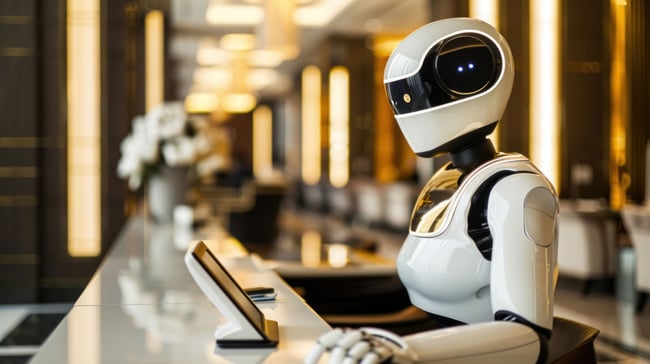
Whether you own a restaurant, provide tours, or run a bustling hotel, AI's ability to emulate human intelligence gives it a prominent place within hospitality.
From a consumer’s point of view, the use of AI in the hospitality industry is already part of the guest journey, often through:
- Chatbots and conversational AI immediately respond to questions and requests, no matter what time of the day or night guests use these tools.
- AI-powered security systems heighten visitor safety.
- AI algorithms that examine patron data and offer personalized recommendations regarding meals, activities, etc. (At the same time as enriching the guest experience, this also promotes upselling!)
| AI is not a future concept. It is already influencing how guests search, book, and interact with your business. If your systems and marketing do not adapt, you risk losing visibility and bookings to competitors who are using AI effectively. |
Benefits of AI in Hospitality
Benefits of AI for the hospitality industry include:
- Greater operational efficiency by using AI to control inventory, prepare staff scheduling, and anticipate maintenance.
- The ability of AI to analyze and predict changes in demand and automatically modify your pricing plans accordingly. Maximizing the number of available rooms with hospitality bed software AI has a positive effect on your bottom line.
- AI systems that adjust lighting and climate control based on occupancy reduce energy use and help with sustainability initiatives.
- Hospitality AI bots (automated hotel management systems that perform predefined tasks) that take care of the repetitive tasks give your team a chance to carry out uniquely human functions.
A clear example is the rise of automation in the hospitality industry, where routine tasks are handled with minimal manual input.
| Focus on operational wins first. Start with areas like pricing, guest communication, or scheduling where AI can reduce manual work and improve consistency. This builds a strong foundation before expanding into more advanced use cases. |
Digital Marketing for Hospitality Artificial Intelligence
Getting the most bang for your marketing buck is a lot easier with AI. It uses AI algorithms to analyze massive amounts of data to:
- provide insights into customer behavior that can be used to improve your marketing initiatives, and
- create individualized marketing messages, e.g., offering pertinent services to past visitors or sending targeted emails with special offers.
AI-powered digital marketing also:
- automates routine tasks like scheduling social media posts or checking email, and
- produce interesting material for websites and social media, ensuring that digital marketing initiatives are constantly current and new.
How to Start Using AI in Your Hospitality Business
If you are planning to introduce AI into your hospitality business, start with a focused approach. The goal is to solve real problems, not add complexity.
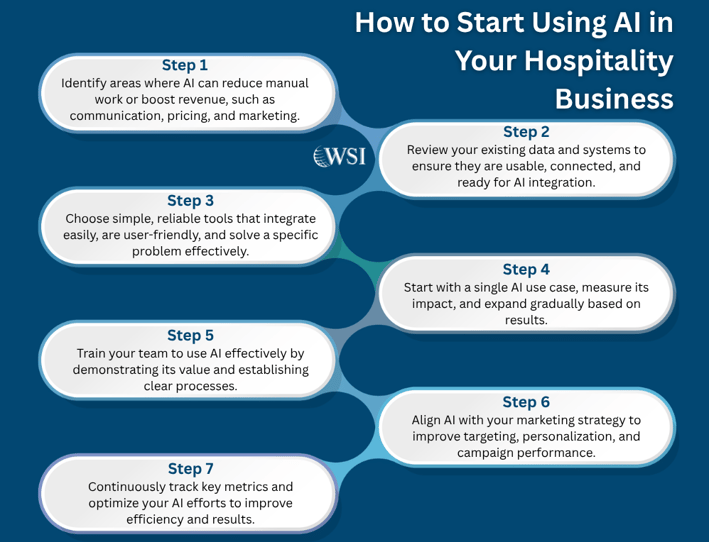
Step 1: Identify High-Impact Areas
Look for areas where AI can save time or increase revenue:
- Guest communication, such as chatbots
- Pricing and demand forecasting
- Email marketing and retargeting
Start where delays or manual work are slowing you down.
Step 2: Audit Your Current Data and Systems
AI depends on data. Check what you already have:
- Booking data
- Guest preferences
- Website analytics
- Campaign performance
Make sure your systems can share data or integrate with new tools.
Step 3: Choose Simple, Proven Tools
Avoid overcomplicated platforms at the start. Focus on tools that:
- Integrate with your PMS or CRM
- They are easy for your team to use
- Solve one clear problem well
Step 4: Start with One Use Case
Do not try to implement everything at once. For example:
- Add a chatbot to handle common guest queries
- Use AI for email campaigns
- Test dynamic pricing tools
Measure the impact before expanding.
Step 5: Train Your Team
Your team needs to understand how AI supports their work:
- Show how it reduces repetitive tasks
- Set clear processes for using AI tools
- Encourage feedback and adjustments
Adoption improves when staff see practical value.
Step 6: Connect AI to Your Marketing Strategy
AI works best when linked to your marketing efforts:
- Use data to improve targeting
- Personalize offers based on behavior
- Adjust campaigns based on performance
This is where AI starts to impact bookings and revenue.
Step 7: Track Results and Optimize
Monitor performance regularly:
- Booking rates
- Response times
- Campaign conversions
- Operational efficiency
Refine your approach based on what delivers results.
| Start small, focus on measurable outcomes, and expand once you see clear results. AI works best when it is applied with a clear goal and supported by your data and team. |
If you are looking to improve bookings or reduce manual work, AI can deliver measurable results when applied in the right areas.
The Future of Artificial Intelligence in the Hospitality Industry
The hospitality sector is prepared for even more revolutionary developments as AI develops. We anticipate additional advancements in voice-activated guest services, AI-driven customization, and augmented reality experiences. These developments will help brands stand out from one another and improve customer happiness.
Let's explore the future trends of the hospitality industry in more detail and how digital marketing tactics might use its potential.
1. AI-Powered Chatbots and Virtual Assistants for Guest Interaction
Chatbots and virtual assistants are revolutionizing how hotels and resorts communicate with guests. They respond to questions immediately, help with reservations, and offer concierge services. These AI-driven solutions can comprehend natural language, guaranteeing frictionless and user-friendly visitor encounters. Chatbots improve guest experiences while lightening the workload on workers by making restaurant recommendations to scheduling spa treatments.
Chatbots can be used in digital marketing techniques to engage potential customers. For instance, a chatbot on a hotel's website can start discussions with guests, find out about their interests, and offer tailored travel options. It's an effective strategy for turning website traffic into confirmed visits.
2. Customized Marketing Initiatives
The ability of AI technology in the hospitality industry to analyze data is crucial for determining visitor preferences. AI algorithms can generate highly individualized marketing strategies by examining historical booking data, social media interactions, and online reviews. For instance, the hotel may send specialized offers for rooms with ocean views to a visitor who usually orders one.
The digital marketing team uses AI to segment their audience and create tailored email marketing campaigns. With increased open rates and conversion rates, AI can identify which offers most likely appeal to particular guest groups.
3. Strategies for Dynamic Pricing
Demand for hotels frequently varies depending on seasonality, regional events, and market competitiveness. To improve pricing tactics, AI systems can assess these variables in real-time. For instance, AI ensures that a hotel's fee hike during a significant event in the neighborhood is prompt and reasonable.
By providing targeted specials at times of low occupancy, digital marketing can supplement dynamic pricing tactics. To entice potential guests with special offers, an AI-driven system might start email or social media campaigns.
4. SEO and Content Creation
Creating content for your hospitality business takes time and effort if it is to be of any use. Utilizing AI content generators to speed up the process frees up the marketing humans-in-the-loop for creative and humanized input. For instance, AI can automatically develop posts about events, attractions, and travel advice on your hotel's blog.
Regarding SEO, AI can recommend keywords and content optimization techniques by analyzing search patterns, competition, and user behavior. AI-driven SEO raises a hotel's online presence and attracts more prospective guests by ensuring the website ranks higher in search engine results.
5. Statistical Analysis and Customer Insights
Another AI-powered tool that helps hotel operations and digital marketing is predictive analytics. By looking at historical data, predictive analytics can forecast customer behavior, occupancy rates, revenue trends, and visitor behavior. This knowledge makes making wise marketing selections much easier.
Predictive analytics can help digital marketing teams deploy funds more wisely. If AI forecasts increased demand during that season, marketers could devote more resources to marketing at that time of year. AI can also assist in determining the most profitable marketing channels and budget allocation.
6. Improved Safety and Security
In the hospitality sector, AI can help provide security and safety. Security systems with AI capabilities can track visitor activities and recognize faces, improving security. These technologies can automatically notify authorities and hotel staff of crises.
Hotels can market their sophisticated security systems from a digital marketing standpoint. The usage of AI tools for visitor safety can be highlighted in marketing initiatives, which may appeal particularly to tourists concerned about their safety.
7. Sustainable Development Programs
Several hotels are embracing sustainability as a core value. AI assists in reaching sustainability objectives by maximizing energy usage. AI, for instance, may manage heating, cooling, and lighting systems depending on occupancy, saving much energy.
Campaigns for digital marketing can highlight a hotel's dedication to sustainability. Hotels can attract customers who care about the environment by promoting eco-friendly practices and initiatives.
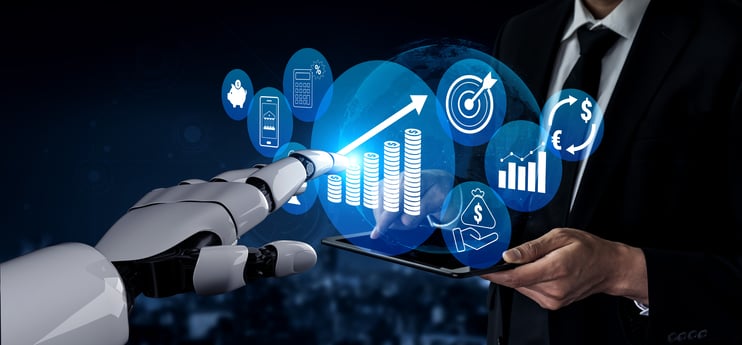
Choose WSI for AI in Marketing
The question you should be asking is not whether or not to implement AI-driven initiatives but how soon you can do so.
To remain competitive in the fast-paced hospitality industry, the role of AI for hospitality will help with:
- Analyzing large amounts of data to return priceless insights,
- Streamlining operational processes,
- Enhance customer service,
- Identify areas for improvement,
- Optimizing pricing, and
- Developing targeted digital marketing campaigns.
If you want to increase direct bookings, improve efficiency, and make better marketing decisions, the next step is to apply AI in a way that fits your business.
WSI works with hospitality businesses to identify where AI can deliver results and how to implement it effectively.
Contact your local WSI consultant to get started.